
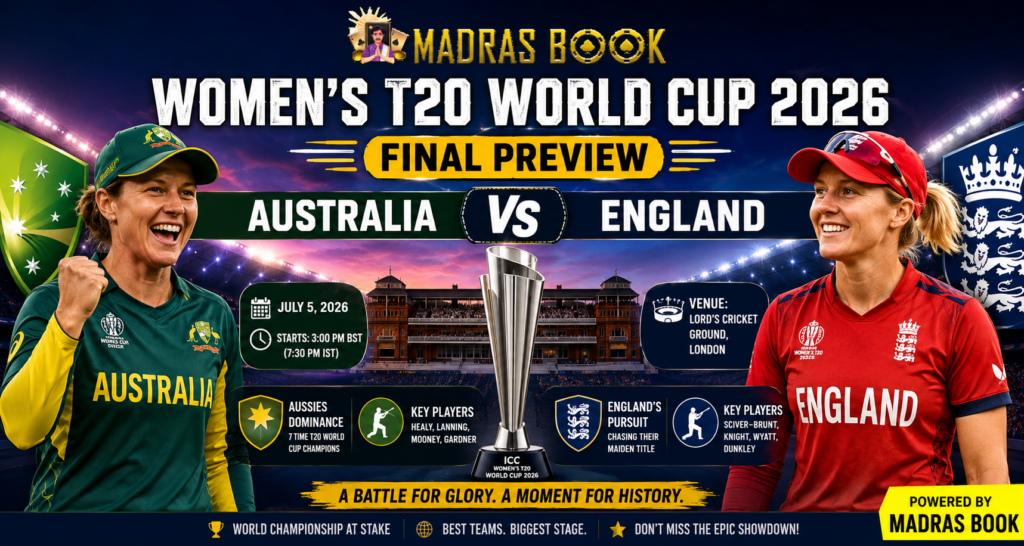
There is only one venue in cricket that carries this specific weight.
Not because of the size. Not because of the capacity — Lord’s is not the largest ground in England and it is nowhere near the largest in the world. It carries this weight because of what it represents. Because of the 1973 final that was played here. Because of the 2009 inaugural Women’s T20 World Cup final that was played here. Because of the portraits on the walls and the history in the brickwork and the fact that when you walk through the Grace Gates, you are walking into cricket’s most concentrated sense of its own significance.
The Women’s T20 World Cup 2026 Final between Australia and England at Lord’s on July 5 is not just a cricket match. It is the culmination of three weeks of extraordinary cricket at this tournament — the most competitive, most watched and most expanded edition in the competition’s history. It is the first time Lord’s has hosted a Women’s T20 World Cup Final. It is the meeting of the two most successful nations in the tournament’s history. And it is a match that, in terms of the specific narrative threads it carries, could not have been scripted better.
Australia — unbeaten throughout the tournament, six-time champions, the machine that women’s cricket has been trying to stop for seventeen years. England — the hosts, the team that won the inaugural edition on home soil in 2009, the team that produced a semi-final performance of complete authority to beat South Africa by 40 runs at The Oval on July 2. Two nations. One ground. One trophy.
The Women’s T20 World Cup 2026 Final begins at 2:30 PM local time on Sunday. By the time it ends, one of these teams will have written a story that Lord’s will hold for a very long time.
Match Details — Final at a Glance
| Detail | Info |
|---|---|
| Match | ICC Women’s T20 World Cup 2026 Final |
| Date | Sunday, July 5, 2026 |
| Venue | Lord’s Cricket Ground, London |
| Start Time | 2:30 PM Local / 8:00 PM IST |
| Australia Captain | Sophie Molineux |
| England Captain | Nat Sciver-Brunt |
| Reserve Day | July 6, 2026 |
| Live Streaming (India) | JioHotstar |
| TV (India) | Star Sports Network |
| Prize Money (Winner) | $2.34 million |
How Australia Got Here — The Unbeaten Machine
Six Wins From Six — The Numbers That Define a Dynasty
Before this final can be understood, Australia’s journey through this tournament needs to be properly appreciated. Because what Sophie Molineux’s side has produced across the Women’s T20 World Cup 2026 is not just impressive. It is historically dominant.
Australia’s tournament results:
- vs South Africa — Won by 65 runs. The tournament’s most powerful statement. South Africa, who reached the last two finals, were dismantled from the very first match.
- vs Netherlands — Won by 98 runs. The debutant Dutch side had no answer.
- vs Pakistan — Won by 113 runs. Ellyse Perry’s all-round show — the one that made every team in the tournament fear them.
- vs Bangladesh — Won by nine wickets. Ruthless efficiency with no need to extend themselves.
- vs India at Lord’s — Won by six wickets. The highest successful run-chase in Women’s T20 World Cup history. Perry 56, Gardner 53*, 100-run stand from 68/3.
- Semi-Final vs West Indies — Won by eight wickets. Beth Mooney 61 not out. Chase completed in 13 overs.
Six matches. Six wins. Net run rate of +4.724 — the highest recorded by any team in Women’s T20 World Cup group stage history. The margin of victories — 65 runs, 98 runs, 113 runs, nine wickets, six wickets, eight wickets — tells the story of a team that has not merely won but dominated every opponent this tournament has placed in front of them.
The only subplot heading into the final is Ellyse Perry’s fitness. She retired hurt during the semi-final chase against West Indies with what Australia have described as “minor quad awareness.” Australia have hinted she could play the final even if not fully fit. Whether Perry is available — and if so, at what percentage of her capacity — is the most significant team news question surrounding Sunday’s match.
How England Got Here — The Perfect Semi-Final
Beaumont 75, Knight 58, Bell and Dean — A Match England Will Remember
England’s path to the final was built on consistency that has been quietly extraordinary throughout the tournament. They are one of only two teams — alongside Australia — who went through the group stage unbeaten, winning all five matches. Their semi-final against South Africa on July 2 at The Oval was England at their complete, organised, clinical best.
South Africa won the toss and chose to bowl first — a decision that gave England the batting conditions they had used all tournament to build the scores that their bowling attack then defended comfortably.
The semi-final in numbers:
- Tammy Beaumont opened and scored 75 — an innings of composed aggression that set the foundation for everything that followed. Beaumont has been one of England’s most consistent performers throughout this tournament and the semi-final showed exactly why her form matters so much to Nat Sciver-Brunt’s side.
- Heather Knight scored 58 — the senior presence in England’s middle order that has been available throughout this tournament following Nat Sciver-Brunt’s earlier calf muscle injury. Knight’s experience of major finals, from 2017 ODI World Cup onwards, makes her one of the most important players England have.
- England posted 169 for 5 — a total that proved more than sufficient.
- Lauren Bell took 2 wickets in the bowling innings — the right-arm pace bowler who has been England’s most potent new-ball option throughout the tournament.
- Charlie Dean took 2 wickets — the off-spinner providing the middle-over pressure that has been consistent across England’s campaign.
- South Africa were bowled out for 129 — restricted 40 runs short of England’s total. Tazmin Brits’ 51 was a lone battle in a target that was ultimately beyond South Africa on the day.
The 40-run margin was England’s most comfortable knockout win and their third consecutive victory at this tournament by more than 25 runs. A team that wins in that manner — with bat, with ball, without panic — is a team that knows what it is doing.
England captain Nat Sciver-Brunt had been managing a calf muscle injury throughout the tournament. She returned for the semi-final and was named in the playing XI — a decision that proved completely vindicated by her impact on the game with the ball and her presence as the dressing room’s most senior leader.
The Head-to-Head — Australia vs England Women’s T20Is
The head-to-head record between these two sides in Women’s T20 World Cups makes sobering reading for England fans. Australia have dominated this tournament since 2010, winning six of the nine editions held so far. Their meetings with England in the knockout stages have historically gone Australia’s way.
Women’s T20 World Cup final meetings:
Australia and England have met in four Women’s T20 World Cup finals — 2010, 2012, 2014 and 2018 — and Australia won all four. England’s only Women’s T20 World Cup title came in 2009, before Australia’s dynasty truly took hold.
In the 2026 group stage, England were in Group 2 and Australia in Group 1 — meaning they did not meet in the group stage. Their last competitive meeting was in the 2024 Women’s T20 World Cup, where Australia’s earlier exit meant they did not face England in the knockout stages.
The overall Women’s T20I head-to-head sits strongly in Australia’s favour — they have won approximately 70% of their completed meetings against England across the format’s history. But the specific context of 2026 — England at home, at Lord’s, unbeaten through the tournament — makes this a very different proposition from the historical average.
The Players Who Will Decide the Final
Australia — The Six Who Matter Most
1. Beth Mooney She has scored 61 not out in the semi-final. Her career record in Women’s T20 World Cups — consistently averaging above 40, clutch performer in knockout cricket — makes her the most reliable run-scorer in this Australian lineup. If Australia chase on Sunday, Mooney batting at the top of the order is their most important individual asset.
2. Ellyse Perry (fitness permitting) Australia have hinted Perry could play even if not fully fit. Her semi-final retirement with quad issues creates uncertainty. If she is available at full capacity, she changes the match. If she is 70% fit and playing, the opposition will target her in the field. If she does not play, Australia lose their most experienced match-winner and all-round option simultaneously.
3. Ashleigh Gardner Her 53 not out against India at Lord’s was the innings that confirmed Australia’s place in the final. Gardner’s ability to take a game on — to turn a difficult chase into a comfortable one through sheer hitting power — is Australia’s X-factor in the batting lineup. England will specifically plan around limiting her scoring options.
4. Sophie Molineux (c) The captain has been Australia’s most consistent bowler across the tournament — 10 wickets at the competition, economy rate below 6. Her left-arm spin on a Lord’s pitch that tends to grip in the afternoon will be a weapon England’s right-handed batters will need specific plans for.
5. Georgia Wareham Has been among Australia’s most dangerous bowling options — her leg-spin at pace creates problems different from Molineux’s finger spin. Wareham and Molineux bowling in tandem in the middle overs could be where England’s middle-order batting is most seriously tested.
6. Kim Garth/Megan Schutt Australia’s pace attack — whether Schutt plays or Garth takes the new ball — will be the first challenge England’s openers face. On a Lord’s pitch that offers early movement, Australia’s new-ball options against Salt-replacing openers will set the tone of the innings.
England — The Six Who Matter Most
1. Tammy Beaumont Seventy-five in the semi-final. She has been the tournament’s most consistent England opening batter and the foundation on which every England innings has been built. Australia will target her early — dismissing Beaumont before she settles is the single most important thing they can do with the new ball.
2. Heather Knight Experience, authority and the specific ability to bat through pressure in a final — Knight has been here before. Her 2017 ODI World Cup final experience at Lord’s gives her something unique in England’s lineup. She knows what this ground feels like when the occasion is at its highest.
3. Nat Sciver-Brunt (c) The captain’s return from injury has been the most significant positive development for England in the knockout rounds. Her presence with both bat and ball in the final changes what England can do tactically. If she is fit and firing, England have a genuine all-round option at number three that Australia cannot simply contain with field settings.
4. Sophie Ecclestone England’s most important bowling asset — 37 wickets in 23 matches at 4.7 runs per over. Ecclestone is the best left-arm spin bowler in women’s cricket right now and on a Lord’s surface that grips in the afternoon, her ability to bowl Mooney and Gardner in the middle overs could be decisive.
5. Lauren Bell Her semi-final performance confirmed her as England’s most dangerous new-ball bowler in this format. Bell’s ability to hit the hard length and generate awkward bounce against Australia’s top order — in conditions that may offer early swing at Lord’s — makes her potentially the match’s most important bowling figure.
6. Charlie Dean Two wickets in the semi-final. Consistent throughout the group stage. Dean’s off-spin from the Pavilion End at Lord’s — where the slope works in favour of right-arm off-spin angling across right-handers — gives England a specific tactical weapon that Australia will need to manage carefully.
The Pitch and Conditions — Lord’s on July 5
Lord’s in July on a Sunday afternoon. The specific conditions that will shape the Women’s T20 World Cup 2026 Final are worth understanding in detail.
Pitch characteristics: The Lord’s surface in July tends to be true and even-paced rather than unpredictable. It is not a seaming pitch in the traditional sense — the ball does not dart off the surface here the way it does at Durham or Headingley. What Lord’s offers in July is a surface that rewards the well-timed ball, punishes poor technique, and grips slightly for spin in the afternoon session.
The slope: Lord’s famous slope — falling from the Pavilion End to the Nursery End — creates specific challenges for both batters and bowlers that do not exist anywhere else in world cricket. Bowlers coming from the Pavilion End have the slope working with them if they angle the ball across right-handers. Bowlers from the Nursery End have it working against them. This asymmetry means captains at Lord’s are constantly thinking about which bowler to use from which end — a tactical element that will keep both Molineux and Sciver-Brunt occupied throughout.
Weather forecast: Sunday is expected to bring partly cloudy conditions in London — temperatures around 19-21°C with a light westerly breeze. No significant rain risk, though the reserve day of July 6 is available if needed. The afternoon cloud cover could keep the ball swinging slightly during the powerplay, which would favour both teams’ pace attacks in the first six overs.
Expected total: 150-165 is par at Lord’s based on recent women’s T20I data. A total of 170+ would be competitive and put real pressure on the chasing side. Given England posted 169 in the semi-final and Australia chased 172 against India at this venue, both sides are capable of surpassing 160 against quality opposition.
The 2009 Connection — England Won the Inaugural Final Here
Sunday’s final carries a specific historical echo that neither side will have missed.
The first-ever Women’s T20 World Cup was held in England in 2009. The final was at Lord’s. England beat New Zealand. Katherine Sciver-Brunt — Nat Sciver-Brunt’s predecessor in every sense — took 3 for 6 in that final. England won the inaugural title.
Seventeen years later, England are back in a Women’s T20 World Cup Final at the same ground. Same venue. Same host nation. The opportunity to bookend the tournament’s first and tenth editions with an England title at Lord’s is not lost on anyone connected with this team. Heather Knight mentioned it after the semi-final: “There’s something special about being here for a final at Lord’s. We won here in 2009. We’d love to do it again.”
Australia won the four finals between 2010 and 2018 when England were in them. England’s one title in this format remains the 2009 edition. Everything about this occasion — the venue, the opposition, the historical framing — makes Sunday’s final one of the most loaded matches in the tournament’s history.
Our Prediction — The Closest Final in Tournament History
The Women’s T20 World Cup 2026 Final is the match that defies easy prediction.
Australia are unbeaten. Their NRR is extraordinary. Their bowling attack — even if Perry is limited — is the deepest in the tournament. Their chase record at Lord’s in this tournament is unbeaten. They are the six-time champions with the institutional knowledge of what it takes to win a final.
England are at home. Lord’s in particular feels like their ground on Sunday in a way that no neutral venue could replicate. They are unbeaten. Nat Sciver-Brunt is fit. Beaumont is in the form of her life. Sophie Ecclestone on a Lord’s surface that grips is potentially the most dangerous individual bowler in either lineup.
The 2017 ODI World Cup final at Lord’s — where England beat India by 9 runs — produced one of the most dramatic matches in women’s cricket history. Sunday could do the same.
Our prediction: England win by 8 runs in the most dramatic Women’s T20 World Cup Final in the tournament’s history.
Beaumont top scores with 52. Sciver-Brunt adds 38 at No. 3. England post 164. Ecclestone takes 3 for 22 in the middle overs. Australia finish 156 for 8. England lift the Women’s T20 World Cup trophy at Lord’s — seventeen years after they won the inaugural edition at the same ground.
Cricket writes its own scripts. This particular script has been building for seventeen years.
Semi-Final Results — How Both Teams Got Here
Semi-Final 1 (June 30, The Oval): Australia beat West Indies by 8 wickets. West Indies 125/7, Australia 127/2 in 13 overs. Beth Mooney 61*.
Semi-Final 2 (July 2, The Oval): England beat South Africa by 40 runs. England 169/5 (Beaumont 75, Knight 58), South Africa 129/8 (Brits 51). Bell 2 wickets, Dean 2 wickets.
Women’s T20 World Cup 2026 Final: Australia vs England Preview | Khelo24
The ICC Women’s T20 World Cup 2026 final promises an interesting clash as Australia tackle England at the long-running Lord’s Cricket Ground on July 5, 2026. Australia settled the final after another dominant tournament, just as England looks to make the most of home conditions in front of passionate crowds. With world-class players, an explosive batting lineup, and fit bowlers on each side, cricket fans can anticipate an interesting contest. Whether you are chasing every ball or planning to stay with friends and revel in the action, this final is poised to be one of the biggest cricketing activities in every of the year Make the experience extra exciting as well with your trusted online cricket ID company Khelo24. Get an instant cricket ID for seamless access to live cricket motions and enjoy stable, fast and reliable betting fun Khelo24 gives short account activations, 24/7 customer support, competitive odds, and a user-friendly platform designed for cricket fans. If you’re looking for a reliable online platform that creates a betting ID or an IPL cricket ID, Khelo24 makes it easy to get started. Sign up these days, get your cricket identity instantly, and enjoy the Australia vs England Women’s T20 World Cup 2026 final with confidence and gusto.
FAQ — Women’s T20 World Cup 2026 Final
Q1: Who is playing in the Women’s T20 World Cup 2026 Final?
Australia and England are playing in the Women’s T20 World Cup 2026 Final at Lord’s Cricket Ground in London on July 5, 2026. Australia beat West Indies by 8 wickets in the first semi-final. England beat South Africa by 40 runs in the second semi-final.
Q2: What time does the Women’s T20 World Cup 2026 Final start?
The final starts at 2:30 PM local time (BST) / 8:00 PM IST on Sunday July 5, 2026 at Lord’s Cricket Ground in London.
Q3: Is Ellyse Perry playing in the Women’s T20 World Cup 2026 Final?
Perry’s availability is uncertain — she retired hurt in the semi-final against West Indies with what Australia described as “minor quad awareness.” Australia have hinted she could play the final even if not fully fit. A final decision will be made on match day.
Q4: What did Nat Sciver-Brunt do in the semi-final?
Sciver-Brunt returned from a calf muscle injury to captain England in the semi-final against South Africa. England posted 169 for 5 with Beaumont 75 and Knight 58, then defended it comprehensively — South Africa bowled out for 129, England winning by 40 runs.
Q5: How many Women’s T20 World Cup titles has Australia won?
Australia have won six Women’s T20 World Cup titles — in 2010, 2012, 2014, 2018, 2020 and 2023. A win on Sunday would give them a record seventh title. England’s only title was the inaugural 2009 edition — also played at Lord’s.
Q6: Where can I watch the Women’s T20 World Cup 2026 Final live?
In India — JioHotstar for live streaming, Star Sports Network for TV broadcast. In England — Sky Sports. In Australia — Fox Cricket. Globally — ICC.tv. Match starts at 8:00 PM IST on July 5, 2026.