
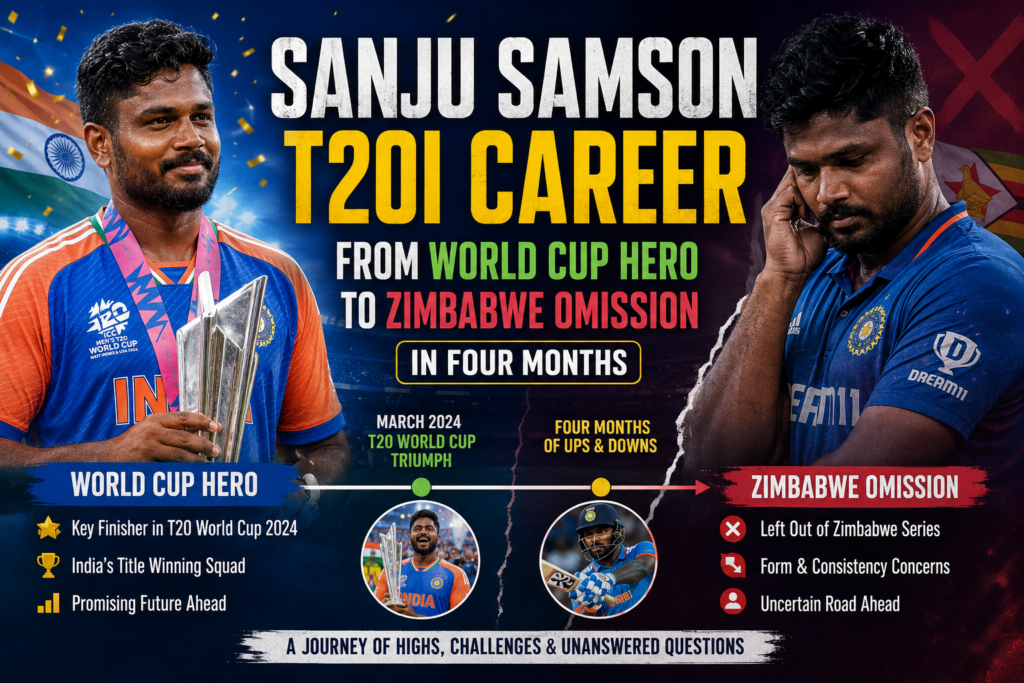
Four months.
That is all it took. Four months between the highest point of Sanju Samson’s international career and the moment that looks — to many observers, to many former players, to many of the fans who were celebrating him in March — like the beginning of the end.
On March 8, 2026, at the Narendra Modi Stadium in Ahmedabad, Sanju Samson received the Player of the Tournament award for the ICC Men’s T20 World Cup. He had scored 321 runs in the tournament. His knockout stage record — 97 not out, 89 not out, 89 not out — is one of the great runs of form in T20 World Cup knockout history. Three consecutive unbeaten scores above 85, in a semi-final and two finals, against some of the best bowling attacks in the world. He did not get out once in the knockouts. India won their third T20 World Cup title. Samson was at the centre of everything.
On July 7, 2026 — four months and one day after that Ahmedabad evening — the BCCI announced India’s squad for the three-match T20I series against Zimbabwe starting July 23. Sanju Samson’s name was not in it. Vaibhav Sooryavanshi’s was. Prabhsimran Singh’s was. Rinku Singh’s was. Multiple new names, multiple returning names — but not the Player of the Tournament from four months ago.
The Sanju Samson T20I career story is one of Indian cricket’s most dramatic recent narratives. Not because the fall was inevitable. Not because the warning signs were obvious in retrospect. But because the speed of it — from the highest high to an omission that multiple analysts have described as potentially permanent — captures something specific and uncomfortable about how Indian cricket treats even its greatest recent performers the moment the form disappears.
This is the complete story.
The Career Before the World Cup — Hot and Cold
The Pattern That Always Defined Him
Before March 2026, the Sanju Samson T20I career was already one of Indian cricket’s most discussed inconsistency narratives.
He made his T20I debut on July 27, 2015 — a decade ago. He was 20 years old, already a celebrated Rajasthan Royals batter in the IPL, and the kind of talent that made selectors reach for the call-up button. The debut produced 14 off 14 balls in a forgettable innings. He was not selected for the next match.
That pattern — included, produces something promising, inconsistent, dropped — repeated itself across the next decade with a frequency that would have broken most cricketers. He was dropped from the 2019 World Cup squad despite being one of the most talked-about batting talents in Indian domestic cricket. He was included in squads and then left out of playing XIs repeatedly — once famously left out of a T20I playing XI despite being named in the squad and traveling to the ground.
The frustration around Samson’s career was not about talent. Everyone who watched him knew he had talent. It was about the specific combination of brilliance and inconsistency that made selectors love him in theory and struggle to trust him in practice.
His overall T20I career average heading into the 2026 World Cup was 27. Not bad for a wicketkeeper-batter. But not commanding for a player whose IPL performances regularly suggested he was capable of something significantly higher. The career average told the story of a player who had match-winning days and disappearing days in roughly equal measure — without ever establishing the sustained consistency that converts talent into certainty.
Then came March 2026. And everything changed.
The World Cup — The Greatest Four Weeks of His Career
97*, 89*, 89 — Three Knockouts, Zero Dismissals
The Sanju Samson T20I career was transformed by the 2026 T20 World Cup in a way that none of his previous performances had managed. Not because of the volume of runs — 321 across the tournament is exceptional but not unprecedented for a World Cup. Because of when those runs came and how they came.
His semi-final innings against England in Mumbai — 97 not out off 46 balls as India chased 254 in a match that produced 499 runs in aggregate, the highest ever in a T20 World Cup — was the innings of his life. India needed a platform in a chase that looked impossible. Samson provided it with an innings of controlled aggression that made 254 feel achievable before the middle order converted the platform into a five-run victory.
He was not out. He batted through the innings.
In the final against New Zealand at Ahmedabad, Samson arrived to open the batting and scored 89 off 46 balls. Abhishek Sharma scored 52 off 21 at the other end. Their 98-run opening partnership in the first seven overs of the final put India on the path to 255 for 5 — the highest total in a T20 World Cup final. New Zealand were bowled out for 159. India won by 96 runs.
Samson was Player of the Match and Player of the Tournament. Three knockout innings. Three unbeaten scores above 85. Not once dismissed.
That World Cup performance did not just change how people thought about Samson’s current form. It changed the entire retrospective reading of his career. The inconsistency that had characterised his decade in international cricket suddenly looked less like a character flaw and more like a player who had needed specific conditions — high-pressure knockouts, high-quality opposition, a team that trusted him unconditionally — to produce his absolute best.
The question that followed the World Cup celebration was simple: had Samson finally arrived? Had the decade of hot and cold produced a player who had found the consistency to be trusted long-term?
The answer, which arrived over the next four months, was more complicated than either his supporters or critics predicted.
The IPL — One Last Warning Sign
Two Centuries and Too Many Single-Digit Scores
Between the World Cup and the England tour, Samson played IPL 2026 for Chennai Super Kings. His numbers were significant — he became the top run-scorer for CSK, including two centuries. He was brilliant in patches.
But the familiar pattern returned too. The two centuries were surrounded by single-digit scores in a way that analysts noticed. He blew hot and cold in the same IPL season that had produced his World Cup hero status. The brilliance was still there. The consistency question had not gone away.
For the selectors, the IPL is a complex data source. Two centuries confirm elite capability. Multiple failures around those centuries confirm the inconsistency that has always been his limitation. The question heading into the Ireland and England tours was which version of Samson would show up.
The answer was neither the century-scorer nor the World Cup hero. It was the third version — the one that Indian cricket had always quietly feared would return.
The England Tour — Where Everything Fell Apart
5, 0, 1 — Three Matches, Six Runs, One Dropped
The specific collapse of Sanju Samson’s T20I career on this England tour happened in stages that built on each other in the worst possible way.
Ireland, 1st T20I, Belfast — Samson scored 5. Caught off Matt Hollard, not doing justice to his World Cup form, not adapting to the seaming Belfast conditions. India lost by 34 runs. Ireland made history. Samson’s contribution was minimal.
Ireland, 2nd T20I, Belfast — Samson scored 0. Jai Moondra — the India-born left-armer playing for Ireland — dismissed him first ball with an inswinger that found him LBW before he had settled. A golden duck in a match India lost by 1 run to complete the historic 2-0 series defeat.
England, 1st T20I, Durham — Samson scored 1. Caught at backward point off Saqib Mahmood’s second international over. India reached 189 for 7 in a match later abandoned due to rain. Samson’s contribution to that total was 1 run.
Three matches. Scores of 5, 0, 1. Six runs combined.
After the Durham match, India made the change. Vaibhav Sooryavanshi came into the XI for the 2nd T20I at Old Trafford — making his debut, becoming the youngest Indian cricketer in international history, hitting two sixes off Jofra Archer and Josh Tongue. Samson sat in the dugout.
He has not played since.
The Zimbabwe Omission — What It Actually Means
Rested or Dropped? The BCCI’s Deliberate Silence
The BCCI announced India’s T20I squad for the Zimbabwe series on July 7, 2026. Fifteen players. Every conversation India’s T20I cricket has been having in recent weeks was represented in the squad — Sooryavanshi retained, Prabhsimran Singh given his maiden call-up, Rinku Singh recalled, four maiden call-ups overall. The squad screamed “new era.”
Sanju Samson’s name was not in it.
The BCCI did not provide a reason. They never do in these situations — the absence of an explanation is itself an explanation. When the board wants to signal that a player is rested rather than dropped, they say so. The word “rested” appears in squad announcements regularly for players like Bumrah, Shami, Rohit when their absence is scheduled and intended to be temporary. No such language appeared around Samson.
Sources familiar with the selection discussions gave different explanations. One version — reported by PTI and IndiaTV News — suggested Samson was “rested” rather than dropped, and that his Asian Games selection in September was evidence the selectors had not written him off. “Why is this surprising that Sanju has been rested for Zimbabwe?” a senior source said. “Sanju is in the Asian Games squad in September. What’s the point of carrying Samson when he won’t play? He is a senior guy.”
Another version — the one that most cricket analysts found more convincing — was blunter. Sooryavanshi has been retained for the Zimbabwe tour despite his own modest start. Prabhsimran Singh earned a maiden call-up after 510 IPL runs at a strike rate of 168.87 for Punjab Kings. Both occupy the opening spots that Samson was playing for. There is simply no room for him in the XI that India’s management is building around a fifteen-year-old and a new generation of opening batters.
For a player who plays only T20I cricket in international cricket — no Tests, no ODIs — being left out of a T20I squad is not a temporary situation with an obvious return pathway. It is an existential question about whether the door is still open at all.
The Prabhsimran Factor — The Player Who Took His Spot
510 IPL Runs at SR 168 — The Writing Was Already on the Wall
The clearest signal in the Zimbabwe squad announcement was not Samson’s omission. It was Prabhsimran Singh’s inclusion.
The Punjab Kings wicketkeeper-batter had been one of the IPL’s most consistent performers across two seasons. In IPL 2025, he scored 549 runs at a strike rate of 160.53. In IPL 2026, he improved to 510 runs purely as an opener at 168.87 — making him PBKS’s leading run-scorer and one of the tournament’s standout batters.
Prabhsimran is 23 years old. He is a right-handed opening wicketkeeper-batter. He has been knocking on India’s T20I door for two years. The Zimbabwe tour is his opportunity.
The parallel with Samson’s own career is uncomfortably precise. Samson spent years producing IPL performances that justified international selection while the door remained closed. Now he is on the other side of that dynamic — the established player making room for the younger one who has spent years producing the performances that justify their chance.
What His Career Numbers Actually Say
The Honest Statistical Picture
The Sanju Samson T20I career in numbers is genuinely mixed. Not bad. Not commanding. Mixed — in the way that has always defined him.
Career T20I average: 27. The 27 average is the number that Yahoo Sports identified as revealing a “player who has always blown hot and cold, making him more replaceable than his star billing might suggest.”
That assessment is harsh but not dishonest. For a wicketkeeper-batter who has been in Indian cricket’s consciousness for a decade, 27 is below the standard that secures long-term selection. The World Cup heroics were real and the numbers from those three knockout innings were extraordinary. But across the full career — across all the Tests of form that international cricket imposes — the average tells a story of someone who was brilliant occasionally and ordinary regularly.
His World Cup record specifically: 321 tournament runs including 97*, 89*, 89 in the knockouts. Against that, his recent England tour record: 5, 0, 1 before being dropped.
Both of those Sanju Samsons are real. The selector’s challenge has always been that you never know which one is coming to the ground until the innings is over.
Is the Asian Games a Lifeline?
The One Door Still Open
The one concrete fact that prevents this from being a definitive career obituary is the Asian Games.
Samson is in India’s squad for the 2026 Asian Games in Japan in September — a tournament that includes a T20I cricket competition. His inclusion there, announced alongside the Zimbabwe omission, suggests the selectors have not formally closed the door on his international career. A senior BCCI source specifically cited the Asian Games selection as evidence that Samson remains part of India’s plans.
But the Asian Games is not the T20 World Cup. It is not an England series or an Ireland tour or any of the high-profile, high-pressure bilateral series that define a cricketer’s international standing. It is a multi-sport event with a cricket competition that does not carry ICC points and does not feature the full-strength opposition that builds or tests international careers.
Samson performing brilliantly at the Asian Games would be welcome. It would maintain his visibility in the selection conversation. But it would not automatically return him to a T20I setup that has moved on in specific, structural ways — Sooryavanshi at the top, Prabhsimran as the new wicketkeeper option — that performance at a secondary tournament cannot reverse.
The Asian Games lifeline is real. But it is thin.
What Former Players Are Saying
The Cricket Establishment Weighs In
The reaction to Samson’s Zimbabwe omission from former India players has been divided — reflecting the genuine complexity of a situation that has no clean answer.
Mohammad Kaif weighed in on the Samson situation after India’s second T20I loss to England — suggesting that the combination of form and the Sooryavanshi factor had made the decision inevitable even if painful.
Parthiv Patel, who backed the decision to delay Sooryavanshi’s debut during the Ireland tour, acknowledged that Samson’s three failures had made the change unavoidable. “When a senior player doesn’t score in three games and you have a 15-year-old who everyone has been waiting to see, the decision makes itself,” is the general sense of what multiple former players communicated.
The counterargument — made most forcefully by those who remember what Samson did in March — is that four bad matches should not erase a World Cup. That the innings of 97 not out, 89 not out and 89 in the knockouts represent a level of performance under pressure that should protect a player from immediate consequences when the form dips.
Both arguments are valid. The selectors appear to have concluded that the structural reality — Sooryavanshi’s presence, Prabhsimran’s form, the need to build around new players — outweighs the protection that the World Cup performance might otherwise have afforded.
Our Assessment — The End or a Pause?
The honest assessment of Sanju Samson’s T20I career in July 2026 is this: it is not definitively over. But the path back is narrow, specific and depends on circumstances that are not entirely within his control.
He needs Sooryavanshi to fail in a sustained way — which, given everything the fifteen-year-old has produced, seems unlikely. He needs Prabhsimran Singh to disappoint at the Zimbabwe series, removing the new wicketkeeper option before it can establish itself. And he needs his own form, at the IPL level, to be so consistently dominant that the selectors find it impossible to ignore him.
All three of those things need to happen simultaneously. That is not impossible. But it is not likely either.
Yahoo Sports described it as “the writing appearing to be firmly on the wall.” Cricinfo reported it as an omission that “sparks fears for his future.” The general sense across cricket media is that this is not a rest — it is, at minimum, a long break from a format he plays exclusively, and at maximum, the effective end of an international career that deserved a more gradual conclusion.
What Sanju Samson deserves — what his World Cup heroics earned him — is the kind of graceful transition that outstanding performers are sometimes afforded. A series against a manageable opposition to rebuild confidence. A chance to go out on his own terms.
What he got was four months.
Sanju Samson T20I Career Stats
| Stat | Detail |
|---|---|
| T20I debut | July 27, 2015 vs Zimbabwe |
| T20I matches | 71 |
| T20I runs | 1,588 |
| T20I average | 27.00 |
| T20I strike rate | 139.54 |
| T20I centuries | 0 |
| T20I half-centuries | 11 |
| Highest T20I score | 97* vs England (WC SF) |
| WC 2026 runs | 321 |
| WC 2026 knockouts | 97*, 89*, 89 (unbeaten all three) |
| England tour 2026 | 5, 0, 1 (6 runs in 3 innings) |
| Zimbabwe squad | Not selected |
| Asian Games | Selected — September 2026 |
Sanju Samson T20I Career: From World Cup Hero to Zimbabwe Omission
Sanju Samson’s T20I career has witnessed dramatic highs and difficult obstacles, from becoming a World Cup captain to being absent from the Zimbabwe team within 4 months, his journey indicates the tension, competition and uncertainty in Indian cricket. Fans following his comeback story can use cricket updates, searches, odds and participant performance to securely suit the song to stay and rely on betting ID. A trusted betting ID provides brief access, secure access, and the enjoyment of a clean suit day.
FAQ — Sanju Samson T20I Career
Q1: Why was Sanju Samson dropped from India’s Zimbabwe T20I squad?
Sanju Samson was dropped from the Zimbabwe T20I squad after scoring just 6 runs (5, 0, 1) in three consecutive T20Is on the UK tour — against Ireland and England. The BCCI gave no official reason, but with Vaibhav Sooryavanshi retained and Prabhsimran Singh earning a maiden call-up, Samson has no clear route back into the playing XI.
Q2: Was Sanju Samson rested or dropped from Zimbabwe?
The BCCI did not clarify whether Samson was rested or dropped. Senior sources cited his Asian Games inclusion as evidence he was rested. However, given that Zimbabwe was a low-pressure series and Samson was unlikely to play regardless, analysts widely interpret the omission as a structural decision reflecting the new direction of India’s T20I batting rather than a temporary rest.
Q3: What did Sanju Samson score at the T20 World Cup 2026?
Samson scored 321 tournament runs including 97* in the semi-final against England, 89* in the first final and 89 in the second final. He was named Player of the Tournament after his three consecutive unbeaten knockout innings — he was never dismissed in the knockout stage.
Q4: Who replaced Sanju Samson in India’s T20I squad?
Prabhsimran Singh earned a maiden T20I call-up for the Zimbabwe series after scoring 510 runs for Punjab Kings in IPL 2026 at a strike rate of 168.87. He and Vaibhav Sooryavanshi are the two opening options that have effectively closed Samson’s path back into the XI.
Q5: Will Sanju Samson play international cricket again?
Samson remains in India’s Asian Games squad for September 2026 — the one confirmed future appearance on his calendar. Whether he returns to the T20I bilateral series setup depends on Sooryavanshi’s trajectory, Prabhsimran’s Zimbabwe performance, and Samson’s own IPL form in 2027.
Q6: What is Sanju Samson’s T20I batting average?
Sanju Samson has a career T20I average of 27.00 in 71 matches — a number that reflects the hot-and-cold nature of his decade-long international career, and which multiple analysts have cited as evidence that his World Cup heroics were always likely to be vulnerable to a sustained run of poor form.