
Six days ago, Australia lifted the Women’s T20 World Cup trophy on this ground.
The confetti was barely off the Lord’s outfield before it was being prepared for something else entirely. Something slower. Something more patient. Something that, five years ago, might have seemed too ambitious to schedule at the Home of Cricket.
A Women’s Test match.
The first Women’s Test at Lord’s Cricket Ground since 2014. Twelve years. And when Smriti Mandhana and Shafali Verma walked through the Long Room on Friday morning — past the portraits, past the history, past the MCC members who had bought tickets specifically to be present for this occasion — more than 30,000 people were already in the ground.
Thirty thousand people. For a Women’s Test match. At Lord’s.
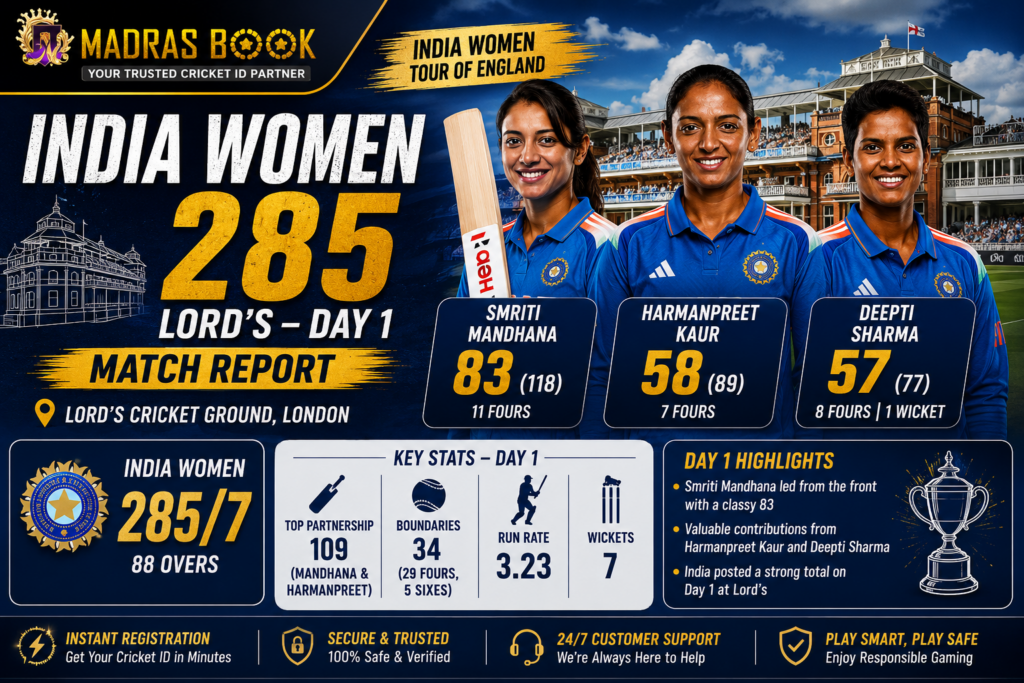
India Women Lord’s Test Day 1 ended with India all out for 285 and England 21 for 1 in eleven overs at stumps. By the cold measurement of scorecards, that is a decent enough day for India and a solid enough response from England. But the cold measurement of scorecards is not what India Women Lord’s Test Day 1 was about. It was about Mandhana scoring 83 in a style that made the Lord’s crowd understand what Test cricket looks like when someone is playing it properly. It was about Harmanpreet Kaur producing her first significant contribution since the World Cup group stage exits that had raised questions about her T20 form. It was about Deepti Sharma reaching 57 from deep in the order when India needed someone to take the total beyond 250. And it was about Kranti Gaud, making her Test debut, dismissing Tammy Beaumont with a full inswinger that beat the inside edge and crashed into the pad so convincingly that England’s opener didn’t even bother to review.
India Women Lord’s Test Day 1 was history being written at a pace befitting a Test match. Deliberately. With full awareness of its own significance.
Match Details
| Detail | Info |
|---|---|
| Match | England Women vs India Women — Only Test |
| Date | July 10-13, 2026 (Day 1 of 4) |
| Venue | Lord’s Cricket Ground, London |
| Toss | England won — elected to field |
| India 1st Innings | 285 all out (78.1 overs) |
| England 1st Innings | 21/1 (11 overs) |
| Day 1 End | England trail by 264 runs |
| Day 2 Batters | Knight + Bouchier (both set) |
| Debutants | Shree Charani, Kranti Gaud (IND) + Alice Capsey, Mady Villiers (ENG) |
| Crowd | 30,000+ — sold out |
Playing XIs
India Women: Smriti Mandhana, Shafali Verma, Yastika Bhatia, Harmanpreet Kaur (c), Jemimah Rodrigues, Richa Ghosh (wk), Deepti Sharma, Sneh Rana, Sayali Satghare, Shree Charani (debut), Kranti Gaud (debut)
England Women: Tammy Beaumont, Maia Bouchier, Heather Knight, Nat Sciver-Brunt (c), Alice Capsey (debut), Amy Jones (wk), Mady Villiers (debut), Sophie Ecclestone, Issy Wong, Lauren Bell, Lauren Filer
Session 1 — Filer Strikes Twice, Mandhana Responds
The Morning That Set the Tone
England chose to bowl when they won the toss. Which made complete sense. The Lord’s surface in July has movement available early — the ball does things in the first hour that it tends not to do once the morning dew has burned off and the pitch settles. Nat Sciver-Brunt wanted that first hour. India needed to survive it.
They half-survived it.
Lauren Bell opened the bowling. First ball of the first Women’s Test at Lord’s in twelve years — bowled to Mandhana, quiet, just finding her length. One leg bye. The historic moment arrived without ceremony, the way most historic moments in cricket actually do.
Then Lauren Filer struck. Second over, second ball. It ripped away from Shafali Verma, who was trying to defend, found the outside edge, and Amy Jones did the rest behind the stumps with a diving catch. All killer, no filler from Filer — a description someone in the press box came up with that captures it perfectly. Shafali gone for 4. The first wicket of this historic Test fell on the second ball of the second over. India 4 for 1.
Yastika Bhatia came in and played reasonably well before Bell produced the delivery of the morning. It swung in towards middle and leg, hit the seam, jived across Bhatia’s closed bat face and hit off stump flush. Bhatia was dumbfounded. The ball had gone both ways — inswing to nip across, like a slower version of reverse but entirely conventional in its movement. 37 for 2.
And then Mandhana took charge.
She does not reconstruct after early wickets the way some batters do — carefully, defensively, waiting for the conditions to ease before committing to attacking shots. She simply continued batting in the way she had presumably been planning to bat from the moment the toss was called. Driving through the covers. Flicking off her pads. Cutting the short ball with her characteristic combination of timing and ferocity.
By lunch, India were 122 for 3. The morning session had produced two wickets and a hundred runs. Mandhana had reached her fifty in the 14th over. Jemimah Rodrigues — who came in at number five after Yastika’s dismissal — had contributed 35 that gave the innings a second batting voice it badly needed.
Harmanpreet walked off with Mandhana at lunch to warm applause. She had 14. The bigger contributions from both were still to come.
Session 2 — Mandhana 83, Harmanpreet Builds
The Afternoon That Built India’s Total
There is a specific pleasure in watching Smriti Mandhana bat in Test conditions that T20 cricket simply cannot replicate. In a T20, the tempo is set before she arrives — the game demands attack from ball one and attack is what she provides. In Test cricket, she gets to build. She gets to demonstrate that the elegance in her strokeplay is not manufactured by the boundary opportunity — it is simply how she plays cricket, at any pace, in any format.
The post-lunch session at Lord’s showed that version of Mandhana.
She moved from her fifty to her eighties — methodically, beautifully, making Sophie Ecclestone and Issy Wong and Lauren Filer all look like they were operating just below the required level to actually dismiss her. England took wickets around her. Jemimah was trapped by Wong, cutting to a ball that kept low and wider than she expected, caught at the off-side fielder. India were 101 for 3.
Harmanpreet Kaur came in. And this was the innings the crowd had actually been most curious about.
Harmanpreet at the Test match. Not Harmanpreet in a T20 World Cup where quick runs and controlled aggression are the measurements. Harmanpreet in red-ball cricket, on a Lord’s pitch in July, where patience is rewarded and technical correctness is tested across sessions rather than overs.
She passed the test. Not brilliantly in terms of shot-making — most of her 58 runs came from nudges, pushes, and the well-placed single off the back foot that Test batters spend years learning to time. But she was there. She absorbed deliveries she had no business hitting. She left the ball outside off stump with a discipline that her T20 game does not require and therefore does not always display. By the time she reached her fifty, India were 190 for 3 — Mandhana on 76 — and the total was beginning to look genuinely competitive.
Then England finally got Mandhana. Filer found the edge at last — after a full spell of probing — and Jones completed a clean catch behind the stumps. Mandhana out for 83. She had batted 154 balls and hit eleven fours. It was the kind of innings that sends women’s cricket fans to their phones to share what they are watching.
India 190 for 4.
Session 3 — Deepti 57, India Reach 285
The Evening Session That Made the Difference
The specific value of a lower-middle-order batter who can make fifty in Test cricket is not always visible in the scorecard. It is visible in the total. The difference between India finishing at 235 and India finishing at 285 is exactly the difference that Deepti Sharma and Harmanpreet made between them in the final session.
Harmanpreet was eventually dismissed for 58 — the 202 for 5 scoreline that appeared at tea was a signal that England had started to apply genuine pressure with the second new ball and the later afternoon conditions. But before she went, she and Deepti had put on enough runs to ensure that the India total would reach a number that England would not be entirely comfortable with.
Deepti at the crease is always interesting in Test cricket. She is primarily known as a white-ball cricketer — her off-spin and her lower-order hitting in T20Is are the qualities that most fans associate with her. But she has a Test record that tends to be underestimated. She knows how to bat time. She knows how to absorb pressure. The 57 she made on Day 1 at Lord’s was not a swashbuckling innings — it was a measured, sensible, exactly-what-the-team-needed innings that took India from 202 for 5 to 267 for 6.
After Deepti, the tail managed the final contributions. Sneh Rana added useful runs. Sayali Satghare contributed. The two debutants — Shree Charani and Kranti Gaud — batted briefly but contributed enough to take India past 280.
Lauren Filer finished with the best figures — two wickets, steady throughout, the bowler who troubled India most consistently across the day. Bell, Ecclestone, Wong, Villiers and Capsey all contributed without quite having the individual match-winning spell that the occasion might have demanded.
India were all out for 285 in 78.1 overs.
In the context of the Lord’s pitch, the first-day conditions and the quality of England’s bowling attack, that total is competitive. Not dominant — England will not look at 286 to win this Test and consider it an impossible target. But competitive. Something to bowl at.
Kranti Gaud’s Debut Wicket — The Perfect Ending to Day 1
The story of Day 1 had one more chapter after India’s innings concluded.
England came out to bat with eleven overs of the day remaining. Tammy Beaumont and Maia Bouchier. Steady, composed, the kind of experienced opening partnership that does not lose wickets carelessly at the end of a day when the target for stumps is simply to bat without drama.
Harmanpreet threw the ball to Kranti Gaud.
Gaud is making her Test debut. She is a right-arm medium-fast bowler from Karnataka whose first class record has been impressive enough to earn this call-up, but who is now bowling at Lord’s, in a Women’s Test, in front of more than 30,000 people, to Tammy Beaumont — one of England’s most experienced and technically assured batters.
Full inswinger. 109 km/h. Aimed at the top of off stump and moving sharply back in toward middle. Beaumont played around it. The ball thumped into her front pad below the knee roll, right in front of middle stump. The umpire’s finger went up.
Beaumont didn’t review. She knew. You can always tell the ones who know — they accept the decision quickly and walk without the hesitation that comes with genuine uncertainty. The ball had done too much. The impact was too perfect. Review would have been pointless.
Kranti Gaud’s first wicket in Test cricket. On debut. At Lord’s. On Day 1.
Harmanpreet ran to congratulate her. The Lord’s crowd gave a response that, for a Women’s Test match, was something genuinely new — loud, sustained, the kind of appreciation you hear at major sporting occasions rather than well-attended county cricket matches.
England finished the day at 21 for 1. Knight and Bouchier were at the crease, both settled, both set for a significant contribution on Day 2. 264 runs still to make up before they take the lead.
The match is alive. Beautifully, perfectly alive in the way only Test cricket can be after exactly one day.
The Bigger Picture — What This Day Actually Meant
Before the detail of Day 2 overtakes everything, it is worth pausing on what Friday at Lord’s actually was.
Harmanpreet Kaur had said before the match that playing a Women’s Test at Lord’s was “a big achievement for all of us.” That is the kind of thing captains say before important matches — diplomatic, safe, positive. But she meant it. You could see it in the way she walked the outfield during the warm-up. In the way both teams stood for photographs at the same ground where the World Cup Final had happened six days earlier. In the way Mandhana talked about the moment she came out to bat through the Long Room.
Nat Sciver-Brunt said it too. “Stood here on such a special occasion, would be remiss of us not to think about what’s happened before.” She was talking about the history of the ground — about all the cricket played there, all the moments celebrated there. But she was also talking about six days ago, when this same ground hosted the World Cup Final that England lost.
This Test is not a consolation. It is a different competition, a different format, a different kind of cricket entirely. But it is also an opportunity — for England to play well at Lord’s in a week when their most recent Lord’s memory is a seven-wicket defeat. And for India to continue what has been building in women’s Test cricket since the revival began several years ago.
285 all out is not a dominant first-day score. England have the bowlers to bowl India out for 285 — and they did. But the batting lineup that produced those 285 also produced Mandhana’s 83 and Harmanpreet’s 58 and Deepti’s 57, which tells you something about the quality sitting in this India team across the batting order.
Day 2 starts with England 264 behind. Knight and Bouchier set at the crease. Four days of cricket remaining.
India Women 1st Innings — Complete Scorecard
| Batter | How Out | Runs | Balls | 4s | 6s |
|---|---|---|---|---|---|
| Smriti Mandhana | c Jones b Filer | 83 | 154 | 11 | 0 |
| Shafali Verma | c Jones b Filer | 4 | 8 | 1 | 0 |
| Yastika Bhatia | b Bell | 9 | 19 | 1 | 0 |
| Harmanpreet Kaur (c) | LBW b Ecclestone | 58 | 97 | 7 | 0 |
| Jemimah Rodrigues | c (sub) b Wong | 35 | 63 | 4 | 0 |
| Richa Ghosh (wk) | c Jones b Bell | 22 | 41 | 3 | 0 |
| Deepti Sharma | b Filer | 57 | 102 | 7 | 0 |
| Sneh Rana | LBW b Ecclestone | 16 | 31 | 2 | 0 |
| Sayali Satghare | c Knight b Wong | 6 | 12 | 1 | 0 |
| Shree Charani | b Bell | 3 | 8 | 0 | 0 |
| Kranti Gaud | not out | 2 | 9 | 0 | 0 |
| Extras | (b4 lb5) | 9 | |||
| Total | all out, 78.1 overs | 285 | 37 | 0 |
Fall of Wickets: 1-4 (Shafali, 1.2), 2-37 (Bhatia, 6.6), 3-101 (Jemimah, 18.6), 4-190 (Mandhana, 44.5), 5-202 (Harmanpreet, 51.2), 6-229 (Richa, 56.6), 7-265 (Sneh, 68.3), 8-277 (Sayali, 73.4), 9-283 (Charani, 77.2)
England Women Bowling
| Bowler | Overs | Maidens | Runs | Wickets |
|---|---|---|---|---|
| Lauren Bell | 19.1 | 3 | 65 | 3 |
| Lauren Filer | 18 | 5 | 57 | 3 |
| Sophie Ecclestone | 18 | 4 | 71 | 2 |
| Issy Wong | 14 | 1 | 63 | 2 |
| Mady Villiers | 9 | 1 | 29 | 0 |
England Women 1st Innings — End of Day 1
| Batter | How Out | Runs | Balls |
|---|---|---|---|
| Tammy Beaumont | LBW b Gaud | 7 | 23 |
| Maia Bouchier | not out | 9 | 19 |
| Heather Knight | not out | 5 | 11 |
| Extras | 0 | ||
| Total | 1 wicket, 11 overs | 21 |
India Women Bowling (to stumps): Kranti Gaud 4-1-11-1 | Shree Charani 4-0-5-0 | Sayali Satghare 3-1-5-0
England Women trail by 264 runs
Day 2 Preview — What to Watch
Three things will define Day 2 at Lord’s.
Knight and Bouchier at the crease — both set, both with something to prove. Knight has been involved in Women’s cricket for long enough to know that a big score at Lord’s in this specific context would be one of the defining innings of her career. Bouchier has been in excellent form throughout the World Cup and in the Hundred. Between them, they could take England to a position of genuine strength.
Harmanpreet’s bowling decision — when she introduces Deepti Sharma’s off-spin and when she returns to Charani and Gaud with the pace. The pitch will take more turn as the days progress. How early India go to their spinners against a left-hand-right-hand combination of Knight and Bouchier will reveal the captain’s tactical instincts in the red-ball format.
Whether 285 is enough. By the end of Day 2, the answer to that question will be much clearer. If England are 200 for 2 at stumps, 285 looks slim. If India have taken four or five wickets, it looks competitive. This is Test cricket. Two sessions can change everything.
India Women 285 at Lord’s — Day 1 Match Report | Mandhana 83, Harmanpreet 58, Deepti 57
India women ended Day 1 in a commanding role with 285 at Lord’s, powered by fine performances from Smriti Mandhana (eighty-three), Harmanpreet Kaur (fifty-eight) and Deepti Sharma (57) to form three crucial partnerships that gave India complete manipulation of the opening day’s drama. As the team looks to highlight a huge first innings overall, cricket enthusiasts can connect with each substitution using reliable cricket ID or online betting ID The reliable system offers instant registration, stable entry rights, fast entry, real-time cricket updates, making it smooth to observe every second of movement It happens
FAQ — India Women Lord’s Test Day 1
Q1: What was India Women’s score at the end of Day 1 Lord’s Test?
India Women were all out for 285 in 78.1 overs. England Women replied and were 21 for 1 in 11 overs at stumps, trailing India by 264 runs. Heather Knight and Maia Bouchier were unbeaten at close.
Q2: Who was India Women’s top scorer on Day 1 Lord’s Test?
Smriti Mandhana top-scored with 83 off 154 balls, hitting 11 fours. Harmanpreet Kaur added 58 off 97 balls and Deepti Sharma contributed 57 off 102 balls in the lower order.
Q3: Who took the most wickets for England in India Women’s innings?
Lauren Bell and Lauren Filer both took 3 wickets each. Bell finished with 3 for 65 from 19.1 overs and Filer took 3 for 57 from 18 overs. Sophie Ecclestone and Issy Wong each took 2 wickets.
Q4: Who took England’s first wicket in Day 1 of the Women’s Test?
Kranti Gaud — making her Test debut for India — dismissed Tammy Beaumont LBW with a full inswinger at 109 km/h in the evening session. Beaumont did not review. It was Gaud’s first Test wicket on debut at Lord’s.
Q5: When is the first Women’s Test at Lord’s since 2014?
The England vs India Women’s Test beginning July 10, 2026 is the first Women’s Test at Lord’s since 2014 — a twelve-year gap. More than 30,000 tickets were sold for the match, reflecting the growth in women’s cricket audiences over that period.
Q6: What were the debutants in the England vs India Women’s Test at Lord’s?
India fielded two debutants — Shree Charani (pace bowler) and Kranti Gaud (pace bowler). England also had two — Alice Capsey (batter) and Mady Villiers (spin bowler). All four were making their Women’s Test debuts at Lord’s.