
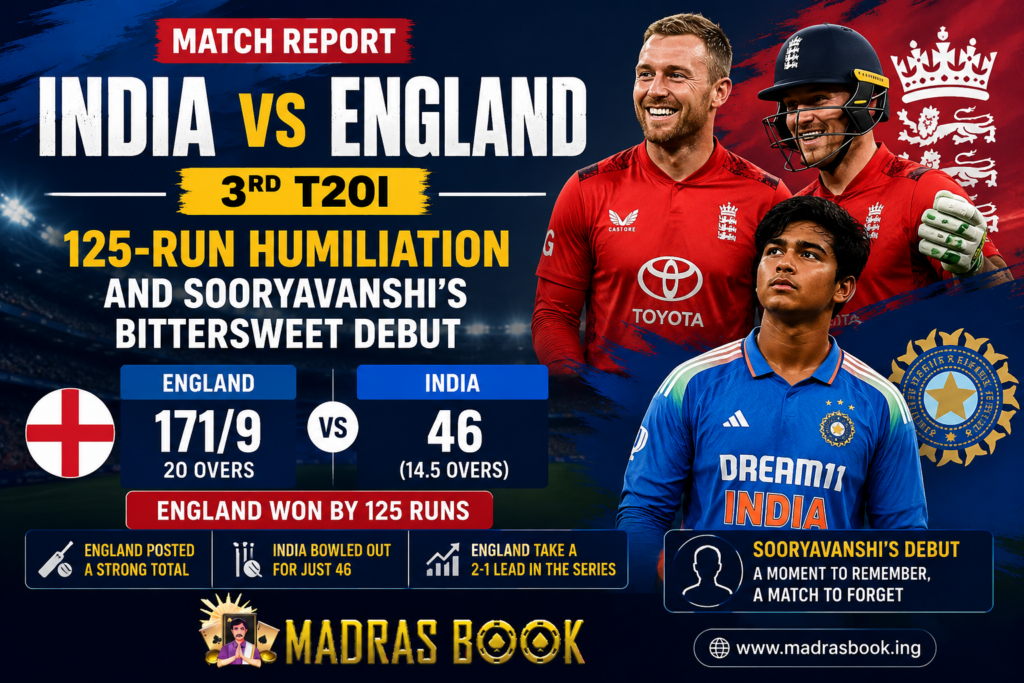
Two things happened at Trent Bridge on Tuesday evening. One was the moment Indian cricket had been waiting for all summer. The other was the worst result Indian cricket has produced in years.
Both happened in the same match. Both belong in the same India vs England 3rd T20I match report. And the specific tragedy of the evening is that the two things cannot be separated — because the debut that everyone wanted to celebrate was immediately swallowed by the defeat that nobody can defend.
Vaibhav Sooryavanshi walked to the crease at Trent Bridge and became the youngest Indian cricketer in history to play senior international cricket, breaking Sachin Tendulkar’s record that had stood for thirty-seven years. He faced Jofra Archer with the ball doing things at 90 mph. He hit two sixes — one off Archer, one off Josh Tongue — in his first ten deliveries. He showed in ten balls exactly why Indian cricket has been talking about him for months.
And then India were bowled out for 76. Chasing 203. Dismissed in 10.2 overs. Their second-lowest T20I total in history. Their biggest defeat in the format’s history by runs. Their fifth consecutive T20I loss on this tour counting the Ireland whitewash and the losses in England. A 0-2 series deficit with two matches remaining.
The India vs England 3rd T20I match report is the story of a debut that deserved a better night and a defeat that deserved to be avoided.
Match Details
| Detail | Info |
|---|---|
| Match | England vs India — 3rd T20I |
| Date | Tuesday, July 7, 2026 |
| Venue | Trent Bridge, Nottingham |
| Toss | India won — elected to field |
| England | 202/6 (20 overs) |
| India | 76 all out (10.2 overs) |
| Result | England won by 125 runs |
| India’s biggest T20I defeat ever | By runs |
| Series Status | England lead 2-0 (2 matches remaining) |
| Sooryavanshi debut | 13 off 10 balls — 2 sixes |
The Debut — Sooryavanshi Finally Plays
The Moment India Has Been Waiting for All Summer
Before the cricket — before the 202, before the 76, before the humiliation of being dismissed in ten overs — the most important thing that happened at Trent Bridge on Tuesday was this.
Vaibhav Sooryavanshi walked out to open the batting for India and became the youngest Indian cricketer ever to represent the national senior team. He is 15 years and 101 days old. Sachin Tendulkar was 16 years and 205 days when he debuted in Karachi in 1989. The record is gone. Before Sooryavanshi faced his first ball, history had already been made.
India had finally broken the glass on their boy wonder. After five matches on this tour — two in Ireland, one abandoned in Durham, one at Old Trafford — Sooryavanshi walked to the crease at Trent Bridge alongside Abhishek Sharma, with a green cap on his head and the weight of an entire country’s expectation on a fifteen-year-old’s shoulders.
His first ball from Jofra Archer — full, fast, on middle stump. Sooryavanshi drove it through the covers for two. The ground acknowledged it. His second encounter with Archer — a short delivery, pulling up around his ribs at 91 mph. Sooryavanshi swung hard and the ball disappeared over the midwicket boundary for six.
Two balls in. Facing England’s fastest bowler. Fifteen years old. Six.
Josh Tongue bowled the third over. Sooryavanshi hit him for another six — this one over long-on, cleanly struck, the kind of shot that makes professional bowling look like something else entirely. In ten deliveries, he had shown exactly why Indian cricket has spent the entire summer debating his non-selection.
Then Archer came back. A full-length ball swinging late. Sooryavanshi tried to drive and the edge flew to Buttler. Out for 13 off 10 balls. Two sixes. One four. Strike rate of 130.
His debut was over before the powerplay was done. India were already wobbling at 17 for 2 when he departed, and the collapse that followed had nothing to do with him. But the specific weight of the occasion — the record broken, the sixes hit, the dismissal by Archer — gave the evening a quality of incompleteness that will stay with Indian cricket until Sooryavanshi gets another chance.
England’s Innings — 202 That Was Always Too Many
Salt 70, Bethell Again, Brook’s Authority
India won the toss and chose to bowl first — the same decision that has produced the same results all tour. England bat, England score, India struggle to defend. The template has not changed and the result at Trent Bridge did not change it either.
Phil Salt — 70 off 44 balls:
Salt has been England’s most destructive opener in this series. At Trent Bridge, he produced his best performance — 70 off 44 balls, attacking from ball one and giving England the kind of powerplay start that puts totals of 200 in reach before the seventh over has been bowled.
India’s bowling at Salt in the powerplay was not good enough. Harshit Rana’s length was inconsistent. Arshdeep Singh’s swing — usually reliable — was not in evidence at Trent Bridge. And when Salt is timing the ball well at a flat pitch with short square boundaries, inconsistent length bowling is treated with contempt.
Jacob Bethell — 76 not out off 48:
The young left-hander has been England’s most significant batting discovery of this series. His 76 not out in the second T20I at Old Trafford sealed the match. His 76 not out at Trent Bridge did the same. Two consecutive unbeaten 76s in T20Is against India — the kind of consistency that earns a player a long run in international cricket.
His presence at the crease in the second half of England’s innings — taking India’s bowlers apart through the leg side and hitting back-of-length deliveries for six with a bottom hand that generates extraordinary power — gave England the 50-plus total above par that makes 202 difficult to chase.
The bowling disaster — Bishnoi’s 60 runs:
Ravi Bishnoi conceded 60 runs in 4 overs — 29 in a single over in the Old Trafford match had already damaged his standing, and Trent Bridge was no better. He was taken apart by Bethell in particular, with three back-foot no-balls adding insult to the injury of the runs conceded. Bishnoi was visibly out of rhythm — his googly not landing, his pace variation not deceiving and his length not consistent.
The decision to play Bishnoi over Prince Yadav — who had taken 3 for 22 on debut against Ireland — became increasingly indefensible with every run conceded.
England finished at 202 for 6. The highest total England have posted against India in a T20I in England. Another record, going the wrong way for India.
India’s Collapse — 76 All Out in 10.2 Overs
The Worst Batting Performance in India’s T20I History
What happened when India batted is not easy to describe without making it sound worse than it was. But it genuinely was as bad as the scorecard suggests.
Archer and Tongue bowled India out for 76 runs in 10.2 overs. Three wickets each. India’s second-lowest total in T20Is — their lowest since a specific match in 2007 when the format was still finding its feet. Their quickest dismissal in the format’s history. Their biggest defeat by runs.
The key numbers:
- Five wickets fell in the powerplay — India’s top order collapsed before the sixth over was done. Sooryavanshi’s debut dismissal for 13 was actually the second-highest score in that powerplay cluster. The others — Abhishek Sharma for 3, Ishan Kishan for 0, Shreyas Iyer for 0 — returned nothing.
- Jofra Archer — 3 for 18 — Pace, bounce, late movement and the specific intelligence of a bowler who knows exactly where to pitch the ball against batters who like to drive. His over that dismissed three of India’s top four was one of the great T20I bowling spells of the summer.
- Josh Tongue — 3 for 21 — The debutant who barely made news at Old Trafford became a match-winner at his home ground. Trent Bridge suits Tongue — he has played here for the opposition as a county cricketer and knows the surface’s characteristics. His ability to generate steep bounce from a length that India’s batters kept trying to drive was relentless.
- India’s batters dismissed for ducks — 4 — Ishan Kishan, Shreyas Iyer, Axar Patel and Prince Yadav all failed to score. Four ducks in one innings in a T20I is not just a bad batting performance. It is a complete collapse of technique, temperament and preparation simultaneously.
- India bowled out in 10.2 overs — The fastest they have ever been dismissed in a T20I. The previous record was 17.2 overs against South Africa in 2015. The new record is not close to the old one.
The collapse over by over:
The powerplay told the entire story. Sooryavanshi gone for 13, Abhishek for 3, Kishan for 0, Iyer for 0 — 19 for 4 at the end of the sixth over. The middle order arrived at the crease against bowlers who were already on a roll, in a chase of 203 that had already become Mission Impossible. Tilak Varma made 22 — the top scorer in an innings where 22 was enough to lead the batting. Shivam Dube made 19. Nobody else reached double figures.
India were all out for 76. The presentation ceremony — as one cricket writer noted — seemed to last longer than India’s innings. Which is not entirely untrue.
Sooryavanshi’s Debut in Context
What Ten Balls Told Us — And What They Did Not
The specific sadness of Sooryavanshi’s debut at Trent Bridge is not the score. Thirteen runs off ten balls in a T20I against England’s new-ball attack is not a failure — it is the kind of innings that happens to good batters on difficult evenings in challenging conditions.
The sadness is the context. His debut came in a match India lost by 125 runs. His dismissal — caught Buttler, bowled Archer for 13 — was barely noticed in the subsequent collapse because the collapse itself was so dramatic that it consumed every other narrative.
But isolate those ten balls. Two sixes — one off Archer, one off Tongue. Both clean. Both hit to different parts of the ground, suggesting he was reading the length and making a conscious decision rather than swinging blindly. His dismissal was an edge to a ball that moved late at 91 mph from England’s fastest bowler — a delivery that would trouble batters three times his age.
Cricinfo’s preview had noted, before the match, that Sooryavanshi “showed glimpses of his talent by smashing two sixes off Jofra Archer and Josh Tongue. Though the 15-year-old batter got out for 14 off 10 balls, he would be desperate to make use of batting-friendly conditions at Nottingham.”
The friendly conditions arrived. India did not make use of them. Sooryavanshi’s 13 were not the problem. Everything else was.
He is 15 years old. He has played one international match. There will be more opportunities, better nights, bigger stages. The debut was bittersweet — the record broken, the sixes hit, the dismissal unfortunate. The innings incomplete in the same way that all debuts for genuinely great players are incomplete. The story has barely started.
What Went Wrong — Three Specific Problems
The Issues That Cannot Be Explained Away
Problem 1 — The Toss Decision
India won the toss and chose to bowl first at Trent Bridge. This was, in hindsight, the wrong call. Trent Bridge historically favours the chasing team under lights — the pitch gets flatter as the evening progresses and the dew helps the batters in the second innings. India know this. They chose to bowl anyway.
The result of that toss decision: England made 202. India then chased in conditions that were better for batting than when England batted. They still made 76. But starting the evening on the wrong foot tactically did not help a team already in fragile shape.
Problem 2 — Bishnoi Over Prince Yadav
The selection of Ravi Bishnoi over Prince Yadav remains the most indefensible decision of India’s entire tour. Bishnoi had already conceded 29 in a single over at Old Trafford. At Trent Bridge he conceded 60 in four overs. Prince Yadav took 3 for 22 on his debut against Ireland. The evidence pointed entirely in one direction. The selection went the other way. By the time Bishnoi had finished his four overs at Trent Bridge, India’s totals in his spells across the tour make painful reading.
Problem 3 — Batting Against Pace in English Conditions
This is the structural problem that one selection change cannot fix. India’s batting lineup is built for flat surfaces where the ball comes onto the bat and timing produces results. English conditions — overcast skies, swinging Dukes ball, Archer and Tongue at 88-92 mph with awkward bounce — require a different approach. More respect in the powerplay. More patience against the moving ball. More willingness to take singles off the back foot rather than driving at deliveries that are going away.
India’s batters — with the partial exception of Sooryavanshi and Tilak Varma — have not adapted to these conditions in any completed match on this tour. The Ireland collapse, the Old Trafford total that England chased, and now the 76 all out at Trent Bridge are three different matches with the same root problem.
Where Does India Go From Here?
Two Matches to Save Some Pride
India trail the series 2-0. Two T20Is remain — Bristol on July 9 and Southampton on July 11. The series is gone. England need one more win from two matches to clinch it. India need to win both to tie it.
Shreyas Iyer has now lost five T20I matches as captain without a win — a run of results that is unprecedented for an India T20I captain in recent history. The questions about his captaincy are no longer gentle ones. Gambhir’s reflection on India’s “heavy loss to England” — highlighted by the ICC as a major news item — suggests that discussions are happening at the highest level about what needs to change.
The two remaining matches will not save the series. But they might save something about India’s credibility as a T20I team heading into the next stage of their preparation. Bristol and Southampton are opportunities to reset, to play without scoreboard pressure, to try combinations and tactics that the must-win pressure of the first three matches made difficult to experiment with.
Sooryavanshi will play both. After Tuesday’s debut, there is no question of returning him to the bench. He is India’s most interesting batting option in conditions that have exposed everyone around him. He will get more balls. He will get better conditions — Bristol and Southampton are typically kinder surfaces than Trent Bridge was on Tuesday.
Whether he can produce the innings that this debut promised — rather than the innings it delivered — is the one question on this tour that still has a genuinely interesting answer.
Complete Scorecard
England 202/6 (20 overs)
| Batter | Runs | Balls | 4s | 6s |
|---|---|---|---|---|
| Phil Salt (wk) | 70 | 44 | 8 | 3 |
| Jos Buttler | 23 | 15 | 2 | 1 |
| Harry Brook (c) | 31 | 22 | 3 | 1 |
| Jacob Bethell | 76* | 48 | 6 | 4 |
| Tom Banton | 14 | 10 | 1 | 1 |
| Sam Curran | 11* | 8 | 1 | 0 |
India Bowling: Harshit Rana 1/38, Arshdeep Singh 2/33, Axar Patel 0/28, Ravi Bishnoi 0/60, Varun Chakravarthy 1/35
India 76 all out (10.2 overs)
| Batter | Runs | Balls | 4s | 6s |
|---|---|---|---|---|
| Vaibhav Sooryavanshi | 13 | 10 | 1 | 2 |
| Abhishek Sharma | 3 | 5 | 0 | 0 |
| Ishan Kishan (wk) | 0 | 2 | 0 | 0 |
| Shreyas Iyer (c) | 0 | 3 | 0 | 0 |
| Tilak Varma | 22 | 19 | 2 | 1 |
| Shivam Dube | 19 | 16 | 1 | 1 |
| Axar Patel | 0 | 1 | 0 | 0 |
| Harshit Rana | 8 | 8 | 1 | 0 |
| Prince Yadav | 0 | 1 | 0 | 0 |
| Arshdeep Singh | 4 | 5 | 0 | 0 |
| Varun Chakravarthy | 5 | 7 | 1 | 0 |
England Bowling: Jofra Archer 3/18, Josh Tongue 3/21, Adil Rashid 2/19, Sam Curran 1/12, Will Jacks 1/4
Result: England won by 125 runs — India’s biggest T20I defeat ever Series: England lead 2-0 (2 matches remaining)
FAQ — India vs England 3rd T20I Match Report
Q1: What was the result of India vs England 3rd T20I at Trent Bridge?
England beat India by 125 runs — India’s biggest ever defeat in T20I cricket by runs. England posted 202 for 6 and bowled India out for just 76 in 10.2 overs. England lead the five-match series 2-0.
Q2: Did Vaibhav Sooryavanshi make his debut in the 3rd T20I?
Yes — Vaibhav Sooryavanshi made his international debut at Trent Bridge, becoming the youngest Indian cricketer in history to play senior international cricket at 15 years and 101 days old. He scored 13 off 10 balls with two sixes before being caught behind off Jofra Archer.
Q3: What was Sooryavanshi’s debut score?
Sooryavanshi scored 13 off 10 balls — hitting two sixes, one off Jofra Archer and one off Josh Tongue, before being caught by Jos Buttler off Archer’s bowling. Despite the modest score, his stroke play showed the talent that made him the most anticipated debut in Indian cricket this year.
Q4: Who took the most wickets for England?
Jofra Archer took 3 for 18 and Josh Tongue took 3 for 21 — sharing six wickets between them to bowl India out for 76 in 10.2 overs. Adil Rashid added 2 for 19 in a comprehensive England bowling performance.
Q5: What is India’s lowest T20I total?
India’s 76 all out at Trent Bridge is their second-lowest T20I total in history and their lowest since a 2007 match. It is also the fastest India have ever been dismissed in T20I cricket — bowled out in just 10.2 overs.
Q6: What does Shreyas Iyer’s captaincy record look like now?
Shreyas Iyer has now lost five T20I matches as India’s captain without a single win — Ireland 0-2 whitewash plus England 0-2 down. It is the worst start to an India T20I captaincy in recent history and significant questions are being asked about both his captaincy and India’s T20 setup under coach Gautam Gambhir.