
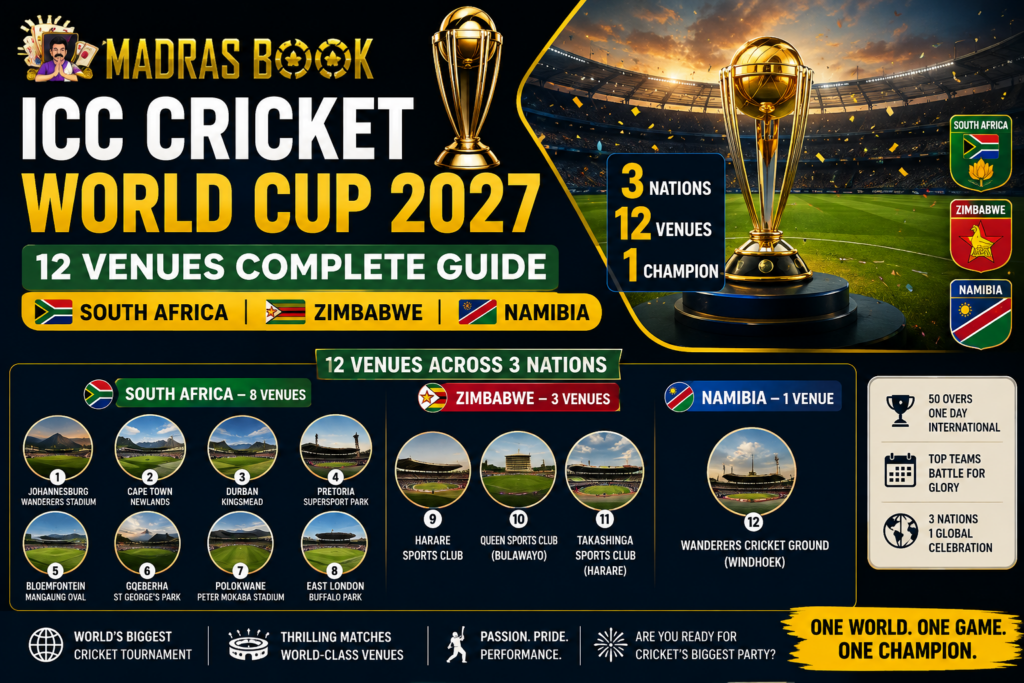
The ICC Cricket World Cup 2027 venues have been confirmed.
Twelve of them. Announced on July 30, 2026 at a ceremony at the Inanda Polo Club in Johannesburg — attended by Graeme Smith, Makhaya Ntini, Hashim Amla, Temba Bavuma and Kagiso Rabada on behalf of South Africa, Hamilton Masakadza for Zimbabwe and Rudie van Vuuren representing Namibia. The ICC’s chairman Jay Shah described the moment as “an exciting milestone on the road to the ICC Men’s Cricket World Cup 2027.” South Africa’s cricket president Rihan Richards was there. Zimbabwe’s Tavengwa Mukuhlani. The three boards together, in Johannesburg, announcing the ICC Cricket World Cup 2027 venues under a tournament theme that captures something real about where these three nations meet: “Three Nations, One Heartbeat.”
The ICC Cricket World Cup 2027 venues span three countries and one time zone. Eight of the twelve are in South Africa — the Wanderers in Johannesburg, SuperSport Park in Centurion, Newlands in Cape Town, Kingsmead in Durban, St George’s Park in Gqeberha, Mangaung Oval in Bloemfontein, Boland Park in Paarl and Buffalo Park in KuGompo City (formerly East London). Three are in Zimbabwe — Harare Sports Club, Queens Sports Club in Bulawayo and the brand-new Mosi-oa-Tunya International Cricket Stadium in Victoria Falls. And one is in Namibia — the Namibia Cricket Ground in Windhoek. The ICC Cricket World Cup 2027 venues announcement confirms October 4 to November 21, 2027 as the tournament dates — 49 days, 57 matches, 14 teams, cricket returning to African soil for the first time in 24 years.
The Big Picture — Africa’s First World Cup in 24 Years
Africa last hosted the ODI World Cup in 2003. South Africa, Zimbabwe and Kenya shared that edition. It produced Sachin Tendulkar’s century against Namibia in Pietermaritzburg, the shocking rain-rule calculation that bounced India to the final without playing their Pakistan match, Kenya beating Sri Lanka in the Super Sixes, and Australia winning the title comprehensively against India at Johannesburg. Twenty-four years later, the tournament is back.
This time without Kenya. With Namibia instead. With fourteen teams instead of fourteen. With fifty-seven matches instead of fifty-four. And with a format that has been redesigned — a Super Series pre-stage plus a group phase plus a Super 7 knockout stage — that aims to give more teams competitive cricket while building toward the final at either the Wanderers or Newlands.
The specific significance of each host nation is different. South Africa carries the tournament — eight venues, approximately forty-four matches, the final, the semifinal, the marquee group games. Zimbabwe returns after hosting the 2003 edition and has been investing in its cricket infrastructure specifically toward this moment. And Namibia — a country of 2.6 million people with a cricket programme that has been quietly developing for decades — hosts a global ICC event for the first time in its history. The Windhoek ground has never seen anything like what is coming in 2027. That is not a criticism. It is a statement about what this tournament means for the Associate nation.
South Africa — 8 Venues
The Wanderers, SuperSport Park, Newlands and Five More
South Africa carries the ICC Cricket World Cup 2027 venues load as the primary host. Eight cities. Approximately forty-four matches. The final.
1. Wanderers Stadium — Johannesburg The Bull Ring. One of the loudest cricket grounds in the world, with a specific acoustic that makes afternoon Test sessions feel like T20 matches. The Wanderers has hosted the 2003 World Cup final — where Australia beat India — and is the confirmed or near-confirmed venue for the 2027 final. If India make the final, the Wanderers will be sold out before the semifinal pairings are known.
2. SuperSport Park — Centurion Cricket South Africa’s most modern venue. The SuperSport Park in Tshwane is technically advanced, has some of the fastest outfield surfaces in world cricket and produces consistently high-scoring matches on pitches that tend to favour batters after the first morning session. The kind of ground where 320 becomes par and 280 does not win group matches.
3. Newlands Cricket Ground — Cape Town The most visually spectacular cricket ground in the world by almost universal consensus. Table Mountain as the backdrop, Devil’s Peak to the right, the atmosphere that Cape Town generates for big cricket matches. Newlands is the alternative final venue if the Wanderers is not selected. The pitch here is slower than Johannesburg’s, which produces differently shaped games — lower scores, tighter contests, the specific Test-match quality of surface that produces memorable cricket rather than just big totals.
4. Kingsmead Cricket Ground — Durban The coastal venue. Durban’s humidity in October-November creates conditions that swing bowlers love and batters who grew up on flat subcontinental surfaces find deeply uncomfortable. Kingsmead is where the World Cup’s biggest upsets are most likely to happen — the specific combination of movement in the air and off the seam, the afternoon sea breeze and the coastal atmosphere that makes cricket in Durban unlike cricket anywhere else in South Africa.
5. St George’s Park — Gqeberha (Port Elizabeth) South Africa’s oldest international cricket ground. St George’s Park has hosted Test cricket since the 1880s — the kind of history that cricket grounds in most countries cannot match. The Gqeberha pitch tends to produce genuine pace and bounce that generates wicket-taking opportunities for quality fast bowlers across the full fifty overs.
6. Mangaung Oval — Bloemfontein The central South Africa venue. Bloemfontein’s altitude — 1,395 metres above sea level — is the specific factor that makes the Mangaung Oval different from every other venue in this World Cup. At altitude, the ball travels further, outfield boundaries feel shorter, and totals that would be par at sea level become modest. Bloemfontein in October can be genuinely hot — conditions that favour the subcontinental batters who are comfortable in heat.
7. Boland Park — Paarl The Western Cape ground outside Cape Town. Paarl’s wine country setting is picturesque but what matters for cricket is the pitch — which tends to assist both pace and spin depending on conditions, producing genuinely variable surfaces that make captaincy decisions at the toss particularly important.
8. Buffalo Park — KuGompo City (East London) The coastal eastern venue. Previously known as East London, KuGompo City’s Buffalo Park has hosted Test cricket for South Africa and returns to the global stage for the first time in years. The coastal conditions here produce cricket that resembles Durban’s — movement in the air, bounce off the surface — but in a smaller, more intimate setting.
Zimbabwe — 3 Venues
Harare, Bulawayo and a Brand-New Victoria Falls Stadium
Zimbabwe last co-hosted the ODI World Cup in 2003. In the twenty-four years since, Zimbabwe cricket has had its difficulties — political turbulence, financial crisis, ICC membership complications — but has emerged from them with a cricket infrastructure that can now support World Cup hosting.
9. Harare Sports Club — Harare The most famous cricket ground in Zimbabwe. Harare Sports Club is where Vaibhav Sooryavanshi scored 175 in the Under-19 World Cup 2026 final. Where India played three T20Is in July 2026. Where Zimbabwe’s home cricket has been played for decades. It is a traditional, well-maintained ground with a surface that helps spin later in matches and produces competitive cricket across all formats. Harare in October is mid-spring — warm but not oppressive, with afternoon cloud cover that can produce movement for pace bowlers in the early sessions.
10. Queens Sports Club — Bulawayo Zimbabwe’s second city has its own cricket ground and its own cricket identity. Queens Sports Club in Bulawayo tends to produce flatter, higher-scoring surfaces than Harare — the kind of pitch that suits subcontinental batters and rewards big first-innings totals. The atmosphere at Queens Sports Club for World Cup matches will be the largest crowds Bulawayo cricket has ever hosted.
11. Mosi-oa-Tunya International Cricket Stadium — Victoria Falls The brand-new venue. The one that does not exist yet as a finished stadium but will be ready before the World Cup begins. Victoria Falls — named after the waterfall that borders Zimbabwe and Zambia, one of the seven natural wonders of the world — is being built a new 10,000-seat cricket stadium specifically for this tournament. It is expected to be completed by the end of 2026 and officially opened in the first quarter of 2027 for domestic matches before the World Cup arrives.
A 10,000-seat cricket ground next to one of the most spectacular natural sites on earth. World Cup matches at Victoria Falls in October 2027 — when the spray from the falls is visible from the ground on the right day — will be among the most photographed cricket matches ever played. The venue itself is the story, before a ball is bowled.
Namibia — 1 Venue
Namibia Cricket Ground — Windhoek — Historic First
12. Namibia Cricket Ground — Windhoek The line in the confirmed venues list that deserves more attention than it will get.
Namibia has never hosted a senior ICC event. They have hosted the men’s Under-19 World Cup, jointly with Zimbabwe, earlier in 2026. But the 2027 ODI World Cup will be the first time a senior global ICC tournament has been played on Namibian soil.
Windhoek is the capital of Namibia — a country of approximately 2.6 million people in southwestern Africa where cricket has been developing quietly and consistently since the country’s independence in 1990. The Namibia Cricket Ground is the national venue, properly maintained and capable of hosting international matches. It is not a stadium on the scale of the Wanderers or Kingsmead. But its presence on the ICC Cricket World Cup 2027 venues list is one of the most significant moments in Associate cricket’s history.
The specific absurdity — and it is an absurdity that cricket loves — is that Namibia will host World Cup matches without having yet qualified for the tournament. As an Associate member, Namibia does not have an automatic berth. They must go through the World Cup Qualifier. They are hosting the event without knowing for certain that they will be playing in it. If Namibia qualifies and plays a group match at their own Windhoek ground, it will be one of the moments of the tournament regardless of the result.
The Tournament Format — Three Stages
The ICC announced the 2027 World Cup format on July 15, 2026 — two weeks before the venue reveal on July 30. The format is new and specifically designed to create more competitive cricket across the early stages while building toward a compelling final week.
Stage 1 — Super Series: The three teams ranked 12th to 14th play a mini-competition. The winner of the Super Series advances to the group stage. This stage was created to give the lowest-ranked qualifiers more meaningful competitive matches before the group stage begins rather than simply arriving as makeweights.
Stage 2 — Group Stage: Twelve teams split into two groups of six. Thirty matches across the group stage. Top three from each group, plus the best fourth-placed team from either group, advance. Seven teams reach the Super 7 knockouts.
Stage 3 — Super 7: Seven teams. The specific format here has not been fully detailed publicly but produces two semifinalists. Then:
Semi-Finals → Final
The final is at the Wanderers in Johannesburg or Newlands in Cape Town. The specific venue may be determined by which semifinal pair produces the more commercially valuable final — though the ICC have not confirmed that explicitly.
57 matches total. 14 teams. 49 days. October 4 to November 21, 2027.
The Tournament Identity — Ubuntu and African Wire Bowl
The visual identity of the ICC Cricket World Cup 2027 venues tournament is rooted in African culture specifically rather than in generic sports branding.
The primary design element is the African wire bowl — the handcrafted wire sculptures made in southern African townships that have become internationally recognised as art objects. The tournament colours are named for African geographies and ecosystems: Zimbabwe Chilli, African Root, Fynbos Pop (after the Cape’s unique plant kingdom), Namib Dune, Harare Dawn and Two Oceans.
The theme “Three Nations, One Heartbeat” draws on the Ubuntu philosophy — the southern African concept that individual identity is constituted through relationship with others. “I am because we are.” For a tournament that brings three nations together to jointly host cricket’s biggest 50-over event, it is an appropriate framing.
Jay Shah’s statement at the launch captured the ICC’s positioning precisely: “An exciting milestone on the road to the ICC Men’s Cricket World Cup 2027.” Not just about cricket. About southern Africa as a region making its statement to the global sporting calendar.
The Qualifier — Who Still Needs to Qualify
Fourteen teams play the 2027 World Cup. The automatic qualifiers are:
- Full Members that are host nations: South Africa, Zimbabwe
- ICC ODI rankings — top-ranked nations at the qualification cut-off date
- 2023 World Cup top teams (with specific thresholds)
The remaining spots go through the World Cup Qualifier tournament — scheduled for early 2027 when South Africa’s main six stadiums are occupied with the SA20 league. Warm-up venues Benoni and Potchefstroom will co-host the Qualifier alongside Namibia’s Windhoek ground.
Namibia, as mentioned, must qualify through this process despite being a host nation. Associate members who have been building toward this moment — Ireland, Scotland, the Netherlands, the UAE, Oman — will compete for the remaining places. The Qualifier is where Associate cricket’s World Cup dreams either live or die.
Complete Venues List — All 12
South Africa (8 venues)
| s.no | Venue | City | Capacity |
|---|---|---|---|
| 1 | Wanderers Stadium | Johannesburg | 34,000 |
| 2 | SuperSport Park | Centurion/Tshwane | 22,000 |
| 3 | Newlands Cricket Ground | Cape Town | 25,000 |
| 4 | Kingsmead Cricket Ground | Durban | 25,000 |
| 5 | St George’s Park | Gqeberha | 19,000 |
| 6 | Mangaung Oval | Bloemfontein | 17,000 |
| 7 | Boland Park | Paarl | 10,000 |
| 8 | Buffalo Park | KuGompo City (East London) | 18,000 |
Zimbabwe (3 venues)
| s.no | Venue | City | Capacity |
|---|---|---|---|
| 9 | Harare Sports Club | Harare | 10,000 |
| 10 | Queens Sports Club | Bulawayo | 10,000 |
| 11 | Mosi-oa-Tunya Int’l Cricket Stadium | Victoria Falls | 10,000 (NEW) |
Namibia (1 venue)
| s.no | Venue | City | Capacity |
|---|---|---|---|
| 12 | Namibia Cricket Ground | Windhoek | 5,000 |
Quick Facts — ICC Cricket World Cup 2027
| Detail | Info |
|---|---|
| Tournament | ICC Men’s Cricket World Cup 2027 (14th edition) |
| Dates | October 4 — November 21, 2027 |
| Duration | 49 days |
| Host Nations | South Africa, Zimbabwe, Namibia |
| Total Venues | 12 |
| Total Matches | 57 |
| Total Teams | 14 |
| Theme | Three Nations, One Heartbeat |
| Format | Super Series + Groups + Super 7 + Semis + Final |
| Final Venue | Wanderers (JHB) or Newlands (CPT) |
| Last Africa edition | 2003 — SA + Zimbabwe + Kenya |
| Gap | 24 years |
| Announced | July 30, 2026 — Inanda Polo Club, Johannesburg |
ICC Cricket World Cup 2027 — 12 Venues Complete Guide | South Africa, Zimbabwe, Namibia
An Online Betting ID lets cricket fans enjoy a seamless experience while following major tournaments like the ICC Cricket World Cup 2027. With a trusted platform such as Madrasbook, you can create your betting ID in minutes, access secure login, fast UPI deposits and withdrawals, and mobile-friendly features. Whether you’re tracking matches across South Africa, Zimbabwe, and Namibia or staying updated with live cricket action, a verified Online Betting ID offers quick account access, reliable payments, and dedicated customer support for a smooth cricket experience.
FAQ — ICC Cricket World Cup 2027 Venues
Q1: Where will ICC Cricket World Cup 2027 be held?
The ICC Cricket World Cup 2027 will be held across South Africa, Zimbabwe and Namibia — 12 venues in total. South Africa hosts eight venues including the Wanderers in Johannesburg and Newlands in Cape Town. Zimbabwe hosts three — Harare Sports Club, Queens Sports Club in Bulawayo and the new Mosi-oa-Tunya stadium in Victoria Falls. Namibia hosts one — the Namibia Cricket Ground in Windhoek.
Q2: When does ICC Cricket World Cup 2027 start and end?
The ICC Men’s Cricket World Cup 2027 runs from October 4 to November 21, 2027 — a 49-day tournament featuring 14 teams, 57 matches and a three-stage format. The final will be held at either the Wanderers Stadium in Johannesburg or Newlands in Cape Town.
Q3: What is the format of ICC Cricket World Cup 2027?
The 2027 World Cup has a three-stage format: Super Series (teams ranked 12th-14th compete, winner advances), Group Stage (12 teams in two groups of six, top three from each group plus best fourth-placed team advance) and Super 7 knockouts leading to the semifinals and final. Total of 57 matches across 14 teams.
Q4: What is the new venue at Victoria Falls for ICC World Cup 2027?
The Mosi-oa-Tunya International Cricket Stadium in Victoria Falls is a brand-new 10,000-seat venue being built specifically for the 2027 World Cup. It is expected to be completed by end of 2026 and opened in early 2027. Victoria Falls is named after one of the seven natural wonders of the world — the stadium sits near the Zimbabwe-Zambia border where the falls generate one of the most spectacular natural settings for any cricket ground.
Q5: Does Namibia automatically qualify for the ICC World Cup 2027?
No — Namibia is an Associate member and does not receive an automatic qualification berth despite being a co-host nation. They must qualify through the World Cup Qualifier tournament scheduled for early 2027. South Africa and Zimbabwe, as Full Members, receive automatic places. Namibia will host matches at their Windhoek ground regardless of whether they qualify to play in the tournament.
Q6: Why is the ICC World Cup 2027 significant for African cricket?
The 2027 World Cup marks the first time the ODI World Cup has been held in Africa in 24 years — since South Africa, Zimbabwe and Kenya jointly hosted in 2003. It is also the first senior ICC global event Namibia has ever hosted and the first ICC World Cup to feature a brand-new venue at Victoria Falls. The tournament theme “Three Nations, One Heartbeat” reflects the regional significance of hosting cricket’s biggest 50-over event across southern Africa.