
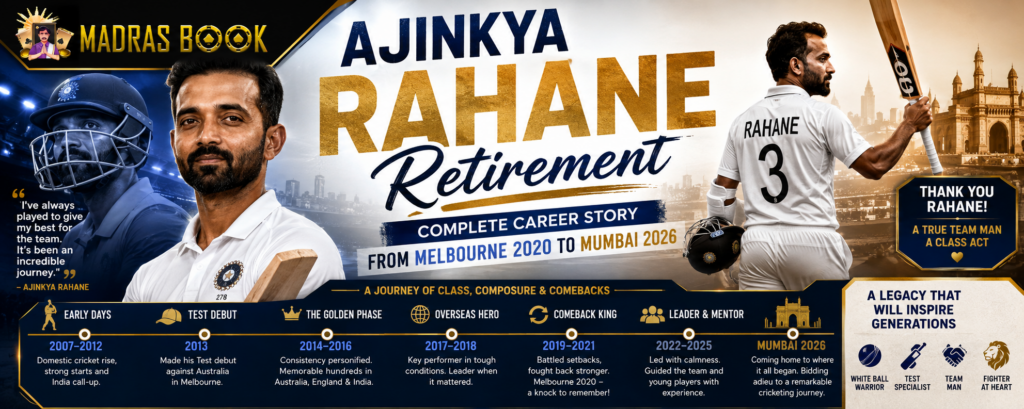
“Ajinkya means unbeatable. But cricket has shown me defeat many times.”
That sentence — from Ajinkya Rahane’s retirement announcement on July 30, 2026 — is the most honest thing a retiring cricketer has said about their own career in years. Not a list of achievements, though the achievements are considerable. Not a grateful overview of everything that went well, though plenty did. A direct acknowledgment that the sport that defined his adult life also humbled him, repeatedly and in public, and that he is at peace with the complexity of that.
Ajinkya Rahane’s retirement from all formats of cricket with immediate effect ends a career that spanned fifteen years of first-class cricket, twelve years of international cricket across all three formats, and one innings in Melbourne in December 2020 that will be talked about as long as India plays Test cricket. The Ajinkya Rahane retirement announcement came via social media — the modern cricketer’s retirement medium — and was received with the specific warmth that players earn when they have given their best, been dropped, come back, been dropped again and eventually retired on their own terms.
He is 38. His last international match was a Test against West Indies in July 2023. His last competitive match was for Kolkata Knight Riders in IPL 2026. In between those two bookends is the complete story of Ajinkya Rahane’s retirement — from a T20I debut in 2011 where he opened the batting against England and struck 69 off 31 deliveries to a final IPL season where he captained KKR to seventh place and scored 335 runs across 14 matches as a 37-year-old.
The Ajinkya Rahane retirement story is not the story of a consistent, uncomplicated career that built toward a natural ending. It is the story of peaks that produced some of India’s greatest away Test performances, valleys that led to being dropped and publicly written off, comeback seasons that earned recall only for the recall to arrive too late, and one six-week period in Australia in 2020-21 that produced the greatest captaincy performance in Indian Test cricket history.
Here is the complete story.
The Beginning — Ashvali, Maharashtra, and the Arrival
Ajinkya Rahane was born on June 6, 1988 in Ashvali in Maharashtra. He came through Mumbai’s extraordinarily competitive domestic cricket system — the same system that produced Sachin Tendulkar, Rohit Sharma and dozens of other India internationals — and established himself as one of the more technically elegant young batters in domestic cricket before most Indian cricket fans had heard his name.
His Mumbai domestic record was the foundation. Patient, technically correct, able to bat long and score heavily in conditions that make batting difficult. The specific Rahane quality that Mumbai cricket develops — the ability to leave the ball outside off stump, to trust the front foot defence, to wait for the right ball to score from — was visible in his domestic career before it translated to international cricket.
His T20I debut against England in 2011 was the first glimpse. He opened the batting, struck 69 off 31 deliveries and gave the Indian cricket watching public a player who could clearly play. His ODI debut in Durham came in the same year — in a match that also happened to be Rahul Dravid’s final ODI appearance, which meant the occasion was covered more for Dravid than for the debutant who contributed 40 off 44 balls in that same middle order.
Test cricket made him wait longer. The Border-Gavaskar Trophy 2013, the fourth Test in Delhi — a series India were winning comfortably — was where his Test cap arrived. He scored 1 and 7. Not the debut that announces itself. The debut that earns nothing more than another chance.
He made sure the other chances counted.
The Lord’s Century — July 2014
Test cricket’s first proper Rahane announcement happened at Lord’s in July 2014. India touring England. The second Test. Rahane walked to the crease and scored 103 — on his first appearance at cricket’s most famous ground, becoming the fourth Indian to score a Test century at Lord’s on debut at the venue.
The innings was not just about the runs. It was about the method. Rahane at Lord’s in 2014 looked entirely at home against a genuinely good England bowling attack on a surface that assisted swing and seam. His technique — the balance, the head position, the specific calm of someone who had prepared for exactly this situation and found it no harder than their preparation had suggested — was the thing that made the innings special rather than just the century.
India lost that series. Rahane’s Lord’s hundred was one of the few bright individual performances in an otherwise difficult tour. But the cricket world had seen enough to understand that this was not a fortunate century by a player who happened to have a good day. This was a technically equipped batter performing at the level his domestic record had always suggested he could reach.
The Middle Years — Consistent Abroad, Inconsistent at Home
The specific pattern of Rahane’s Test career through 2015-2019 was one that both justified his selection and, occasionally, invited questions about it.
Overseas, he was excellent. Australia, England, South Africa, New Zealand — on surfaces that tested technique and rewarded patience, Rahane produced. His overseas Test average significantly exceeded his home average across the middle of his career. The away series that others found most difficult were the ones where Rahane’s specific skills — the ability to leave, to defend, to wait — were most applicable.
At home, on subcontinental turning surfaces where India’s top order typically dominated visiting bowling attacks, Rahane was less consistently productive. He averaged below his career figure at home. This created the specific situation that Indian cricket found uncomfortable: a batter who was arguably most valuable in the conditions that came around least frequently, and somewhat less reliable in the conditions India played most often.
He was also developing a reputation for something harder to measure than batting averages. In the slip cordon, Rahane was establishing himself as one of the finest fielders in Test cricket. He took 99 catches across his Test career — many of them from positions at slip where the margin for error is measured in millimetres and the reflexes required belong to athletes at the absolute peak of their physical capability. He set the world record for catches by a non-wicketkeeper in a single Test match — eight — a number that captures both his technical excellence in the cordon and the specific relentlessness with which he chased every opportunity.
The Adelaide Collapse — December 17, 2020
Context for Melbourne requires understanding what happened in Adelaide first.
India were bowled out for 36. Their second innings. Against Australia. At Adelaide Oval. 36 all out is the lowest Test innings total in India’s history. It has never been beaten. It produced a 1-0 deficit in the Border-Gavaskar Trophy, a defeat by eight wickets, and the departure of Virat Kohli — who returned home for the birth of his daughter and paternity leave — after the first Test.
Rahane was appointed captain for the remaining three Tests. India were 1-0 down. Their highest-profile player was gone. The squad was depleted by injuries throughout the series. The hosts were overwhelming favourites.
What followed across the next six weeks is the greatest Test series comeback in Indian cricket history and one of the greatest in any country’s cricket history.
Melbourne — December 26-29, 2020 — The Innings
India’s first innings at the MCG in the Boxing Day Test. Rahane came to the crease with India in early trouble. He scored 112 off 223 balls. The century was announced with a six — an unusual shot for a player known for restraint — and built through the middle of the innings with the specific authority of someone who had decided that this match, in this situation, with this context, required him to be at his absolute best.
India scored 326 in their first innings. They bowled Australia out for 195. Then 200. India won by 8 wickets. The series was level at 1-1.
The specific quality of Rahane’s Melbourne century was not just the runs. It was the decision-making. Which deliveries to leave. Which ones to hit. When to accelerate and when to consolidate. In a crisis situation — the biggest Test series India plays, 1-0 down, playing without their captain, on the MCG — he played the best innings of his career.
Kohli was watching from India. After the win, Rahane was visibly emotional in the dressing room. The team that had been bowled out for 36 nine days earlier had just beaten Australia at the MCG.
The Gabba — January 2021 — The Greatest Finish
The series went to Brisbane. The Gabba. Australia’s fortress. They had not lost a Test at the Gabba in 32 years.
India were depleted beyond what seemed survivable. Jasprit Bumrah was injured and delivering the ball with one hand from around the wicket in the first innings. Multiple other players were carrying injuries. The team that took the field for the Gabba Test was, in terms of its headline names, not the team that India’s selectors had chosen for the series.
They won.
Shubman Gill’s 91, Rishabh Pant’s unbeaten 89 off 138 balls to chase a target of 328 on the final afternoon — these are the individual numbers. But Rahane’s captaincy across those six weeks — the bowling changes, the field placements, the specific management of a depleted squad under sustained pressure — was the framework inside which every individual performance happened.
India won the series 2-1. It remains the most celebrated away Test series win in India’s history. The specific captaincy that produced it — calm, tactical, clear-headed, never looking like it was in doubt even when everything suggested it should be — is Ajinkya Rahane’s permanent contribution to Indian cricket beyond any individual batting number.
The Drop, The Comeback, The End
Form deserted him in 2021-22. Fifteen Tests between 2021 and the South Africa tour of early 2022. An average of 20. Not the Rahane who had averaged 40-plus across his prime years. The selectors dropped him after South Africa.
He was 33. Most assumed it was finished.
He went back to Ranji Trophy cricket with Mumbai. Scored 634 runs at an average of 57.6 in the 2022-23 season — the most significant domestic season of his post-international period. The BCCI could not ignore it. He was recalled for the WTC Final against Australia at The Oval in 2023 — a match India lost but in which Rahane contributed with the bat in both innings.
His last international appearance was in West Indies in July 2023. After that, he became KKR’s captain for IPL 2025 and 2026. Finished seventh in 2026, eighth in 2025. Modest returns for a franchise that had been IPL champions in 2024.
On July 30, 2026, he posted his retirement announcement on social media. The voice that broke while thanking his wife Radhika, his family, the BCCI and the fans was the voice of someone who had been in Indian cricket for long enough to understand exactly what it meant to leave it.
Complete Career Statistics
International Career
| Format | Matches | Runs | Average | 100s | 50s | HS |
|---|---|---|---|---|---|---|
| Tests | 85 | 5,077 | 38.46 | 12 | 26 | 188 |
| ODIs | 90 | 2,962 | 35.26 | 3 | 20 | — |
| T20Is | 20 | 375 | 20.83 | 0 | 1 | — |
First-Class Career
| Matches | Runs | Average | 100s | 50s | Catches |
|---|---|---|---|---|---|
| 201 | 14,000 | 45.16 | 41 | 59 | 265 |
IPL Career
| Matches | Runs | Average | SR | Teams |
|---|---|---|---|---|
| 278 | 7,073 | 29.84 | 124.52 | MI, RR, DC, CSK, KKR |
Records and Firsts
| Record | Detail |
|---|---|
| 8 catches in one Test | World record for non-wicketkeeper — single match |
| First WTC century | First Indian Player of Match — WTC |
| Lord’s debut century | 4th Indian to score Test ton at Lord’s on debut at venue |
| Melbourne 112 | Boxing Day century — platform for series-winning comeback |
| BGT 2020-21 | Led India to 2-1 win — broke Gabba 32-year record |
| 99 Test catches | Among most prolific slip fielders India has produced |
| 5th Indian | To score centuries in each innings of a Test |
The Farewell Quote — In Full
“From starting out as a young player in Mumbai, playing for India, it has been an absolute honour. There have been many wins and losses along the way, but the sheer joy of playing cricket, being part of different teams, and creating lifelong memories — that has been the greatest satisfaction of my career.”
“To the BCCI, the MCA, my teammates, my coaches, every IPL franchise, to Radhika, my entire family, my friends, and everyone who stood by me, thank you. And a very special thank you to all the cricket fans who supported me through all the highs and lows.”
“Ajinkya means unbeatable. But cricket has shown me defeat many times.”
That last line. It contains more self-awareness than most retirement speeches produce in their entirety. A man named Unbeatable acknowledging that he was beaten. Often. And that the beating was part of the story rather than a footnote to it.
Ajinkya Rahane Retirement — Complete Career Story | From Melbourne 2020 to Mumbai 2026
Ajinkya Rahane’s retirement closes a memorable chapter in Indian cricket. His calm leadership, remarkable overseas performances, and historic 2020-21 Australia series victory made him a respected figure in the game. If you love following cricket action, a trusted Online Cricket ID lets you enjoy live match updates, secure payments, and access to major tournaments. Choose a verified platform with fast registration, reliable support, and responsible gaming features for a smooth experience.
FAQ — Ajinkya Rahane Retirement
Q1: When did Ajinkya Rahane retire from cricket?
Ajinkya Rahane announced his retirement from international cricket and all formats with immediate effect on July 30, 2026 via a social media post. He was 38 years old. His last international match had been a Test against West Indies in July 2023 and his last competitive match was for KKR in IPL 2026.
Q2: What are Ajinkya Rahane’s Test career statistics?
Rahane played 85 Tests for India, scoring 5,077 runs at an average of 38.46 with 12 centuries and 26 half-centuries. His highest Test score was 188. He also took 99 catches in Tests — setting the world record for most catches by a non-wicketkeeper in a single Test match with 8 catches.
Q3: What was Ajinkya Rahane’s greatest achievement as captain?
Rahane led India to a historic 2-1 Test series win in Australia in 2020-21 — stepping in as captain after Virat Kohli returned home after the first Test. India came back from being bowled out for a record low 36 in Adelaide to win the series, including breaking Australia’s 32-year unbeaten record at the Gabba. Rahane himself scored a crucial 112 in the Melbourne Boxing Day Test.
Q4: What did Ajinkya Rahane say in his retirement statement?
Rahane said: “From starting out as a young player in Mumbai, playing for India, it has been an absolute honour. There have been many wins and losses along the way, but the sheer joy of playing cricket, being part of different teams, and creating lifelong memories — that has been the greatest satisfaction of my career.” His most quoted line: “Ajinkya means unbeatable. But cricket has shown me defeat many times.”
Q5: What was Rahane’s role in KKR before retiring?
Rahane captained Kolkata Knight Riders in IPL 2025 and IPL 2026. KKR finished eighth in 2025 and seventh in 2026 — modest returns for a franchise that had won the IPL title in 2024. In his final IPL season in 2026, he scored 335 runs across 14 matches at age 37.
Q6: What records did Ajinkya Rahane set in Test cricket?
Rahane set the world record for most catches by a non-wicketkeeper in a single Test match (8 catches). He was the first Indian to score a century in the World Test Championship and the first Indian Player of the Match in WTC history. He was the fourth Indian to score a Test century at Lord’s on his debut at the venue. He led India to break Australia’s 32-year unbeaten record at the Gabba in 2021.