
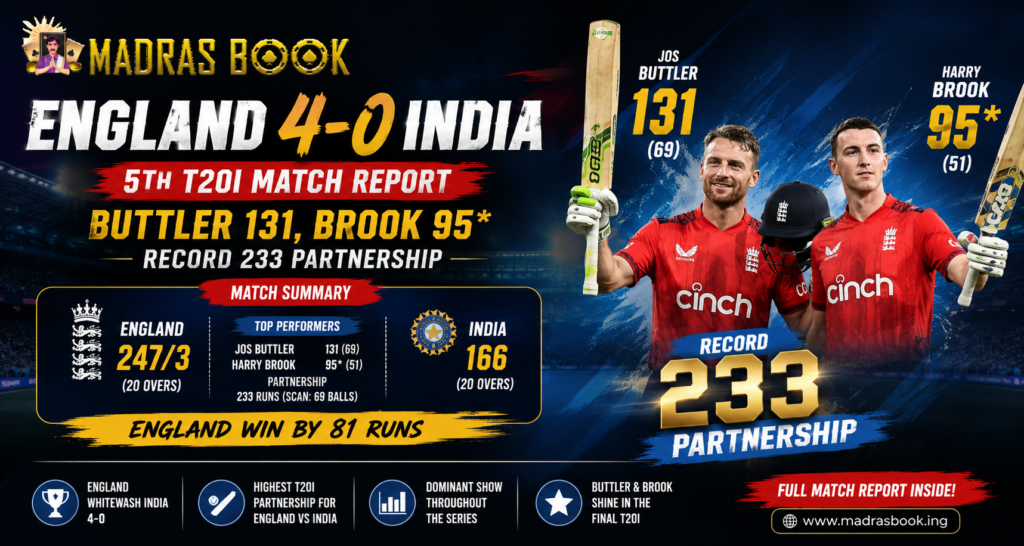
There was a moment somewhere around the 14th over when even the most committed India supporters in the Rose Bowl press box stopped making notes and just watched.
Not because there was nothing to write. Because what Jos Buttler and Harry Brook were doing together in the middle was the kind of cricket that stops the analytical part of the brain and engages something more primitive. Batting as demolition. Batting as spectacle. Batting as the specific, devastating, rhythmically perfect dismantling of a bowling attack that had no answer and knew it.
Buttler on 89. Brook on 71. England on 190-something. The asking rate for 258 already beyond India before the 16th over had been bowled.
And somewhere in that Southampton afternoon, the England 4-0 India 5th T20I series became official. Not at the toss. Not when the scorecard read 257 for 3 at the end of 20 overs. Not when Sam Curran dismissed Sanju Samson first ball. The series was decided in those middle overs when England’s captain and wicketkeeper put on the highest partnership in England T20I history — 233 runs for the second wicket — and turned what should have been a competitive five-match series into the most comprehensive T20I series victory over India that any team has produced in the last five years.
England 4-0 India 5th T20I. India losing their first five-match T20I series 4-0 (with one abandoned) since the format gained prominence. India’s T20I winless streak extended. India’s new captain Shreyas Iyer losing every completed match. England reclaiming the No. 1 spot in the ICC Men’s T20I rankings. And Buttler’s first century in any format on English soil since his Test hundred against Pakistan at this same venue in 2020.
Everything else about this tour gets processed later. This is the match report.
Match Details
| Detail | Info |
|---|---|
| Match | England vs India — 5th T20I |
| Date | Saturday, July 11, 2026 |
| Venue | The Rose Bowl, Southampton |
| Toss | India won — elected to field |
| England | 257/3 (20 overs) |
| India | 201/8 (20 overs) |
| Result | England won by 56 runs |
| Series Result | England won 4-0 (1 abandoned) |
| Player of Match | Jos Buttler — 131 off 64 |
| Player of Series | Harry Brook — 229 runs |
| Cricinfo MVP | Jos Buttler — 116.91 points |
| England T20I Ranking | New No. 1 |
Pre-Match Drama — India Stuck in Traffic
Before a ball was bowled, the story of this match had already begun. And it began badly for India.
The India team bus got stuck in traffic in Southampton on the way to the Rose Bowl. Not a five-minute delay. A significant one. Journalist Matt Roller — who had traveled from Southampton Airport Parkway station by bus, a journey of under four miles — noted it took 57 minutes for him to reach the ground by public transport. The India team, traveling in a presumably more comfortable vehicle, managed to be even later.
The toss was delayed until 7:15 PM IST. First ball pushed back to 7:30. India arriving late to a venue. Scrambling. Slightly disheveled. Coming into a dead rubber match — England already 3-0 up — with the specific chaos of a journey-gone-wrong as their pre-match preparation.
These things should not matter in professional cricket. Players are supposed to be able to switch on regardless of the commute. And against county opposition or an Associate team, the traffic problem would have been absorbed without consequence.
Against England. In Southampton. With Jos Buttler finding form he had not touched in a long time. The traffic was the least of India’s problems within approximately three overs of the match actually beginning.
India made two changes from the previous match. Sanju Samson returned to open the batting — replacing Vaibhav Sooryavanshi, who was rested but whose omission immediately generated controversy. Outlook India noted that “experts say this decision wasn’t fair and Vaibhav should have been given exposure for future matches” — a sentiment that was widely shared across Indian cricket commentary.
Suryansh Shedge — a maiden T20I appearance — replaced Washington Sundar in India’s bowling.
India won the toss. They chose to field.
England’s Innings — 257/3
Salt Departs Early. Buttler and Brook Destroy Everything.
Phil Salt lasted nine balls. Six runs. Caught by the substitute fielder Shedge off Prasidh Krishna in the second over of the match. England 8 for 1. India with the early breakthrough that had been their only consistent positive in any completed match this series.
And then.
Jos Buttler walked to the crease. Harry Brook was already there, having navigated those early overs. What followed across the next eighteen and a half overs is the most extraordinary extended batting partnership India’s T20I bowlers have faced since — well, it is hard to think of a comparison because nothing in this series or the Ireland series came close.
Brook reached his fifty in 19 balls. Buttler reached his in 27. At that point, England were somewhere around 120 and the match was already being played in a different dimension from what either team’s pre-match plans had assumed.
The specific quality of the 233-run partnership is difficult to capture in a match report because the numbers already capture it — 233 runs between the first wicket falling (8 for 1) and the second wicket falling (241 for 2), in 109 balls, at a run rate of approximately 12.8 runs per over. But the numbers do not capture the manner. The way Brook generates power without appearing to exert effort. The specific Buttler quality of looking slightly unhurried while scoring at 200-plus. The fact that India’s captain tried six different bowlers across those eighteen overs and none of them found a way to make either batter uncomfortable for more than one delivery at a time.
The dropped catch matters too. Brook was on 3 off 4 balls when Shivam Dube, running back from short third, spilled what should have been a straightforward catch. Dube running back, tracking the ball, getting his hands to it — and putting it down.
Had that catch been taken, England would have been 61 for 2 after the powerplay with India’s best bowlers still with overs to bowl. The Cricinfo forecaster had England reaching 195 at that point. Instead, Brook stayed, and England eventually finished on 257.
Prince Yadav bowled one of the worst overs of his career. England took 24 off it in a single over at a critical point of the innings. The commentary noted it matter-of-factly — “Prince Yadav just bowled one of the worst overs of his career” — which did not require elaboration because the runs scored said everything that needed to be said.
Buttler was eventually caught by Iyer off Dube in the 19th over for 131 off 64 balls — 12 fours, 8 sixes, strike rate of 204.69. It was his first century in any domestic or international format in England since a Test hundred against Pakistan at this same venue in 2020. Six years. Same ground. A century that felt, at various points in the innings, like it might go to 150 or beyond.
Brook finished unbeaten on 95 off 45 balls — 4 fours, 8 sixes, strike rate of 211. He reached his fifty in 19 balls, which is the fastest T20I fifty of his career. Had Bethell not been out first ball to give Dube his second wicket, Brook would almost certainly have reached his century. The 95 not out is the innings that India will revisit in video analysis for months — specifically, the way he used his wrists to generate power even when cramped, the specific inability of India’s seamers to find a consistent length against him.
Jacks hit the final ball for six. England finished at 257 for 3. The highest total England have posted against India in any T20I. A target of 258. In Southampton.
India’s Innings — 201/8
Samson First Ball, Iyer Falls, Kishan Fifty Not Enough
India needed 258 to win. Everyone in the ground knew what that meant. The Cricinfo forecaster — which had been tracking the match — understood that a team chasing 258 needs to score at over 12 runs per over from the first ball.
Sanju Samson opened. His return to the playing XI — replacing Sooryavanshi in a decision that generated immediate criticism — lasted one ball.
Sam Curran bowled it. Full. Nipping back. Samson’s bat came down in the wrong shape and the ball took the inside edge to short fine leg. Caught. First ball. Out for zero.
His series: 5, 0, 1, 1, 0. Seven runs in five innings. Player of the T20 World Cup final four months ago. Out for a duck off the first ball of his series recall in the final match.
Abhishek Sharma fell cheaply thereafter. India 35 for 2 after four overs and the match, while technically still alive by the mathematics of cricket, was effectively over as a contest.
Ishan Kishan at least gave India something to celebrate. His 56 — scored at a strike rate significantly above the required rate, taking on both pace and spin with the aggression that his No. 1 T20I ranking suggests is natural to him — was the brightest individual batting performance of India’s innings. Against Rashid, his strike rate was 252. Against the pace, he cleared the boundary multiple times.
But one batter scoring at 250 cannot compensate for the others collectively scoring at under 120. Kishan was always fighting a losing battle alone in an equation that required the entire batting order to operate simultaneously at maximum efficiency.
Tilak Varma added 53. Two half-centuries in a chase of 258 — in any context other than this series, that would read as a competitive effort. Here, it reads as two batters performing while the others could not match the required rate from ball one.
India reached 201 for 8 in 20 overs. A score that, in a different match, would represent a reasonable total to defend. As a chase of 258, it is a 56-run defeat.
Liam Dawson took key wickets in the middle overs. Playing at his home ground at the Rose Bowl. His left-arm spin against India’s right-handers on the turning Southampton surface — in the conditions where he has played more cricket than almost anyone in England — was the kind of bowling that is specifically difficult to counter when the asking rate is already impossible.
Adil Rashid, playing his 150th T20I, also took wickets. Another milestone delivered in a match that England had completely under control from the 14th over of their innings onward.
The Records That This Match Made
The England 4-0 India 5th T20I match produced a specific set of records that deserve to be listed clearly because they contextualise just how dominant England were.
The 233-run partnership between Buttler and Brook is England’s highest for any wicket in T20Is. Breaking the previous record of 182 between Dawid Malan and Eoin Morgan. It is also the highest second-wicket partnership in all T20Is, breaking the previous record of 210 between Sanju Samson and Tilak Varma — the same Samson and Tilak Varma who were in the India side that suffered this particular record partnership against them.
Buttler’s 131 off 64 is the highest individual score by an England batter in a T20I against India. His strike rate of 204 across that innings, maintained across 64 balls rather than in a cameo, is the specific quality that makes it technically remarkable rather than merely statistically impressive.
Brook’s 229 runs across the series as Player of the Series represents the most runs scored by any batter in a five-match T20I series against India. His specific consistency — scoring heavily in every match he batted in — was not flash. It was sustained quality.
England going to No. 1 in the ICC Men’s T20I rankings as a consequence of this series result is the most significant structural outcome of the tour. The same team that had been hovering around the top five for months and had been beaten by India at consecutive T20 World Cups is now the world’s top-ranked T20I team.
India’s winless T20I streak — which now extends to six consecutive completed matches, counting the Ireland whitewash and the England series — is the longest in the current Indian T20I setup’s history.
Shreyas Iyer — “Going to Make Me Better Going Forward”
The quotes at the end of a 4-0 series defeat are never comfortable to give or to receive. Shreyas Iyer gave them anyway with reasonable grace.
“Going to make me better going forward,” he said at the post-match presentation. The specific sentence is notable for what it does not say. It does not say the team underperformed. It does not say the conditions were unfair. It does not say anything that a captain says when they are deflecting responsibility. It accepts the learning and places it in the context of individual development.
Whether that individual development produces a different Iyer in the ODI series — which begins July 14 with Kohli and Bumrah returning — is the question that India’s management needs to answer before Edgbaston.
He also conceded that India were outplayed throughout the series. The conditions in England and Ireland were difficult. The batting lineup did not adapt. The bowling attacks were expensive when England’s senior batters found form. The fielding — the dropped Brook catch being the most costly single example — cost India specifically at the moment when a wicket would have changed the match.
BCCI secretary Jay Shah confirmed after the match that the board will review India’s “bad phase” in T20Is following the tour. That review was always coming. This match made it inevitable.
Sooryavanshi — The Dropped Player Who Became the Story
He did not play. That is the factual statement. Vaibhav Sooryavanshi was rested for the final match of India’s T20I series — the match where, at 15 years old, he could have had one more opportunity to show the form that his IPL campaign demonstrated was possible.
Instead, Sanju Samson came back and was dismissed for a duck off the first ball.
The specific criticism from experts — that Sooryavanshi should have been given the exposure of another match ahead of the Zimbabwe T20I series where he will need that experience — is impossible to dismiss. The decision to rest him in the final match of a dead rubber, while bringing back a player who was out of form throughout the series, is the decision that will generate more discussion than any other single selection call of this entire tour.
Sooryavanshi heads to Zimbabwe with two T20Is played, 26 runs scored, four sixes hit, two impressive debuts against quality fast bowling in genuine international conditions. The debate about whether he should have played more in England will follow him into that series and beyond.
Complete Scorecard
England 257/3 (20 overs)
| Batter | Runs | Balls | 4s | 6s | SR |
|---|---|---|---|---|---|
| Phil Salt | 6 | 9 | 1 | 0 | 66.7 |
| Jos Buttler (wk) | 131 | 64 | 12 | 8 | 204.7 |
| Harry Brook (c) | 95* | 45 | 4 | 8 | 211.1 |
| Jacob Bethell | 0 | 1 | 0 | 0 | 0.0 |
| Will Jacks | 7* | 2 | 0 | 1 | 350.0 |
| Extras | 18 |
India Bowling:
| Bowler | Overs | Runs | Wickets |
|---|---|---|---|
| Prasidh Krishna | 4 | 44 | 1 |
| Arshdeep Singh | 4 | 54 | 0 |
| Prince Yadav | 4 | 63 | 0 |
| Axar Patel | 4 | 48 | 0 |
| Shivam Dube | 2 | 24 | 2 |
| Suryansh Shedge | 2 | 22 | 0 |
India 201/8 (20 overs)
| Batter | Runs | Balls | 4s | 6s |
|---|---|---|---|---|
| Abhishek Sharma | 14 | 11 | 2 | 1 |
| Sanju Samson (wk) | 0 | 1 | 0 | 0 |
| Ishan Kishan | 56 | 34 | 5 | 5 |
| Shreyas Iyer (c) | 19 | 18 | 1 | 1 |
| Tilak Varma | 53 | 38 | 4 | 3 |
| Shivam Dube | 22 | 15 | 2 | 1 |
| Suryansh Shedge | 15 | 10 | 1 | 1 |
| Axar Patel | 12 | 9 | 1 | 0 |
| Arshdeep Singh | 4 | 5 | 0 | 0 |
| Prasidh Krishna | 1 | 3 | 0 | 0 |
England Bowling:
| Bowler | Overs | Runs | Wickets |
|---|---|---|---|
| Sam Curran | 4 | 36 | 3 |
| Jofra Archer | 4 | 33 | 2 |
| Adil Rashid | 4 | 34 | 2 |
| Liam Dawson | 4 | 44 | 1 |
| Josh Tongue | 2 | 26 | 0 |
| Will Jacks | 2 | 28 | 0 |
Result: England won by 56 runs Series: England won 4-0 (1st T20I abandoned)
Series Summary — England vs India T20I 2026
| Match | Venue | Result | Margin |
|---|---|---|---|
| 1st T20I | Durham | No Result | Abandoned — rain |
| 2nd T20I | Old Trafford | England won | 4 wickets |
| 3rd T20I | Trent Bridge | England won | 125 runs |
| 4th T20I | Bristol | England won | — |
| 5th T20I | Southampton | England won | 56 runs |
Series Result: England won 4-0
England wrapped up a dominant 4-0 Twenty20 series win over India with a sensational batting performance inside the fifth T20I. Jos Buttler smashed a breathtaking 131, even as Harry Brooke remained unbeaten on 95* as the duo collectively stitched a file-breaking 233 run partnership, giving Indian bowlers no solution Cricket fanatics wanting to experience every thrill in shape can sign up via MadrasBook to get stable access Cricket updates, search in shape, and revel in continuous online cricket.
What Comes Next
Virat Kohli returns on July 14. Jasprit Bumrah returns on July 14. The ODI series begins at Edgbaston. A different format, different squad, different conditions and different expectations.
The T20I series is done. Four losses from four completed matches. The debate about Iyer’s captaincy, Sooryavanshi’s selection, Samson’s form and India’s inability to adapt to English conditions will continue through the three ODIs — not because those debates are relevant to the 50-over format but because they generate the kind of discussion that travels alongside a touring cricket team regardless of the format.
What India need from the ODI series — beyond just results — is a reset of the narrative. Kohli arriving at Edgbaston on Monday and scoring 70-odd runs would do more for this tour’s legacy than any post-series review or coaching statement.
The T20Is belonged entirely to England. Monday belongs to cricket.
FAQ — England 4-0 India 5th T20I
Q1: What was the result of England vs India 5th T20I at Southampton?
England beat India by 56 runs at The Rose Bowl in Southampton on July 11, 2026. England posted 257 for 3 — Jos Buttler scoring 131 off 64 and Harry Brook 95 not out off 45. India were bowled out for 201 for 8 in reply. England won the series 4-0.
Q2: What record did Buttler and Brook set in the 5th T20I?
Jos Buttler and Harry Brook shared a 233-run partnership for the second wicket — the highest partnership for any wicket in England T20I history, breaking England’s previous record of 182. It is also the highest second-wicket partnership in all T20I cricket, breaking the previous record of 210 set by Sanju Samson and Tilak Varma.
Q3: Who was Player of the Match in the 5th T20I?
Jos Buttler was named Player of the Match for his innings of 131 off 64 balls — 12 fours and 8 sixes at a strike rate of 204. It was his first century in any format in England since a Test hundred against Pakistan at The Rose Bowl in 2020.
Q4: Who was Player of the Series in England vs India T20I 2026?
Harry Brook was named Player of the Series with 229 runs across the series — the most by any batter in a five-match T20I series against India. His scores included two consecutive unbeaten 76s at Old Trafford and Trent Bridge before the 95 not out in Southampton.
Q5: Did Sanju Samson play the 5th T20I — and what happened?
Yes — Samson returned to open the batting, replacing Vaibhav Sooryavanshi who was rested. He was dismissed for zero off the first ball he faced, caught at short fine leg off Sam Curran. His series total across five innings was 7 runs.
Q6: Are India now No. 1 in T20I rankings after the series?
No — England reclaimed the No. 1 spot in the ICC Men’s T20I rankings as a result of their 4-0 series win over India. England going top is described as comparable to “what the Test team did in 2011” when England became No. 1 in Test cricket.