
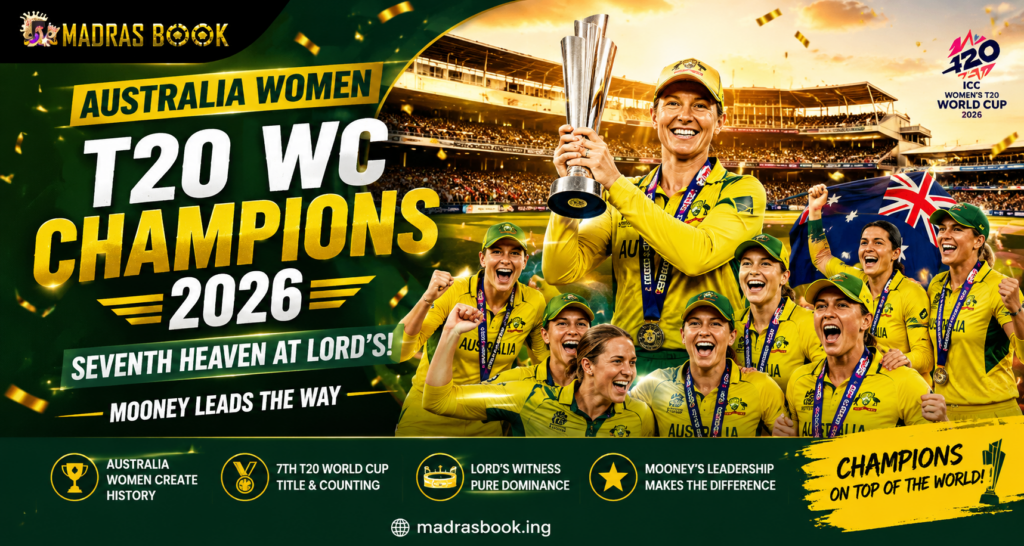
Same old Aussies. Always winning.
That phrase — typed somewhere in a cricket chat, shared immediately, gone viral within seconds — captures something true and slightly uncomfortable about what happened at Lord’s on Sunday afternoon. Australia Women T20 WC champions 2026. For the seventh time. Seven finals in the tournament’s history. Seven wins. A perfect record that has now extended across seventeen years and nine editions of the competition without a single final defeat.
England had won every home Women’s World Cup they had ever hosted — in any format, across any era. That record ended on Sunday. Lord’s, which had been buzzing with thirty thousand English fans convinced today was finally the day their team would match Australia’s dynasty, fell silent by the halfway point of the chase as Beth Mooney and Phoebe Litchfield made it look easy. Not competitive. Not close. Easy.
Australia Women T20 WC champions 2026 — defeating England by seven wickets with 17 balls to spare after bowling the hosts out for 150 from 20 overs. A target of 151. Chased in 17.1 overs. The highest successful run chase in Women’s T20 World Cup final history, completed against England at Lord’s, in England, in front of England’s most passionate home crowd. The irresistible force beat the immovable object at a canter.
Australia Women T20 WC champions 2026 — seven wins from seven across the entire tournament, the only team since this format began to go through a complete Women’s T20 World Cup campaign without dropping a single match. Coming into this final after consecutive ICC tournament exits — knocked out in the semi-finals at the 2024 T20 World Cup in UAE and at the 2025 ODI World Cup in India — they arrived in England determined to remind the world why their cabinet is overflowing with trophies.
Consider that mission accomplished. Australia Women T20 WC champions 2026. The story of how they did it belongs in a different league from simply winning a cricket match.
Match Details — The Final at a Glance
| Detail | Info |
|---|---|
| Match | ICC Women’s T20 World Cup 2026 Final |
| Date | Sunday, July 5, 2026 |
| Venue | Lord’s Cricket Ground, London |
| Toss | Australia won — elected to bowl first |
| England | 150/4 (20 overs) |
| Australia | 153/3 (17.1 overs) |
| Result | Australia won by 7 wickets (17 balls remaining) |
| Player of the Match | Beth Mooney — 64 off 49 |
| Player of the Series | Beth Mooney — 238 runs |
| Cricinfo MVP | Kim Garth — 53.01 points |
England’s Innings — Where It Went Wrong
The Batting That Was Never Quite Enough
Australia won the toss and made the decision that would shape the entire match — they chose to bowl first. On a Lord’s surface that Sophie Molineux knew offered some variable bounce and rewarded keeping the ball in the stumps, putting England in under the evening cloud cover was tactically sound. What followed was a masterclass in disciplined, varied, suffocating bowling that reduced the tournament’s most in-form batting lineup to something considerably less than their best.
The powerplay disaster:
England needed to come hard in the first six overs. Their run rate through the tournament had been built on powerplay aggression — Danni Wyatt-Hodge attacking from ball one and building the platform that the middle order converted into match-winning totals. That plan collapsed almost immediately.
Charlie Dean opened the bowling for England — an unusual decision that Australia took full advantage of. Georgia Voll dumped Dean’s first ball through long-on for four. She was then given out LBW second ball, only for the review to overturn it. The confusion in England’s bowling plan was already visible.
Annabel Sutherland took the crucial wicket that changed everything. A brush of the glove down leg from Danni Wyatt-Hodge — detected only on DRS — with Mooney making a brilliant diving take after parrying the initial chance. Wyatt-Hodge gone for just 3. The tournament’s leading run-scorer, dismissed cheaply in the final. England were 32 for 2 inside the powerplay and the suffocation had begun.
Lauren Bell delivered a wide full toss that went for five no-balls — not the start she needed. The powerplay ended with England 39 for 2. Against the final’s bowling attack in these conditions, that was already a deficit that would take exceptional batting to overcome.
The middle-overs struggle:
England could not break free through the middle. Alice Capsey briefly unsettled Australia’s poise — three boundaries helping take 16 off the ninth over — before Molineux’s clean delivery through the stumps ended her innings for 23. Heather Knight fell to a back-of-hand legcutter from Lucy Hamilton that found her edge. England were 67 for 3, then 87 for 4.
The innings needed saving. Nat Sciver-Brunt and Freya Kemp provided it.
Sciver-Brunt and Kemp — The 80-Run Stand:
Sciver-Brunt, who had been largely shackled by Australia’s disciplined lines, and Kemp, arriving at the crease when England were in trouble, combined for an unbroken 80-run partnership from 55 balls that rescued England from what could have been 120 to a genuinely competitive 150.
Sciver-Brunt finished with 58 not out off 53 balls — not the striking innings England needed her to play, but an anchor performance that at least gave Australia something to chase. Kemp’s unbeaten 44 from 28 balls — including two boundaries off the final over — provided the late acceleration that made 150 possible.
Not enough. As it turned out, not nearly enough.
The Bowling That Set Up the Chase
How Australia Strangled England’s Most Dangerous Batters
Before Mooney and Litchfield destroyed the target, it was Australia’s bowlers who won this match. They varied pace, bowled tight channels and never gave England anything to hit cleanly from ball one.
Key bowling performances:
- Kim Garth — 1 for 20 from 4 overs — Cricinfo’s MVP of the match with 53.01 impact points. Her ability to hit the hard length and extract bounce from the Lord’s surface made her the most difficult of Australia’s bowlers to get away in the powerplay.
- Lucy Hamilton — 1 for 19 from 3 overs — The most economical bowler of the innings. Hamilton’s back-of-hand slower balls consistently deceived England’s batters who were trying to accelerate. Heather Knight’s dismissal to a ball she simply could not read was Hamilton’s finest moment.
- Sophie Molineux — 1 for 32 from 4 overs — The captain bowled her four overs at the right time, taking the wicket of Alice Capsey just as the batter had started to find her rhythm. Molineux targeting the base of off stump with the turn working away from the right-hander’s outside edge was textbook captaincy bowling.
- Annabel Sutherland — 1 for 30 from 4 overs — The wicket of Wyatt-Hodge through the brilliant glove work from Mooney behind the stumps was Sutherland’s defining contribution. Taking the dangerous opener out of the equation for just 3 runs changed the entire match.
- Georgia Wareham — 0 for 24 from 3 overs — Did not take a wicket but kept England’s run rate in check through the middle overs. Her leg-spin at pace on a Lord’s surface that offered some turn made batting against her difficult even without the wicket column reflecting it.
Not often you see Nat Sciver-Brunt facing 53 balls in a T20 game and scoring only 58. Australia did not give her an inch.
Mooney and Litchfield — The Partnership That Won the World Cup
100 Runs in 67 Balls — The Defining Partnership of the Tournament
England needed early wickets. They got one — Georgia Voll’s middle stump demolished by Lauren Bell after a wild cut went wrong for 9. England had the breakthrough. Bell celebrated with the relief of a bowler who had just survived a difficult start to her over.
Then Beth Mooney walked to the crease.
What happened next was not a chase. It was a demolition. A systematic, beautiful, utterly professional dismantling of a target that had seemed competitive until Mooney and Phoebe Litchfield decided it wasn’t.
Mooney’s innings — 64 off 49:
She is already the greatest knockout batter in Women’s T20 World Cup history — averaging 72.00 in the tournament’s knockout matches. Sunday confirmed that record will not be broken any time soon.
Her innings was not constructed on violence. It was built on timing — the specific quality that makes Mooney so difficult to contain. She did not clear the boundary as often as Litchfield. She did not have the youth’s fearlessness of a player in her first World Cup final. What she had was something more valuable: the absolute clarity of a batter who has been in this situation before, who knows exactly which deliveries to attack and which to rotate, and who understands that in a chase of 151, patience at one end while the strike rotates is as valuable as hitting boundaries at the other.
Her partnership with Litchfield reached fifty in 29 balls. It reached a hundred in 67 balls — the fastest century partnership in Women’s T20 World Cup final history. The game was over as a contest when that partnership crossed fifty. It was a formality when it reached a hundred.
Litchfield’s innings — 48 off 35:
Phoebe Litchfield is 23 years old. She was playing her first T20 World Cup final on Sunday at Lord’s. And she played it as though she had been in this position a dozen times before.
Her first ball — hit straight down the ground off Lauren Bell for four. The statement was immediate: no nerves, no hesitation, no deference to the occasion. Just a batter who had decided the boundary was where the ball was going, and executed it perfectly.
She was eventually dismissed for 48 — the Australia management slightly disappointed she did not complete the fifty her innings deserved. But the 100-run partnership was done by then and the match was won. Litchfield’s contribution will not be remembered merely for the 48 runs. It will be remembered for the fearlessness that defined every one of those 35 deliveries.
The finish:
Mooney was finally dismissed for 64 — lbw to Sophie Ecclestone with the ball tracked onto leg stump, after a review upheld the decision. England had their breakthrough. Australia needed 11 from 22 balls with seven wickets in hand and Ashleigh Gardner and Ellyse Perry in the middle.
It was not a contest. Five wides off the penultimate over meant Australia did not even need to play a final ball. They won by seven wickets with 17 balls remaining.
Gardner hugged Perry — the veteran of seven Women’s T20 World Cups, the woman who was on the field when Australia confirmed their seventh title. Perry, who had been managing her quad throughout the tournament, did not bat but was present in the middle when the winning runs were completed. That image — Perry in the middle, smiling, champions again — is the one that will define this tournament.
What the Numbers Say About This Campaign
A Tournament That Redefined Australian Dominance
Australia’s unbeaten 2026 campaign:
| Match | Opposition | Result | Margin |
|---|---|---|---|
| Group 1 | South Africa | Won | 65 runs |
| Group 2 | Netherlands | Won | 98 runs |
| Group 3 | Pakistan | Won | 113 runs |
| Group 4 | Bangladesh | Won | 9 wickets |
| Group 5 | India | Won | 6 wickets |
| Semi-Final | West Indies | Won | 8 wickets |
| Final | England | Won | 7 wickets |
Seven matches. Seven wins. Every single one by a margin that left no doubt about who the better team was.
Beth Mooney — Player of the Series: 238 runs across the tournament at a tournament average that confirms her place not just as Australia’s most important batter but as the finest knockout performer in Women’s T20 World Cup history. Her three consecutive semi-century-plus scores in finals — 74 not out in 2023, 61 not out in the semi-final this year, 64 in the final — represent a consistency under the ultimate pressure that no other player in the tournament’s history has matched.
The Perfect Final Record: Australia have now played seven Women’s T20 World Cup finals. They have won all seven. Seven appearances. Seven trophies. A perfect record across seventeen years of the competition’s history that encompasses multiple captains, multiple generational transitions, multiple coaching setups — and one consistent result.
The comeback story: This Australia Women T20 WC champions 2026 story has a specific emotional weight that goes beyond the numbers. After losing in the semi-finals at the 2024 T20 World Cup in UAE and at the 2025 ODI World Cup in India — consecutive ICC tournament exits that generated genuine pressure on the squad — they arrived in England with something to prove. The seven wins, the unbeaten campaign, the seven-wicket final victory with 17 balls to spare — all of it is the answer.
England — The Gracious Losers
Home World Cup Record Ends, But Pride Remains
England arrived at this final having won all seven of their matches in the tournament. They had never lost a home Women’s World Cup. Both records ended on Sunday.
The team’s disappointment was visible and genuine. A home final at Lord’s — the most iconic ground in English cricket — with 30,000 supporters in the ground, and a result that was decided by the halfway point of the chase. That is a specific kind of loss that takes time to process.
But England had genuinely improved under head coach Charlotte Edwards. The semi-final performance against South Africa — overcoming 23 for 3 to post 169 and then defending it by 40 runs — was one of the tournament’s finest performances from any team. Sciver-Brunt’s captaincy throughout was impressive. The bowling attack — particularly Sophie Ecclestone and Lauren Bell — was the second-best of the tournament.
They were beaten by a better team on Sunday. That is the simple, uncomfortable truth. The gulf between England and Australia in Women’s T20 cricket remains real, even if it has narrowed.
Australia have 13 wins from 15 appearances in all World Cup finals — 50-over and T20 combined. That is the benchmark. England will now focus on the first-ever Women’s Test match at Lord’s — against India starting on Friday — before Australia return for the Ashes series in the summer of 2027.
Molineux collected the trophy from ICC chairman Jay Shah with tears of joy. Gardner and Alana King opened the champagne. Perry — her quad somehow surviving the occasion — was out in the middle when the final wicket fell, smiling the smile of someone who has done this seven times and still finds every single one of them extraordinary.
Complete Scorecard
England Women 150/4 (20 overs)
| Batter | Runs | Balls | 4s | 6s |
|---|---|---|---|---|
| Amy Jones (wk) | 1 | 4 | 0 | 0 |
| Danni Wyatt-Hodge | 3 | 4 | 0 | 0 |
| Nat Sciver-Brunt (c) | 58* | 53 | 5 | 1 |
| Alice Capsey | 23 | 20 | 3 | 0 |
| Heather Knight | 14 | 17 | 1 | 0 |
| Freya Kemp | 44* | 28 | 4 | 1 |
Australia Bowling: Lucy Hamilton 1/19, Kim Garth 1/20, Sophie Molineux 1/32, Lauren Bell — (ENG), Annabel Sutherland 1/30
Australia Women 153/3 (17.1 overs)
| Batter | Runs | Balls | 4s | 6s |
|---|---|---|---|---|
| Georgia Voll | 9 | 7 | 1 | 0 |
| Beth Mooney (wk) | 64 | 49 | 7 | 1 |
| Phoebe Litchfield | 48 | 35 | 6 | 1 |
| Ashleigh Gardner | 18* | 16 | 2 | 0 |
| Ellyse Perry | 13* | 12 | 1 | 0 |
England Bowling: Sophie Ecclestone 1/24, Charlie Dean 1/28, Lauren Bell 1/38
Result: Australia Women won by 7 wickets (17 balls remaining) Player of the Match: Beth Mooney (64 off 49) Player of the Series: Beth Mooney (238 runs) Cricinfo MVP: Kim Garth (53.01 impact points)
Women’s T20 World Cup 2026 — Tournament Awards
| Award | Winner | Detail |
|---|---|---|
| Player of the Final | Beth Mooney (AUS) | 64 off 49 balls |
| Player of the Series | Beth Mooney (AUS) | 238 tournament runs |
| Cricinfo MVP | Kim Garth (AUS) | 53.01 impact points |
| Highest Run Scorer | Danni Wyatt-Hodge (ENG) | 328 runs |
| Tournament Top Score | Danni Wyatt-Hodge (ENG) | 328 runs in 8 matches |
All Women’s T20 World Cup Champions — Updated
| Year | Champion | Final Opponent | Venue |
|---|---|---|---|
| 2009 | England | New Zealand | Lord’s |
| 2010 | Australia | New Zealand | Barbados |
| 2012 | Australia | England | Colombo |
| 2014 | Australia | England | Dhaka |
| 2016 | West Indies | Australia | Eden Gardens |
| 2018 | Australia | England | Antigua |
| 2020 | Australia | India | MCG |
| 2023 | Australia | South Africa | Cape Town |
| 2024 | New Zealand | South Africa | Dubai |
| 2026 | Australia | England | Lord’s |
Australia: 7 titles — the most in Women’s T20 World Cup history
Australian women set records through dominating the Women’s t20 World Cup 2026 at Lord’s, beating England in a dominant final led by Beth Mooney’s healthy winning innings as cricket fans celebrate any other unforgettable ICC event, many additionally cricket ID and so on Enjoy excitement through relying on online betting and cricket ID. With a static cricket ID, customers can get access rights to live cricket markets, real-time odds, instant deposits, early withdrawals to primary events Whether following ICC tournaments, bilateral series or T20 league, choosing a trusted cricket ID company is clean, secure and responsible for every fan Ensures on-line cricket experience
FAQ — Australia Women T20 WC Champions 2026
Q1: Who won the Women T20 WC Final 2026?
Australia Women won the Women’s T20 World Cup 2026, defeating England by 7 wickets with 17 balls to spare at Lord’s Cricket Ground in London on July 5. Australia chased 151 in 17.1 overs — the highest successful run chase in Women’s T20 World Cup final history.
Q2: What was the final score in the Women T20 WC Final 2026?
England Women posted 150 for 4 in 20 overs. Australia Women chased it down to 153 for 3 in 17.1 overs. Australia won by 7 wickets with 17 balls to spare.
Q3: Who was Player of the Match in the Women T20 WC Final 2026?
Beth Mooney was named Player of the Match for her innings of 64 off 49 balls. She was also named Player of the Series with 238 runs across the entire tournament.
Q4: How many Women’s T20 World Cup titles has Australia won?
Australia have now won 7 Women’s T20 World Cup titles — in 2010, 2012, 2014, 2018, 2020, 2023 and 2026. They have played in 7 finals and won all 7 — a perfect record.
Q5: What happened to England’s home World Cup record?
England had previously won all four Women’s World Cups — in any format — that they had hosted. That record ended on Sunday when Australia beat them at Lord’s to claim the 2026 title.
Q6: Who was Phoebe Litchfield in the Women T20 WC Final 2026?
Phoebe Litchfield scored 48 off 35 balls, sharing a 100-run second wicket partnership with Mooney in just 67 deliveries that effectively ended the match as a contest. Playing her first World Cup final at age 23, she batted with the fearlessness of a veteran.