
There are moments in sport that do not just happen. They are felt.
The Narendra Modi Stadium in Ahmedabad — the largest cricket ground on earth — held 132,000 people on the night of March 8, 2026. Every single one of them was on their feet. The scoreboard read India 255/5. New Zealand 159 all out. Margin of victory: 96 runs — the biggest in the history of a T20 World Cup final.
And in the middle of that stadium, surrounded by his players, Suryakumar Yadav lifted the ICC T20 World Cup 2026 India trophy for the first time as captain — and Indian cricket did something it had never done before in the tournament’s nineteen-year history.
ICC T20 World Cup 2026 India delivered not one, not two, but three historic firsts simultaneously. The first team to win three T20 World Cup titles. The first team to successfully defend the title. The first host nation to win the tournament on home soil. Three records. One night. One stadium. One team.
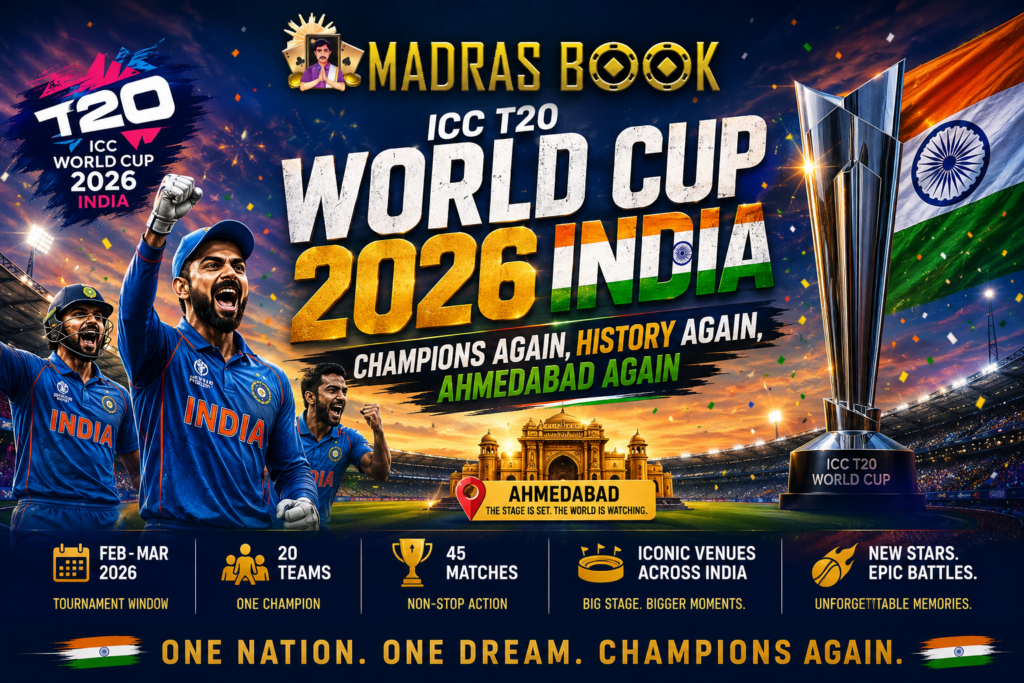
ICC T20 World Cup 2026 India was hosted across five Indian venues and three Sri Lankan venues from February 7 to March 8, 2026 — a tournament of twenty teams, 55 matches and more than 1.3 million spectators. And through all of it, India were the story — their batting, their bowling, their records, and ultimately their triumph.
ICC T20 World Cup 2026 India was also a tournament of painful transition. Rohit Sharma had retired from T20 internationals after the 2024 World Cup win. Virat Kohli had followed. Two of the greatest T20 players in India’s history were watching from commentary boxes as a new generation — Suryakumar, Samson, Abhishek, Kishan, Bumrah — wrote their own chapter.
And what a chapter ICC T20 World Cup 2026 India turned out to be.
India T20 World Cup 2024 — How It All Began in the Caribbean
The Tournament Format — How ICC T20 World Cup 2026 India Was Structured
A Tournament Bigger Than Ever Before
- Twenty teams competed in 55 matches across five venues in India — Narendra Modi Stadium in Ahmedabad, M. A. Chidambaram Stadium in Chennai, Arun Jaitley Stadium in Delhi, Eden Gardens in Kolkata and Wankhede Stadium in Mumbai — and three venues in Sri Lanka.
- The tournament ran from February 7 to March 8, 2026 — a month of cricket that gripped an entire nation and, at its peak, the entire cricketing world.
- Group stage had four groups of five teams — top two from each group advanced to the Super 8 stage, where teams were split into two groups of four, with top two from each group moving to the semi-finals.
- More than 1.3 million spectators attended matches across the eight venues — making this one of the most attended cricket events in history.
- Bangladesh’s withdrawal created a significant pre-tournament controversy — the BCB refused to play in India citing security concerns, and ICC replaced them with Scotland, the next highest-ranked T20I team.
- Italy qualified for the first time in Men’s T20 World Cup history — one of the tournament’s more charming subplots as European cricket continued to grow.
India’s Group Stage Journey — Dominant from Day One
How India Sailed Through to the Super 8
- India began with a victory over the United States at Wankhede Stadium in Mumbai — a clinical performance that set the tone for what was to follow.
- India defeated Namibia at Arun Jaitley Stadium in Delhi in their second group game — another comfortable win that confirmed India’s batting firepower was operating at a completely different level from the opposition.
- India defeated Pakistan in Colombo — the most anticipated group stage match of the entire tournament, played in Sri Lanka to ensure it could go ahead without political complications.
- India defeated Netherlands in Ahmedabad — finishing the group stage as winners of Group A with four wins from four matches.
- India hit 106 sixes across the entire tournament — the first time any team had hit over 100 maximums in a T20I event. The power-hitting wasn’t a strategy. It was an identity.
- Sanju Samson was immediately the tournament’s standout batter — accumulating runs at a strike rate that left opposition captains with nowhere to hide.
India vs Pakistan ICC T20 World Cup 2026 — Full Match Report
The Super 8 Stumble — India’s Only Loss and Why It Didn’t Matter
South Africa Ended the Win Streak. India Didn’t Panic.
- In the Super 8, India lost to South Africa in Ahmedabad — ending their record-breaking win streak of 12 matches at T20 World Cups and 17 at ICC limited-overs tournaments. It was the only match India lost in the entire tournament.
- The South Africa defeat was significant for what it tested — for the first time in this World Cup, India’s batting came under sustained pressure from a high-quality bowling attack in swinging conditions. The response told everything about this team’s character.
- India defeated Zimbabwe in Chennai in their next Super 8 match — a statement of intent after the South Africa loss. The batting clicked again. The bowlers were ruthless.
- India defeated West Indies in Kolkata — finishing as runners-up of Group 1 in the Super 8, behind South Africa on points but fully confident heading into the semi-final.
- The one loss to South Africa, in hindsight, may have been the best thing that happened to India — it forced a conversation inside the dressing room about what needed to be sharper, tighter, more clinical. They answered that conversation in the semi-final and final in the most emphatic way possible.
- Suryakumar Yadav’s captaincy throughout these matches was calm and proactive — the same attacking intent that defines his batting translated into his match management. He backed his players, trusted his plans, and never looked like a captain who doubted himself.
The Semi-Final — India vs England, Mumbai, 499 Runs, Pure Theatre
The Greatest T20 Semi-Final in History
- India vs England in the semi-final at Mumbai produced the highest match aggregate in T20 World Cup history — 499 runs. India posted 253/7. England responded with 246/7. A five-run India win that had 80,000 people at Wankhede completely breathless.
- India’s 253/7 was built on another platform of explosive batting — Abhishek Sharma set the tone at the top, Samson contributed through the middle, and the lower order cleared the boundary at will against an England attack that had been among the best in the tournament.
- England’s 246/7 in response was an extraordinary effort — Jos Buttler led their challenge with a fifty and at various points in the chase, the match could have gone either way.
- The semi-final produced 34 sixes combined — the highest number of sixes in any T20 World Cup match in history. It was batting from another era, another dimension of what T20 cricket could be.
- India’s death bowling held its nerve when it mattered — the final two overs, with England needing 22 off 12 balls, produced cricket of extraordinary tension. Bumrah bowled the penultimate over. It went for eight runs. India qualified.
- After the match, Suryakumar Yadav said something that captured the entire India campaign: the team had come to Ahmedabad to win in the same stadium where they had lost the ODI World Cup final to Australia in 2023. That goal — that specific, personal, powerful goal — drove everything.
The Final — Ahmedabad, March 8, 2026 — 255 Runs and Immortality
The Night India Became Cricket’s Greatest T20 Nation
- New Zealand won the toss and elected to field first — a decision that, in retrospect, was the last moment of the match that went in their favour.
- Sanju Samson and Abhishek Sharma put on 98 runs in the first seven overs — each scoring half-centuries, Abhishek’s arriving in just 18 balls (the fastest fifty in this tournament’s knockout games), Samson’s in 33 balls.
- India raced to 92/0 in the powerplay — the joint-highest powerplay score in T20 World Cup history, equalling West Indies’ 92/1 against Afghanistan from 2024. Matt Henry and Lockie Ferguson were carted to all parts of the Narendra Modi Stadium.
- Ishan Kishan then scored 54 off 25 balls — putting on a 105-run partnership with Samson that destroyed whatever hope New Zealand had of a competitive target.
- Samson was dismissed for 89 off 46 balls — the highest individual score in a T20 World Cup final history, surpassing Marlon Samuels and Kane Williamson’s 85s. The Narendra Modi Stadium rose as one to acknowledge it.
- Shivam Dube hit 26 runs off the final over bowled by James Neesham — taking India to 255/5, the highest total ever in a T20 World Cup final.
Bumrah Destroys New Zealand — The Chase That Never Started
Four Wickets, 15 Runs, the Greatest World Cup Bowling Spell Ever
- Jasprit Bumrah delivered a brilliant spell of 4/15 — immediately setting the tone as New Zealand’s chase began with the atmosphere of the Narendra Modi Stadium turned all the way to maximum.
- Finn Allen, Rachin Ravindra and Glenn Phillips fell cheaply in the early overs — key wickets at critical moments that made New Zealand’s task go from difficult to almost impossible within the first eight overs.
- Axar Patel played magnificently with the ball on his home ground — taking 3/27 and finishing as joint-highest wicket-taker in the tournament alongside Bumrah, with 14 wickets each.
- Tim Seifert scored a half-century in 23 balls for New Zealand — a fighting, defiant innings in a lost cause that at least gave the Kiwi fans something to cheer about on a night that belonged completely to India.
- New Zealand were bowled out for 159 in 19 overs — never at any point threatening the target. The match was effectively over as a contest by the 12th over of the chase when India had already taken six wickets.
- India won by 96 runs — the biggest margin of victory in a T20 World Cup final ever. India became the fourth team to win while batting first, and two of the other three occasions were also India, in 2007 and 2024.
The Records That Night — Numbers That Will Stand Forever
Every Milestone India Broke in Ahmedabad
- India became the first team to win three T20 World Cup titles — 2007 under Dhoni, 2024 under Rohit, 2026 under Suryakumar. Three different captains. Three different eras. One nation.
- India became the first team to successfully defend the T20 World Cup — no nation had managed consecutive titles before. This India team made it look almost routine.
- India became the first host nation to win the Men’s T20 World Cup — a feat that eluded every previous host, including India themselves when they hosted in 2016.
- 255/5 — the highest total in a T20 World Cup final, surpassing India’s own score of 176 in the 2024 final. India set records against themselves.
- India registered two 250+ scores in a row — 253/7 against England in the semi-final and 255/5 against New Zealand in the final. The first team to ever achieve this in a T20 World Cup.
- 106 sixes across the tournament — the first team to hit over 100 sixes in any T20I event. Sanju Samson alone hit 24 sixes across the campaign, the most in a single World Cup edition.
The Heroes — Who Made ICC T20 World Cup 2026 India So Special
The Players Who Wrote the Chapter
- Sanju Samson — Player of the Tournament with 321 runs including three fifties. His 89 off 46 in the final was the highest individual score in a T20 World Cup final. He spent years being the most talented cricketer in India who couldn’t hold down a permanent spot. In 2026, he was the most important batter in the world’s best T20 team.
- Jasprit Bumrah — 4/15 in the final with a 3.75 economy rate — the best bowling figures ever in a T20 World Cup final. Joint-highest wicket-taker in the tournament with 14 wickets. The best T20 bowler on the planet, performing on the biggest stage, in front of the largest cricket crowd in history.
- Abhishek Sharma — Fifty in 18 balls in the final — the fastest in this tournament and the fastest in any T20 World Cup knockout game. The left-handed opener who had been in patchy form through parts of the tournament peaked at exactly the right moment.
- Ishan Kishan — 54 off 25 balls in the final, contributing to the 105-run partnership with Samson that turned a good score into an unreachable one. His diving catch to dismiss Ravindra off Bumrah’s bowling was one of the tournament’s great fielding moments.
- Suryakumar Yadav — The captain who followed two of India’s greatest ever T20 players into the job and made it look natural. His batting contributions were solid throughout, and his captaincy — calm, decisive, always attacking — set the culture for everything India achieved.
- Axar Patel — 3/27 in the final, 14 wickets in the tournament. Bowling on his home ground in Ahmedabad in the final. The kind of symmetry that cricket occasionally produces and immediately becomes legend.
- Shivam Dube — 26 runs off the final over of India’s innings to take the total from 229 to 255. The difference between a good score and an invincible one. Asked about his train journey from Ahmedabad to Mumbai after the final, he laughed and said he was on the top berth trying to process what had just happened.
The Emotional Moment — Exorcising 2023 ODI World Cup Demons
Why This Trophy Meant More Than Any Other
The Narendra Modi Stadium in Ahmedabad was the same venue where India had lost the 2023 ODI World Cup final to Australia. That defeat — in front of a hundred thousand Indian fans, in the biggest game Indian cricket had played in years — left a wound that no amount of subsequent success fully closed.
- Suryakumar Yadav had spoken about this specifically before the final — India wanted to win the ICC T20 World Cup 2026 India trophy at the same stadium where the ODI heartbreak had happened. Not just win it somewhere in India. Win it here. In this stadium. In front of these people.
- When the final wicket fell and India had won by 96 runs, the noise from the Narendra Modi Stadium was described by everyone present as something they had never experienced in any cricket ground before.
- Rohit Sharma was in the commentary box when the trophy was lifted. The man who had captained India to the 2024 title watched his successors lift the 2026 one. He had said after announcing his T20I retirement that he hoped this was “just the start.” It was.
- “I hope this is just the start,” Rohit’s words from his retirement speech rang true across the Narendra Modi Stadium as Suryakumar raised the trophy into the Ahmedabad night.
ICC T20 World Cup 2026 India — Final Scorecard
India 255/5 (20 overs)
| Batter | Runs | Balls |
| Sanju Samson | 89 | 46 |
| Abhishek Sharma | 52 | 21 |
| Ishan Kishan | 54 | 25 |
| Shivam Dube | 26* | 8 |
| Suryakumar Yadav | 0 | 1 |
James Neesham 3/46
New Zealand 159/10 (19 overs)
| Batter | Runs | Balls |
| Tim Seifert | 52 | 23 |
Jasprit Bumrah 4/15 | Axar Patel 3/27
Result: India won by 96 runs Player of the Match: Jasprit Bumrah Player of the Tournament: Sanju Samson (321 runs)
FAQ — ICC T20 World Cup 2026 India
Q1: Did India win the ICC T20 World Cup 2026?
Yes — India won the ICC T20 World Cup 2026 by defeating New Zealand by 96 runs in the final at Narendra Modi Stadium in Ahmedabad on March 8, 2026. India posted 255/5 and bowled New Zealand out for 159 in 19 overs.
Q2: Who was Player of the Tournament in ICC T20 World Cup 2026 India?
Sanju Samson was the Player of the Tournament in ICC T20 World Cup 2026 India, scoring 321 runs across the tournament including three fifties and 24 sixes — the most in a single World Cup edition.
Q3: How many T20 World Cups has India won now?
India have won three T20 World Cups — in 2007 under MS Dhoni, in 2024 under Rohit Sharma, and in 2026 under Suryakumar Yadav. They became the first nation to win three titles and the first to defend their title successfully.
Q4: What records did India break in T20 World Cup 2026 final?
India broke multiple records in the final — highest total in a T20 WC final (255/5), highest individual score in a WC final (Samson’s 89), biggest winning margin in a WC final (96 runs), and best bowling figures in a WC final (Bumrah’s 4/15).
Q5: Who captained India in ICC T20 World Cup 2026?
Suryakumar Yadav captained India in the ICC T20 World Cup 2026, becoming the fourth Indian captain to win a major ICC event after Kapil Dev (1983), MS Dhoni (2007, 2011, 2013) and Rohit Sharma (2024, 2025).
Q6: Where was ICC T20 World Cup 2026 India hosted?
The ICC T20 World Cup 2026 was co-hosted by India and Sri Lanka. India’s venues were Narendra Modi Stadium (Ahmedabad), Wankhede Stadium (Mumbai), Eden Gardens (Kolkata), M. A. Chidambaram Stadium (Chennai) and Arun Jaitley Stadium (Delhi).