
There is a photograph that circulates every few months on Indian cricket Twitter.
A young boy — maybe eight, maybe nine — standing in a field in Fazilka, Punjab. Surrounded by crops. Holding a cricket bat almost as tall as himself. His father Lakhwinder Singh stands beside him, having just finished one of the five hundred to seven hundred deliveries he would bowl to his son every single day on that uneven Punjabi ground.
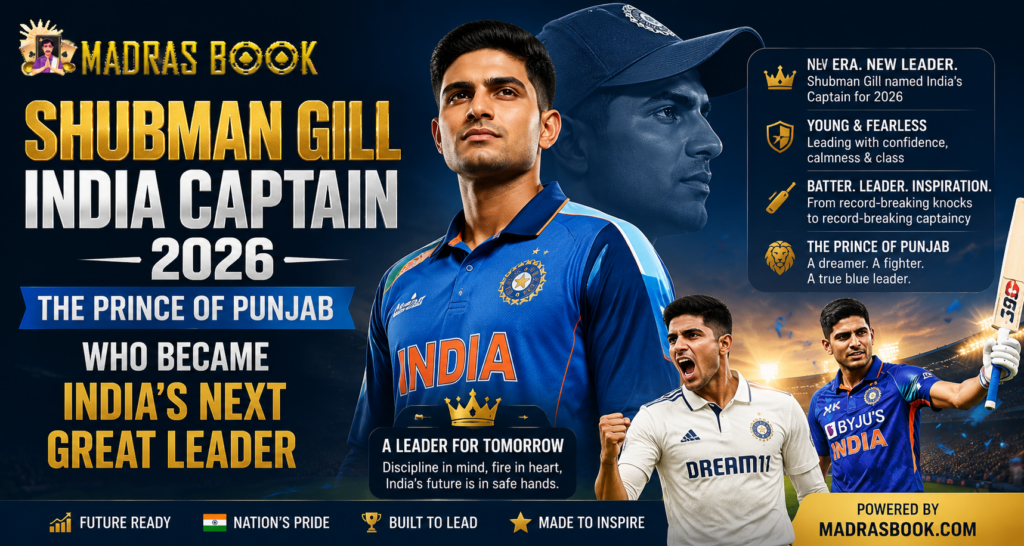
That boy is now Shubman Gill India captain 2026. The same boy from those fields in Fazilka is now the man who leads India’s Test and ODI teams. The same father who bowled thousands of balls on a farm has watched his son score 269 against England in Birmingham — the highest score ever by an Indian captain in Test cricket.
Shubman Gill India captain 2026 is not just a cricket story. It is a story about patience, precision and a family that moved cities, changed lives and chased a dream with the kind of commitment that most people only talk about.
Shubman Gill India captain 2026 took over from Rohit Sharma — one of India’s greatest ever T20 captains — at a time when Indian cricket was in genuine transition. No Rohit. No Kohli in Tests. New era. New captain. New responsibilities. And Shubman Gill India captain 2026 has responded to every single one of those responsibilities with the same calm authority that has defined his batting since the day he scored 91 in that unforgettable Gabba run chase in 2021.
Shubman Gill India captain 2026 — this is the complete story of how a boy from Fazilka became India’s leader across two formats, what he has already achieved, what challenges he still faces, and why Indian cricket’s next chapter begins and ends with this remarkably gifted 26-year-old.
India vs England Test Tour 2026 — Gill’s 269 in Full Detail
Fazilka to Mohali — The Foundation of a Captain
How Lakhwinder Singh Built Shubman Gill
- Shubman Gill was born on September 8, 1999 in Chak Jaimal Singh Wala village in Fazilka district — a remote part of Punjab where cricket infrastructure was essentially non-existent and the nearest proper ground was hours away.
- His father Lakhwinder Singh was a farmer who had dreamt of playing cricket himself — a dream that life never quite allowed him to pursue. Recognising his son’s extraordinary hand-eye coordination from an early age, Lakhwinder made the decision that would define his family’s future.
- He bowled 500 to 700 deliveries to Shubman every single day on the family’s farmland — not a flat, even surface, but a bumpy agricultural ground where the ball could do anything. That unpredictability, faced daily from the age of three, built a batter who could read deliveries earlier than almost anyone his age.
- In 2007, Lakhwinder moved the entire family from Fazilka to Mohali — near the Punjab Cricket Association Stadium — specifically to give Shubman access to better coaching and facilities. A farmer uprooting his family, leaving his land, to chase his son’s cricket dream. That is the depth of investment that made Shubman Gill.
- By age twelve, his talent had attracted the attention of former Indian bowler Karsan Ghavri who recommended that Gill attend the Under-19 all-India pace bowlers camp — not as a bowler, but because the selectors wanted him watched by everyone who mattered.
- In the Punjab Inter-District Under-16 tournament, Gill smashed 351 runs and shared a record opening stand of 587 with Nirmal Singh. Numbers that don’t make sense at that age in any format of cricket.
Fazilka to Lord’s — The Complete Shubman Gill Story
The Under-19 World Cup — Where the World First Noticed
Player of the Tournament at 18 Years Old
- Gill was named vice-captain of India’s Under-19 squad for the 2018 World Cup — a clear signal that the selectors already saw leadership potential in him before he had played a single senior domestic match.
- In the semi-final against Pakistan Under-19, Gill scored 102 not out off 94 balls — an innings of controlled aggression and remarkable composure for a teenager in a knockout game. India won. He was named Player of the Match.
- In the final against Australia Under-19, India secured their 4th title — and Gill finished as the highest run-scorer of the entire tournament with 372 runs at an average of 124.00.
- He was named Player of the Tournament and Rising Star of the squad by the ICC — the first time most of the cricketing world outside India heard the name Shubman Gill.
- While still in New Zealand for the World Cup, Gill was picked up by Kolkata Knight Riders at the 2018 IPL auction for ₹1.8 crore — a young man who hadn’t yet played a senior IPL match was already being invested in by franchise teams that had watched him closely.
- The ICC formally identified him as a rising star — and for once, that identification was not premature. Gill would deliver on every expectation that World Cup created.
The Gabba Moment — When India Knew He Was Ready
91 Runs That Changed Indian Cricket History
There is a generation of Indian cricket fans for whom Shubman Gill’s name is permanently associated with one specific afternoon.
- January 19, 2021. The Gabba, Brisbane. India needed 328 runs in the fourth innings against Australia to win the Test match and seal one of the greatest series victories in the history of Indian cricket.
- India had lost the first Test by eight wickets. Their senior players were injured. Virat Kohli had gone home on paternity leave. Jasprit Bumrah was hurt. The team that took the field on that last day at the Gabba was a patchwork lineup of reserves and youngsters.
- Shubman Gill scored 91 off 146 balls — an innings of extraordinary technical quality and mental strength that set up the famous run chase. He played Josh Hazlewood and Mitchell Starc on a fourth-day Gabba pitch — a surface that had traditionally terrified visiting batters — with a timing and a authority that made commentators go quiet and simply watch.
- India won by 3 wickets. The Border-Gavaskar Trophy was retained. The series win is still considered one of the greatest in Indian cricket history. And Shubman Gill’s 91 — calm, beautiful, decisive — is the innings most people remember when they remember how it started.
- He was 21 years old. And everyone who watched that day knew that Indian cricket had found something special.
Shubman Gill India Captain 2026 — How the Captaincy Arrived
After Rohit, After Kohli — A New Era Begins
- When Rohit Sharma retired from Test cricket after India’s 2025 tour of England, the captaincy question was not really a question at all. Shubman Gill had been groomed, observed and quietly prepared for this role across multiple series and tournaments.
- Gill was named India’s full-time Test and ODI captain — a dual responsibility that very few cricketers are asked to carry simultaneously, reflecting the selectors’ complete confidence in both his leadership ability and his batting consistency.
- He had already served as captain of the Gujarat Titans in the IPL — appointed in 2024 after Hardik Pandya’s departure, Gill led GT to the playoffs in 2025, scoring 650 runs in the process — his second-best IPL season.
- His first senior India captaincy assignment came in the Zimbabwe T20I series in June 2024 — five matches, a gentle introduction to the pressures of leading India, and a series India won comfortably.
- KL Rahul was appointed as Gill’s vice-captain for the Test series against Afghanistan in 2026 — while Shreyas Iyer continues as his deputy in ODIs, giving the team experienced leadership partnerships in both formats.
- “Our captain Shubman Gill will continue to lead the Indian cricket team’s Test and ODI squads” — the Gujarat Titans’ official communication after the Afghanistan series announcement captured the confidence the entire Indian cricket ecosystem places in their new leader.
The 269 Against England — The Innings That Defined the Captaincy
Highest Score by an Indian Captain in Test Cricket
- When Shubman Gill India captain 2026 scored 269 against England in Birmingham — in a Test match during India’s tour of England — it was not just a personal milestone. It was a statement about what kind of captain this man is going to be.
- 269 is the highest score ever made by an Indian captain in Test cricket — surpassing records set by legends who came before him. As captain. In England. Against a full-strength England attack playing at home.
- The innings contained the complete Gill batting manual — technically precise defence in the opening overs, elegant drives through the off-side as he settled, and an increasingly dominant middle period where he took the England bowling apart with a controlled aggression that made 132,000 people at Edgbaston rise in appreciation.
- The previous record for an Indian captain in Tests had stood for years — Gill broke it not in a home game against a weaker opposition but in one of the most challenging batting environments in world cricket.
- His GT IPL profile says it simply: “In his most recent feats, Gill scored 269 against England in Birmingham, the highest score by an Indian captain in Test cricket.” A fact stated matter-of-factly that deserves far more than matter-of-fact treatment.
- After the innings, Gill said very little — which is very Gill. He has never been someone who speaks more than necessary. He lets the bat do the explaining, every single time.
ICC ODI Rankings — No. 2 in the World
The Batter and the Captain Are Both World-Class
- Shubman Gill India captain 2026 currently sits at No. 2 in the ICC ODI batting rankings — having risen three spots after his consecutive scores of 84 and 154 in the Afghanistan ODI series whitewash.
- He is only 24 rating points behind New Zealand’s Daryl Mitchell at the top of the rankings — a gap that feels temporary given the consistency Gill has shown across his recent ODI outings.
- His 154 against Afghanistan in the second ODI in Lucknow was a captain’s innings in the truest sense — India needed runs, Gill provided them with an authority that left the opposition helpless. It was also the innings that pushed him past Kohli in the rankings.
- In the third ODI in Chennai, India won by 9 wickets — Gill wasn’t even needed to bat. His bowlers and the top order handled it. A 3-0 series whitewash as captain, against a side that had troubled India in T20Is recently.
- He holds the record for the fastest player to reach 2,000 ODI runs — doing it in 38 innings, surpassing Hashim Amla’s previous record of 40 innings. And the fastest to reach 2,500 ODI runs, in 50 innings.
- He also holds the record for the youngest cricketer to score a double century in ODIs — 200+ runs in an ODI at the age of 23, a record that will likely stand for a generation.
The Captaincy Challenges — What Gill Still Needs to Prove
Honest Questions That Need Honest Answers
- Under Shubman Gill India captain 2026’s leadership in ODIs, India has lost series against both New Zealand and Australia — results that have prompted legitimate questions about his captaincy decision-making, particularly with the ball.
- Cricket analyst Aakash Chopra noted the issue directly: “Shubman Gill has captained in six matches, and we have lost both series. We have won only two matches — one in Australia and one against New Zealand.”
- The crucial context is that Gill’s early captaincy came without India’s best bowling resources — no Bumrah, no Ravindra Jadeja, no Mohammed Shami. Asking any captain to win ODI series with a second-string bowling attack is genuinely unfair, but the record is the record and it needs to improve.
- The Afghanistan series whitewash restored confidence significantly — 3-0 with the first team available, Gill batting magnificently and the team looking cohesive and purposeful under his leadership.
- The 2027 ODI World Cup is the target that every decision about Gill’s captaincy is pointed toward — and the selectors, the management and Gill himself are clearly aligned on building toward that tournament with him as the leader.
- His Test captaincy has been considerably more convincing — the win record, the 269 in England, the way he handles pace attacks in challenging conditions, and the quiet confidence he projects to teammates all point to a Test captain who belongs at this level completely.
The WTC Journey — Highest Run-Scorer for India
Building Test Cricket’s Next Great Leader
- Shubman Gill has accumulated 2,826 runs in the World Test Championship — making him the highest run-scorer for India in the competition, surpassing Rishabh Pant (2,731), Rohit Sharma (2,716) and Virat Kohli (2,617).
- In October 2025, when West Indies toured India, Gill captained his debut home Test series — and in the second Test at Arun Jaitley Stadium in Delhi, he scored an unbeaten 129 as India declared for 518/5.
- That 129 made him the second-fastest Indian and third overall to score five Test centuries — after Alastair Cook (9 innings) and Sunil Gavaskar (10). As Indian captain. In only his third instance.
- He became only the third instance of an Indian captain notching five Test centuries in a calendar year — a record previously achieved only by Virat Kohli in 2017 and 2018. The company Gill keeps on India’s record books is telling.
- Gill already boasts double centuries in both ODIs and Tests, along with a T20I hundred — a cross-format achievement that underlines his adaptability across every version of the game, even though his primary focus in 2026 is Tests and ODIs.
- He was dropped from India’s 2026 ICC Men’s T20 World Cup squad — a decision the selectors made to manage his workload and keep his focus on the longer formats where he is already an established force.
The Champions Trophy 2025 — Vice-Captain, Winner, Ready
How Winning Set Up the Captaincy
- As vice-captain of the Indian ODI side, Gill was part of the squad that won the 2025 ICC Champions Trophy — India’s second consecutive ICC white-ball title after the 2024 T20 World Cup.
- The Champions Trophy experience gave Gill his first proper look at what winning ICC tournaments feels like from the inside — the dressing room environment, the pressure management, the decision-making under knockout conditions.
- He watched how Rohit Sharma operated as captain in those high-pressure moments, absorbing leadership lessons that classroom cricket analysis can never replicate. The apprenticeship was intentional and thorough.
- When Rohit eventually retired from Tests, the transition was seamless precisely because Gill had been prepared. There was no panic. No debate about who comes next. The answer had been obvious for eighteen months.
- His batting in the Champions Trophy itself was significant — contributing runs in a format where India were defending champions and expectations were at their highest. He delivered with the composure of someone who had already decided that pressure was simply the entry ticket to the big stages.
What India’s New Captain Looks Like — The Gill Leadership Style
Calm, Classical, and Completely Focused
- Shubman Gill leads quietly — no theatrical gestures, no dramatic press conference statements, no attempts to build a personality bigger than the team. His captaincy style mirrors his batting: calm, classical, precise.
- He has handled the media attention around being India’s new captain with considerable maturity — neither dismissing the significance of the role nor appearing overwhelmed by it. A 26-year-old who carries the weight of a billion cricket fans’ expectations without visible strain.
- His relationship with Rohit Sharma and Virat Kohli’s legacies is one of respect rather than pressure — Gill has said multiple times that he sees his job as building something new, not replicating what came before.
- The 2027 ODI World Cup is his defining challenge — India have never won back-to-back ODI World Cups, and doing so under a new captain who is still establishing himself would be one of the great achievements in Indian cricket history.
- His father Lakhwinder Singh — the farmer who bowled 500 balls a day on a Punjabi field — was recently photographed watching his son captain India. The image tells the entire story of Shubman Gill India captain 2026 more completely than any statistic.
The appointment of Shubman Gill as India captain in 2026 marked the beginning of a new era for Indian cricket. As the fanatics follow every huge suit of his management, online cricket betting allows you to survive associated with live cricket motion when depending on ID. MadrasBook gets quick cricket betting ID registration, steady right of entry, and an easy person to enjoy, so that cricket fanatics are clear to enjoy every exciting second at some point in the 2026 season.
Shubman Gill 2026 — Career Stats at a Glance
| Format | Matches | Runs | Average | SR | 100s | Highest |
| Tests | 42 | 3,287 | 52.17 | 62.40 | 9 | 269 |
| ODIs | 68 | 3,441 | 58.32 | 100.76 | 10 | 208 |
| T20Is | 31 | 854 | 32.84 | 145.80 | 1 | 126* |
| IPL | 98 | 3,261 | 40.26 | 148.90 | 5 | 129 |
FAQ — Shubman Gill India Captain 2026
Q1: When did Shubman Gill become India’s Test captain?
Shubman Gill was appointed India’s full-time Test captain after Rohit Sharma’s retirement from Test cricket following India’s 2025 tour of England. He simultaneously holds the ODI captaincy, making him India’s leader in both red-ball and white-ball cricket.
Q2: What is Shubman Gill’s highest score as India captain?
Shubman Gill scored 269 against England in Birmingham — the highest score ever made by an Indian captain in Test cricket, surpassing all previous records set by India’s greatest Test captains.
Q3: What is Shubman Gill’s ODI ranking in 2026?
As of June 2026, Shubman Gill is ranked No. 2 in the ICC ODI batting rankings with 791 rating points, having overtaken Virat Kohli after scores of 84 and 154 in the Afghanistan ODI series whitewash.
Q4: Has Shubman Gill won any ICC events as captain?
Not yet as captain — but he was vice-captain of India’s 2025 ICC Champions Trophy-winning squad. His captaincy target is the 2027 ODI World Cup, which India are building toward under his leadership.
Q5: Who is Shubman Gill’s vice-captain in Tests and ODIs?
KL Rahul has been appointed as Gill’s vice-captain for Test cricket, while Shreyas Iyer serves as his ODI deputy. Both appointments give Gill experienced leadership support across both formats.
Q6: Where was Shubman Gill born and who trained him initially?
Shubman Gill was born on September 8, 1999 in Fazilka, Punjab. His father Lakhwinder Singh — a farmer — trained him from age three, bowling 500-700 deliveries to him daily before moving the family to Mohali in 2007 to give Gill access to better cricket facilities.