
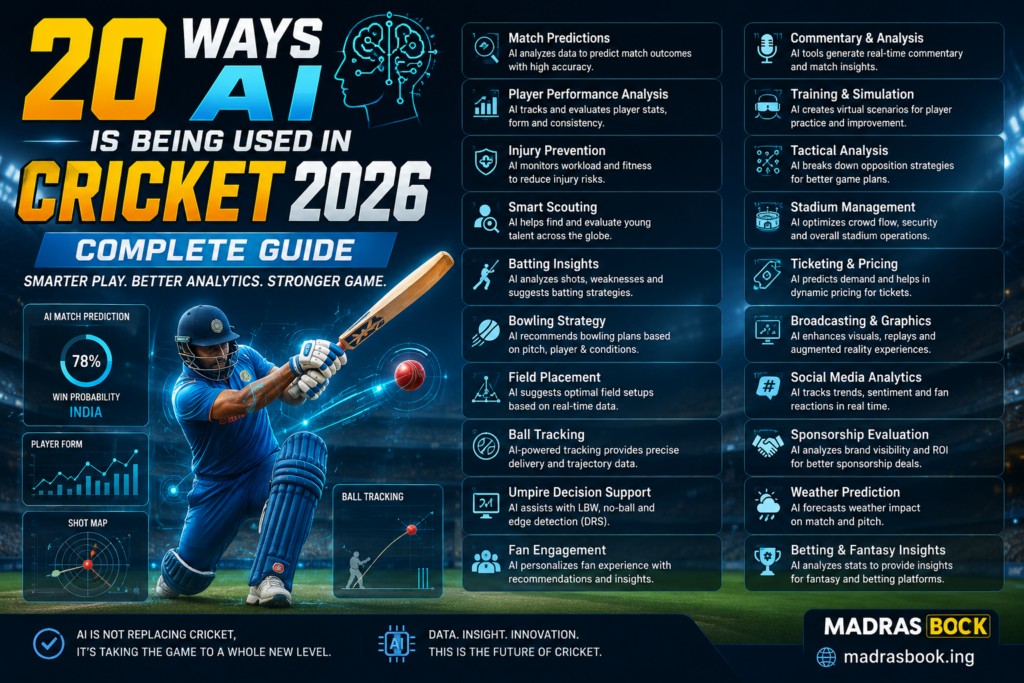
Cricket has always been a game of numbers.
Run rates. Strike rates. Economy rates. Bowling averages. Partnership values. Required run rates shifting delivery by delivery. The numerical architecture of the sport is more complex than almost any other game played at international level — which is precisely why AI use in cricket 2026 has not merely been adopted but has been absorbed into every layer of how the game is played, coached, broadcast, administered and consumed.
The AI use in cricket 2026 story accelerated dramatically in January when Google and the International Cricket Council announced their Gemini 3 Pro partnership — a deal that immediately demonstrated what modern AI can do with cricket data by identifying two batters, a bowler and a field placement from a 45-second clip in under five seconds. The AI use in cricket 2026 story continued in March when CricMind.ai launched as India’s first purpose-built AI cricket prediction platform, correctly predicting both IPL 2026 opening matches before a ball was bowled. The artificial intelligence cricket 2026 revolution has not happened at the edges of the game — it has happened at the centre. In dugouts. In broadcast studios. In BCCI offices where selector conversations now include data presentations that were impossible three years ago. In training sessions where individual player weakness profiles are generated by machines rather than estimated by coaches. Understanding AI use in cricket 2026 requires going through every dimension of the game where it has landed — all twenty of them. Here is the complete guide to AI use in cricket 2026.
1. Ball Tracking and Hawk-Eye Evolution
The original AI application in cricket is still the most visible one. Hawk-Eye — the ball-tracking technology that powers DRS — has been part of cricket since 2001. In 2026, the AI behind it is significantly more sophisticated than what existed even five years ago.
Modern AI ball-tracking systems process data from multiple high-speed cameras simultaneously, cross-referencing the data to produce trajectory predictions that are more accurate than the original Hawk-Eye model. The specific improvement that AI has delivered is in the marginal decisions — the balls pitching on off stump and hitting middle, where even a millimetre of error in the tracking model changes the umpiring decision. AI-driven ball tracking now reduces those errors to sub-millimetre precision.
The practical result: fewer DRS reviews overturned. Fewer controversies. More consistent decisions across all pitches and conditions.
2. Google Gemini + ICC Partnership — Live Match Intelligence
The biggest AI use in cricket 2026 story of the year arrived on January 30 when Google and the ICC unveiled their Gemini 3 Pro partnership.
During the demonstration, engineers uploaded a 45-second clip from a women’s T20 semifinal. Gemini 3 Pro identified both batters, the bowler and the entire field placement in under five seconds. It then annotated the leg-break delivery, marked the swing deviation and explained exactly why the googly had deceived the batter. It summarised momentum shifts using scoreboard data combined with crowd audio peaks — the specific combination of visual data, statistical data and audio data that human analysts take hours to process and that Gemini processed in seconds.
The ICC partnership promises AI-generated match insights during live broadcasts, personalised content for fans based on their viewing preferences and AI-powered accessibility tools that explain cricket’s complex rules in real time for new audiences. For a sport trying to expand beyond its traditional markets, real-time AI explanation of leg-before-wicket decisions in fifty different languages is the kind of specific capability that transforms global reach.
3. CricMind.ai — India’s First AI Cricket Platform
March 30, 2026. IPL 2026’s opening week. CricMind.ai launched as India’s first purpose-built AI cricket prediction and analytics platform — free for the entire IPL season, no registration required.
The platform’s Oracle Engine predicted both IPL 2026 opening matches correctly before the first ball of each match was bowled. Every prediction is published before the match begins and permanently logged in a public Accuracy Tracker — an unedited record of every call the engine made and every result that followed.
The platform’s features represent the most comprehensive publicly available AI use in cricket 2026: the Live Dashboard delivers real-time match intelligence as each game unfolds; the Deep Analysis module provides post-match breakdowns from the full historical dataset; the AI Terminal allows fans to ask natural language questions about any player, team or match scenario; the Argument Settler resolves cricket debates with statistical evidence; the Player Scout provides individual performance profiling across conditions and opponents; and the Match Simulator models hypothetical scenarios against real historical data.
What CricMind.ai represents is the democratisation of cricket analytics — giving every Indian fan access to the same quality of data-driven intelligence that previously only franchise analytics teams and national selectors could access.
4. AI Pitch Analysis — Predicting Surface Behaviour
Before a ball is bowled, AI systems now analyse historical pitch behaviour at each venue, cross-referenced with soil composition data, moisture levels, grass coverage measurements and local weather forecasts to predict how the surface will evolve across a match.
The specific practical value: captains deciding whether to bat or bowl at the toss now have access to AI-generated pitch projections that tell them not just what the pitch looks like on day one, but what it will look like on day three after 250 overs have been bowled on it. For Test cricket captains making that toss decision, the difference between a flat pitch and a deteriorating one — identified correctly before the match begins rather than guessed from experience — is potentially the difference between winning and losing.
India’s coaching staff used AI pitch projections throughout the England tour in 2026. The analysis of Edgbaston’s surface — which behaved differently in the ODI than in the previous Test match on the same ground — was processed by the analytics team before the match and fed into Shubman Gill’s decision to field first after winning the toss.
5. Wearable AI Sensors — Fitness Monitoring in Real Time
Every India player wears GPS tracking sensors and heart rate monitors during training sessions in 2026. But the AI use in cricket 2026 extends far beyond simply recording the data — the specific breakthrough is in what AI does with that data in real time.
AI systems analyse player movement patterns, heart rate variability, muscle fatigue indicators and bowling load metrics simultaneously, generating alerts when a player’s physical condition suggests injury risk before any symptoms appear. Jasprit Bumrah’s workload management — the specific reason he is rested from certain series and used carefully in others — is now quantified through AI-generated load monitoring rather than estimated through coach experience alone.
The wearable data feeds directly into selection decisions. When Bumrah’s knee injury at Cardiff was assessed at the BCCI Centre of Excellence, the AI load monitoring data from the previous six months of his bowling — every delivery, every training session, every innings — was part of the medical picture that informed the rehabilitation timeline.
6. AI Batting and Bowling Coaches — Personalised Training
The traditional coaching model — a batting coach watching a player in the nets and identifying weaknesses — has been supplemented in 2026 by AI systems that process high-speed camera footage of every delivery faced in training and generate individualised weakness profiles.
For a batter like Vaibhav Sooryavanshi, the AI coaching system identified that he is specifically vulnerable to balls angled into his body from around the wicket by left-arm pace bowlers — a pattern that appeared in the IPL data before anyone had consciously noticed it. The training programme designed in response to that specific vulnerability contributed to his improvements against that delivery type across the Zimbabwe series.
For bowlers, AI systems analyse biomechanical efficiency — identifying whether a specific delivery action is generating unnecessary stress on a joint, whether the follow-through is creating injury risk, whether the release point is consistent across delivery types. This is the specific application that has transformed fast bowling development at the NCA.
7. AI-Powered DRS — The Automation Debate
The Decision Review System in 2026 uses AI-enhanced ball tracking, but the debate about full AI umpiring — removing human third umpires from the review process — has been one of the most discussed AI use in cricket 2026 topics among administrators.
The specific argument for full AI umpiring: AI decisions are faster (under two seconds versus the current average of 34 seconds for a DRS review), more consistent across venues and conditions, and free from the specific biases that human umpires inevitably carry across a long match.
The specific argument against: cricket’s human element — the front-line umpire’s authority, the theatre of a review, the accountability of a human decision — is part of the sport’s culture in a way that complete automation would permanently alter.
The ICC has committed to increasing AI’s role in reviews without removing human umpires from the process. Full AI umpiring for major ICC events before the 2028 T20 World Cup is considered unlikely — but not impossible.
8. AI Match Prediction Engines
The Oracle Engine inside CricMind.ai is the most prominent example of AI match prediction in Indian cricket, but it is not alone. Multiple AI systems — AllCric, various fantasy cricket platforms, the ICC’s own internal analytics tools — now generate match outcome probabilities before the first ball.
The specific capability: win probability updated ball by ball during a match, factoring in not just the score and wickets but the specific matchups between the batter at the crease and the bowler with the ball, the field settings, the conditions, the historical performance of each player at this venue and the time of day.
During India’s first ODI against England at Edgbaston, the live forecaster had India’s win probability at 88% when Gill was batting on 74 and Iyer was on 33. The final result confirmed the prediction. These systems are not always right — cricket’s unpredictability is irreducible — but they are right often enough to have become a standard part of how broadcasters, fans and even coaches process a match in real time.
9. Automated Highlights Generation
One of the most practically impactful AI use in cricket 2026 developments has happened in broadcasting — not in the analytics room.
AI systems now generate automated 60-second highlight packages from any cricket match worldwide within minutes of the final delivery being bowled. The AI identifies the significant moments — wickets, boundaries, close fielding, exceptional catches — by analysing ball tracking data, crowd audio peaks and broadcaster camera cuts simultaneously, then sequences them into a coherent narrative highlight package without human editorial input.
For fans in non-traditional cricket markets — the United States, Europe, parts of Africa — this means cricket highlights are available in their preferred format and language within minutes of any match ending. The ICC’s stated goal of reaching a billion new cricket fans by 2030 is directly served by AI-generated highlights that require no broadcaster relationship or live streaming access.
10. AI Fantasy Cricket Assistants
The fantasy cricket industry in India is worth billions of rupees annually — and AI has transformed how serious fantasy players approach team selection.
AllCric — the AI fantasy cricket assistant launched ahead of IPL 2026 — provides pre-match AI team recommendations based on pitch conditions, weather, head-to-head records, venue statistics and recent form, processed simultaneously in a way that no human analyst can replicate manually before a team deadline.
The specific value: AI fantasy recommendations account for matchup data that casual fans rarely process — which specific bowler has dismissed this batter three times in the last four encounters at this venue, which captain tends to bowl their best spinner in the powerplay at grounds with large outfields. This granular matchup analysis, processed automatically, gives AI-assisted fantasy teams a measurable statistical edge over teams selected on reputation alone.
11. AI Opponent Analysis — Bowler vs Batter Matchups
Every major international team’s analytics department uses AI to generate opponent profiles before a series. The specific application: every delivery a batter has faced over the last three years, categorised by line, length, pace, seam movement and swing, analysed to identify the specific delivery type they struggle with.
Before England’s T20I series against India in 2026, England’s analytics team identified that Abhishek Sharma — India’s World No. 2 T20I batter — has a specific weakness against the ball angling into his body at over 140 km/h from a right-arm bowler. Sam Curran and Jofra Archer exploited that weakness across the series. Abhishek was dismissed multiple times through the channel that AI had pre-identified as his vulnerability.
This is not a new concept — opposition analysis has existed in cricket for decades. What AI has done is make the analysis comprehensive rather than selective, processing every ball rather than the balls that a human analyst remembered to note.
12. Smart Stadium Management
Edgbaston, Lord’s and the Wankhede Stadium in Mumbai have all introduced AI-powered smart stadium management systems in 2026. The applications range from crowd flow analysis — AI cameras identifying congestion points before they become safety issues — to dynamic pricing for food and merchandise based on crowd density at specific points in the ground.
More significantly for the cricket itself: smart stadium AI systems now process pitch camera data continuously during play, providing real-time surface condition updates to both coaching teams via their dugout tablets. The specific information — how the pitch is playing compared to how AI expected it to play based on the pre-match analysis — is updated after every over.
13. AI Injury Prediction and Prevention
The relationship between bowling workload and injury risk in fast bowlers is the best-documented injury pattern in cricket — but translating workload data into specific injury risk assessments for individual players has historically been more art than science.
AI injury prediction systems in 2026 process bowling load data from wearable sensors, historical injury patterns for each player, biomechanical data from high-speed cameras and recovery metrics from sleep monitoring to generate daily injury risk scores. A fast bowler whose risk score exceeds a certain threshold is flagged for reduced workload that day — not because a coach has noticed something wrong but because the AI has detected a pattern in the data before symptoms appear.
14. AI-Powered Broadcasting — Real-Time Insights
Sony Sports’ coverage of India’s England tour in 2026 used AI-generated real-time insights throughout each broadcast — on-screen graphics showing ball-tracking data, batter wagon wheels updating after every shot, bowler heat maps showing length distribution, win probability lines moving with each delivery.
The specific development from previous years: AI now generates natural language commentary suggestions — actual sentences describing what has happened — that human commentators can choose to use, ignore or adapt. The AI suggestion for Buttler’s century at Southampton (“this is now England’s highest T20I partnership for any wicket — 233 runs, the record that previously belonged to Malan and Morgan”) appeared on a commentator’s tablet within 0.4 seconds of the 200-run mark being passed.
15. AI Umpire Support Systems — Not Replacement
Short of full AI umpiring, the 2026 implementation that has generated the most on-field discussion is the AI umpire support system — a technology that provides front-line umpires with a real-time earpiece notification when ball-tracking data suggests a caught-behind edge that the umpire may not have heard.
The system does not give an out decision. It flags a potential edge. The umpire retains full authority over the decision. But in a 90-over day of Test cricket where an umpire may be standing for six hours, the AI support reduces the specific human fatigue factor that contributes to missed edges in the final session.
16. AI-Generated Scorecards and Statistics
Cricinfo’s scorecard generation in 2026 is entirely AI-driven — player statistics, partnership analyses, wagon wheels, pitch maps and bowling economy analyses are all generated and published in real time without any human editorial input.
The specific speed improvement: full scorecard and statistics package available within 90 seconds of the final ball of any international match, regardless of the time zone in which it is played.
17. AI in Player Recruitment — IPL Auctions
IPL franchise analytics teams used AI scouting models extensively in their 2026 auction preparation. The specific application: processing first-class and List A statistics from every domestic cricket competition worldwide to identify players whose performance metrics — when adjusted for opposition quality, ground dimensions and conditions — suggest international potential that the raw numbers alone might not reveal.
Gurnoor Brar’s emergence as a genuine international bowling option — his double strike at Edgbaston in India’s first ODI against England was one of the most impactful bowling moments of India’s entire England tour — was partly identified through this kind of AI-assisted domestic performance analysis before his IPL franchise invested in him.
18. AI Translation and Accessibility
The ICC’s partnership with Google has produced an immediate accessibility dividend: AI-generated real-time translation of cricket commentary into 57 languages, plus AI-generated visual descriptions of match action for visually impaired fans.
The specific numbers: cricket commentary translated in real time into 57 languages — including multiple African languages where cricket is developing — represents the most significant expansion of cricket’s potential audience since the sport was first broadcast on television.
19. AI-Powered Fan Engagement Platforms
Platforms like CricMind.ai’s Argument Settler represent the specific application of AI to Indian cricket culture’s most distinctive feature: the argument. Cricket fans in India argue about everything — whether Dhoni was the greatest captain, whether Kohli or Tendulkar is the better batter, whether the DRS decision that dismissed Rohit was correct. The Argument Settler uses the platform’s full historical dataset to generate statistical evidence for or against any cricket proposition.
The results are not always what either side of the argument wants — which is precisely why they tend to be trusted.
20. AI Match Simulation — What-If Cricket
CricMind.ai’s Match Simulator and similar tools across multiple platforms now allow fans and coaches to model hypothetical cricket scenarios against real historical data.
What would have happened if India had not dropped the Dube catch off Root in the first ODI at Edgbaston? AI simulation suggests England would have been bowled out for 189 rather than 258 — and India’s chase would have been completed with fifteen overs to spare rather than four. The simulation does not know what would have happened. It calculates what historically tends to happen when those specific conditions occur — and gives cricket a new category of analysis that was entirely unavailable five years ago.
Trusted Online Cricket ID for a Better Cricket Experience in 2026
Whether you are new to online cricket platforms or have been using them for years, choosing a trusted Online Cricket ID provider makes a real difference. Madrasbook offers a simple registration process, quick account activation, secure payment methods, and responsive customer support. Your account remains easy to manage on both mobile and desktop, allowing you to enjoy a smooth and reliable experience. Before creating an Online Cricket ID, always verify that the provider is genuine, follows secure practices, and offers transparent customer assistance.
The Future — Where AI in Cricket Goes Next
The twenty applications above represent what AI use in cricket 2026 looks like today. What it looks like in 2028 — by the time the T20 World Cup in Bangladesh arrives — will likely include full AI umpiring for at least one format, predictive pitch preparation that uses AI soil analysis to prepare surfaces with specific characteristics on demand, and AI coaching systems so sophisticated that the line between the AI’s recommendation and the coach’s decision becomes genuinely difficult to draw.
Cricket’s resistance to change is part of its character. The sport that preserved timeless Tests into the 1960s and resisted coloured clothing into the 1980s does not adopt technology quickly. But when it adopts it, it tends to adopt it completely. AI in cricket is at that inflection point in 2026. The game will not look the same in ten years.
Summary Table — 20 AI Uses in Cricket 2026
| s.no | Application | Real-World Example |
|---|---|---|
| 1 | Ball tracking + Hawk-Eye | Sub-millimetre DRS accuracy |
| 2 | Google Gemini + ICC | 5-second player + field identification |
| 3 | CricMind.ai platform | Oracle Engine — IPL match prediction |
| 4 | AI pitch analysis | Pre-match surface evolution prediction |
| 5 | Wearable sensors | Bumrah load monitoring + injury prevention |
| 6 | AI batting/bowling coaches | Sooryavanshi vulnerability profiling |
| 7 | AI-powered DRS | Faster, more consistent review decisions |
| 8 | AI match prediction | Win probability ball by ball |
| 9 | Automated highlights | 60-second packages — any match worldwide |
| 10 | AI fantasy cricket | AllCric matchup-based team recommendations |
| 11 | Opponent analysis | Abhishek Sharma weakness — England exploited |
| 12 | Smart stadiums | Edgbaston crowd flow + pitch condition AI |
| 13 | Injury prediction | Daily risk scores — prevent before symptoms |
| 14 | AI broadcasting | Real-time natural language commentary support |
| 15 | Umpire support systems | Edge detection alert — umpire retains authority |
| 16 | AI scorecards | 90-second full stats post any match |
| 17 | Player recruitment | IPL AI scouting — Gurnoor Brar identified |
| 18 | AI translation | 57 languages — ICC + Google partnership |
| 19 | Fan engagement | Argument Settler — statistical debate resolution |
| 20 | Match simulation | What-if cricket — historical data modelling |
FAQ — AI Use in Cricket 2026
Q1: How is AI being used in cricket in 2026?
AI is being used across every dimension of cricket in 2026 — from ball tracking and DRS to player recruitment, injury prevention, pitch analysis, broadcasting, fan engagement and match prediction. The most significant development is the Google-ICC Gemini 3 Pro partnership announced in January 2026, which delivers real-time match intelligence and player identification from live footage.
Q2: What is CricMind.ai and how does it work?
CricMind.ai is India’s first purpose-built AI cricket prediction and analytics platform, launched during IPL 2026. Its Oracle Engine predicts match outcomes before the first ball and logs every prediction publicly. Features include a Live Dashboard, Deep Analysis module, AI Terminal for natural language questions, Argument Settler, Player Scout and Match Simulator. It was free for the entire IPL 2026 season without registration.
Q3: What did Google and ICC announce for AI in cricket?
Google and the ICC announced a partnership using Gemini 3 Pro — Google’s multimodal AI model — to deliver real-time match intelligence during ICC events. In the January 30, 2026 demonstration, Gemini identified players, field placement and delivery type from a 45-second clip in under five seconds and explained why a googly had deceived the batter using ball-tracking data combined with crowd audio analysis.
Q4: Will AI replace human umpires in cricket?
Not immediately. In 2026, AI supports human umpires through enhanced ball tracking, DRS technology and edge detection alerts rather than replacing them. The ICC has committed to increasing AI’s role in reviews while retaining human umpires. Full AI umpiring for major ICC events before the 2028 T20 World Cup is considered unlikely, though the technology already exists to deliver decisions faster and more consistently than human review panels.