
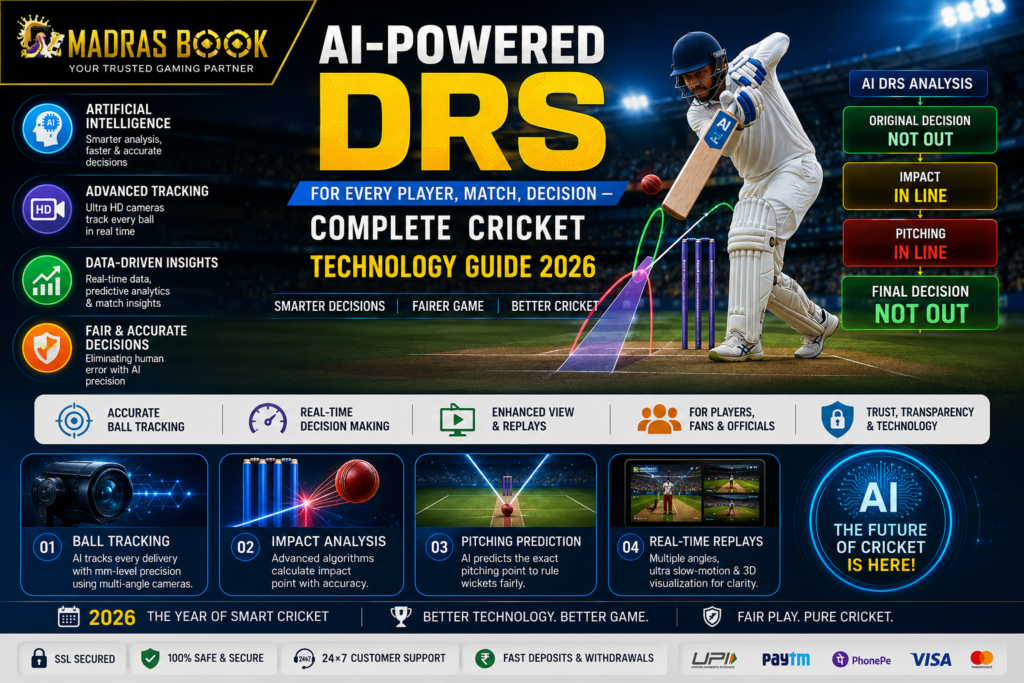
The DRS review that changed the way you think about cricket did not happen in a Test match at Lord’s.
It happened in Darwin, Australia. In a women’s grade cricket competition. On a ground where there is no television broadcast, no third umpire, no Hawk-Eye van parked outside and no multi-million dollar technology contract. A batter was given out LBW. She picked up her phone, pressed review. A single camera mounted on a tripod at the bowler’s end had recorded every frame of the delivery. The AI-powered DRS cricket 2026 system — trained on one million deliveries, using 2D ball detection combined with physics-based 3D trajectory reconstruction — produced its verdict in seconds. The ball was missing leg stump. Not out. The AI powered DRS cricket system had done what the umpire could not quite manage from 22 yards: traced the exact path of the ball from release to the point of impact on the pad to where it would have gone next. The specific moment that AI powered DRS cricket 2026 went from elite technology to democratic reality happened not at a World Cup but at a Darwin women’s grade match in April 2026 — and what it signals about where cricket’s technology is going is more significant than anything that happened in any international stadium this year. AI powered DRS cricket is no longer the exclusive property of billion-dollar broadcasting ecosystems. It is available on a phone. For $9.99 a month. For two million cricketers who use Fulltrack AI. For a women’s grade competition in the Northern Territory that decided to be the first in Australia to run AI reviews at community level. AI powered DRS cricket 2026 exists at every level of the game simultaneously — the Hawk-Eye system processing 340 frames per second at international venues, and a single tripod-mounted camera tracking the same physics in Darwin. This is the complete story of AI-powered DRS cricket 2026 — from Hawk-Eye’s IPL 2026 integration to Fulltrack AI’s Darwin experiment, from CSK’s real-time batter simulations to the $9.99 individual plan that gives amateur cricketers access to ball-tracking data that Joe Root himself uses for training.
Part 1 — What AI-Powered DRS Actually Is
From Manual to Millimetre
The original Decision Review System existed before AI. Ball tracking, edge detection, trajectory prediction — the original Hawk-Eye model from 2001 used cameras and basic computer vision to produce ball-path projections. It was sophisticated for its time. By 2026 standards, it was an early draft.
What AI has done to DRS is what it has done to every other data-intensive system it has touched — it has made the analysis faster, more accurate and more comprehensive simultaneously.
The specific technical architecture of AI powered DRS cricket 2026 at international level involves three distinct AI systems working simultaneously:
Ball tracking AI: Hawk-Eye uses six to eight high-speed cameras positioned around the ground, capturing 340 frames per second. AI processes this multi-camera footage simultaneously to triangulate the ball’s 3D position at every point of its trajectory — from the bowler’s hand to the batter’s pad to the stumps. The result: sub-millimetre accuracy on LBW decisions that previously required educated guesswork in the millimetre range.
Edge detection AI (UltraEdge): Hot Spot thermal imaging combined with UltraEdge audio processing uses machine learning to detect bat-ball contacts that generate sounds below the threshold of human hearing. AI identifies the specific acoustic and thermal signatures of a genuine edge — distinguishing it from the noise of bat hitting pad, boot hitting ground or ball hitting glove — in milliseconds.
Trajectory prediction AI: The most technically complex component. Given the ball’s tracked position at the point it hit the pad, AI calculates — from the ball’s speed, seam position, pitch landing point and surface conditions — the probability that it would have gone on to hit the stumps. The AI model is trained on historical data from every similar delivery across multiple seasons, making its predictions increasingly accurate as the dataset grows.
In 2026, the combination of these three systems resolves LBW decisions in under 30 seconds — using ball-tracking, acoustic and thermal data simultaneously. The average DRS review in Tests takes 34 seconds from the captain’s signal to the decision appearing on the broadcast. The AI computation itself takes under two seconds. The rest is production time.
Part 2 — IPL 2026 — AI DRS in the Franchise Era
CSK Real-Time Simulations. MI 30% Better at the Death.
The IPL is where AI powered DRS cricket 2026 has gone furthest beyond the review system itself — into the dugout, into the pre-match preparation room, into the second-by-second tactical decisions that captains and coaches make during matches.
Mumbai Indians improved their death-over wicket yield by nearly 30% in IPL 2026 using AI-driven bowling rotation models. The specific application: before each match, MI’s data science team feeds the opposition batting order into an AI model trained on every delivery bowled to every current IPL batter across multiple seasons. The model identifies — for each specific batter — the delivery type, length and line that has dismissed them most frequently, the delivery they hit for boundaries most reliably, and the specific weakness that the model’s pattern analysis identifies as currently exploitable.
The bowling captain uses this information to make over-by-over decisions that are informed by data no human analyst could process manually in the time available between deliveries.
Chennai Super Kings run real-time mid-match simulations on every batter they face. As a batter walks to the crease, the CSK analytics team generates a fresh delivery vulnerability profile — updated based on that batter’s performance in the previous week’s matches rather than on historical data alone. The profile identifies specific delivery patterns within overs: which ball in a CSK bowling spell this batter has consistently attacked, which ball they have consistently defended, and which ball has taken their wicket most frequently across similar conditions.
The IPL 2026 auction was decided as much by AI data models as by human scouts. Cameron Green went for Rs 25.20 crore. The AI models that drove that valuation — processing his boundary percentage versus spinners in the powerplay, his bowling economy against left-handers across different pitch types, his fitness trend scores from the previous season — produced a specific number that justified the price in terms of expected value rather than reputation alone.
Every IPL franchise in 2026 runs a dedicated data science cell. AI is not a pilot project in the IPL. As the NeenOpal analysis of the 2026 season concluded: it is the operating system.
Part 3 — Fulltrack AI — The $9.99 Revolution
Darwin, Australia. One Camera. One Million Deliveries.
The most significant AI powered DRS cricket 2026 story of the year did not happen in Chennai or Mumbai. It happened in Darwin.
Darwin’s premier women’s cricket competition — the DDCC (Darwin District Cricket Council) Women’s Division 1 — became the first grade-level competition in Australia to introduce an AI-based umpire review system in April 2026. The technology is Fulltrack AI. The CEO is Arjun Verma — an Indian-origin entrepreneur who began the company’s journey five years ago when Harvard and MIT cricket club captains in Cambridge, Massachusetts started discussing whether they could build a phone-based DRS for university matches.
The Darwin system works like this. One phone on a tripod at the bowler’s end. Pointed at the pitch. Left alone. Fulltrack AI’s machine learning model — trained on approximately one million recorded deliveries — automatically detects every ball bowled, records it and generates ball trajectory data in real time. When a batter wants to review an LBW decision, the AI reconstructs a 3D ball path from the 2D camera footage using physics-based modelling, calculating where the ball pitched, where it struck the pad and where it would have gone.
The result appears on the umpire’s device. The umpire reviews it and makes the final call.
Two challenges per innings for each team. The same structure as the international DRS. On a grade cricket ground in Darwin.
The specific accuracy figure: Fulltrack AI aligns with on-field umpire decisions approximately 85% of the time. Not perfect — the multi-camera Hawk-Eye systems used in international cricket are more precise. But 85% alignment at a fraction of the cost is the specific trade-off that makes democratised AI DRS viable. As the iTWire analysis of the Darwin trial observed: AI systems do not need to be flawless to be transformative. They need to be reliable enough to reduce friction, cost and dispute. At grassroots level, that friction is human — arguments over decisions, perceived bias and the shortage of willing umpires.
PINT captain Amy Yates said the review system “adds fairness in a format where players get limited opportunities.” Coach Will Glover highlighted “the value of the data insights for player development” — noting that the ball-tracking data generated by Fulltrack AI during matches gives players a level of performance analytics that was previously only available if a club could afford specialist coaching sessions.
NT Cricket officials added that the trial aims to reduce disputes in self-umpired matches and encourage more people to take up officiating roles — the specific umpire shortage that affects club cricket globally is partly addressed by a system that makes every umpiring decision reviewable without requiring a second human at each match.
Arjun Verma told ABC: “We are thrilled to partner with the DDCC to bring our ball-tracking technology to the community level. Darwin’s unique winter cricket window makes it the ideal environment to showcase how AI can assist officials and players in real time.”
The 2026 Darwin trial was rolled out in two phases — beginning with Women’s Division 1 matches under accredited umpires before expanding to additional grades. The technology works. The expansion is coming.
Part 4 — Fulltrack AI — The Platform Every Cricketer Can Access
$9.99 a Month. 2 Million Users. Joe Root Uses It.
Fulltrack AI is not just a DRS system for grade cricket competitions. It is a personal cricket analytics platform available to any cricketer with a smartphone.
The setup is genuinely simple: one phone placed on a tripod, pointed at the sporting environment, left alone. Fulltrack AI’s machine learning model automatically detects play-by-play action, records every delivery and generates analytics — ball speed, swing measurements, spin rate, pitch maps and play-by-play video — without any human operation.
The data is stored in the cloud and available on other devices — for other players, coaches or family members to review. A player batting in the nets can have their entire session tracked, charted and analysed before they have finished their cool-down.
Pricing: $9.99 per month for individual plans (300 deliveries). The professional-level Coach Plus plan at $149 per month provides unlimited deliveries and full pitch map access.
Users: 2 million-plus cricketers globally. Users include Joe Root, Jake Fraser-McGurk and Cricket South Africa — the range from England’s most technically precise Test batter to one of the most explosive stroke-makers in international cricket to an entire national cricket board suggesting that Fulltrack AI has found the specific quality that makes technology adoption universal: it works for every level of the game simultaneously.
The specific value for an Indian club cricketer: ball speed data that tells you whether your bowling genuinely reaches 130 km/h or whether you have been overestimating by ten. Pitch maps that show every delivery you have bowled in a training session — lengths, lines, where the ball landed. Swing data that confirms whether you are actually generating movement or whether the ball is going straight. All of this from one phone, costing less per month than a good cricket ball.
Part 5 — The International Stage — Hawk-Eye 2026
340 Frames Per Second. Sub-Millimetre Accuracy.
At the international level, the AI powered DRS cricket 2026 system that processes Hawk-Eye footage is the most sophisticated sports technology deployed in any stadium setting globally.
Six to eight cameras. 340 frames per second. Every camera angle cross-referenced simultaneously by AI to produce a ball trajectory that is accurate to sub-millimetre precision at every point of its path. The thermal data from Hot Spot. The acoustic data from UltraEdge. All three data streams processed together by machine learning models that have been trained on thousands of hours of international cricket footage.
The specific practical improvement that AI has delivered over the previous generation of Hawk-Eye: the marginal LBW decisions — the balls that pitch on the edge of off stump and would clip the top of middle, where the difference between out and not out is the trajectory over a distance of two to three metres — are now resolved with a confidence level that was impossible when the original ball-tracking models were processing lower frame rate footage with simpler algorithms.
The ICC’s stated target for DRS accuracy: 98% across all LBW decisions. Based on post-match analysis of overturned third-umpire decisions across IPL 2026 and international cricket, the current AI-enhanced system is operating at approximately 96-97% — close to but not yet at target.
Part 6 — The Debate — Will AI Replace Human Umpires Entirely?
The Arguments, Honestly Assessed
The specific question that every AI DRS conversation eventually arrives at: if AI can make the decision faster, more accurately and more consistently than any human — why is a human still making the final call?
The arguments for full AI umpiring are real. AI decisions under two seconds versus 34-second review averages. Consistency across all venues, all conditions, all stages of a match — eliminating the specific human fatigue factor that contributes to missed edges in the final session of a Test day. No bias toward either team. No career pressure affecting marginal decisions.
The arguments against are also real. The theatre of a DRS review — the captain’s signal, the replays, the crowd reaction, the third umpire’s deliberation — is part of cricket’s entertainment in a way that a 1.8-second automated decision is not. The human umpire’s authority is a cultural institution in cricket across 150 years of the sport. The specific accountability that comes from a named individual making a decision — rather than an algorithm — is something that cricket’s culture values in ways that are difficult to quantify but easy to observe.
The ICC’s current position: AI enhances human umpires rather than replacing them. Full AI umpiring for major ICC events before the 2028 T20 World Cup in Bangladesh is considered unlikely. What is coming — gradually, in stages — is more AI and less human involvement in each step of the review process.
The Darwin model suggests a different timeline for club cricket. Where there are not enough umpires, AI fills the gap. Where decisions are disputed in self-umpired matches, AI provides an appeal mechanism. Full AI umpiring at club level — where human umpiring is already scarce — may arrive well before it arrives at Test level.
Complete Technology Comparison — DRS Levels 2026
| Level | Technology | Cameras | Accuracy | Cost |
|---|---|---|---|---|
| International (Hawk-Eye) | Full AI DRS — 6-8 cameras, 340fps, thermal + acoustic | 6-8 HD | ~97% | $500K+ per series |
| IPL Franchise | AI match simulation + full DRS | Full Hawk-Eye | ~97% | Franchise analytics budget |
| Grade Cricket (Fulltrack) | 1 camera, physics-based 3D reconstruction | 1 phone | ~85% | $9.99/month |
| Club Self-Umpired | Fulltrack AI on tripod — no umpire needed | 1 phone | ~85% | $9.99/month |
| Training/Nets | Fulltrack personal analytics | 1 phone | Ball tracking | $9.99/month |
Key Players in AI DRS Cricket 2026
| Company/System | Role | Key Fact |
|---|---|---|
| Hawk-Eye (Sony) | International DRS — ball tracking | 340fps — sub-mm accuracy |
| UltraEdge | Edge detection — acoustic + thermal | Hot Spot technology |
| Fulltrack AI | Club + personal AI DRS | Founded 2021 — 2M+ users — $9.99/month |
| CricMind.ai | Match prediction + analytics | India’s first AI platform — IPL 2026 |
| MI Data Science | IPL franchise AI | 30% death-over wicket improvement |
| CSK Analytics | Real-time batter simulation | Per-batter vulnerability within overs |
AI-Powered DRS for Every Player, Match, Decision — Complete Cricket Technology Guide 2026
An Online Cricket ID gives you quick and secure access to cricket-related platforms from your mobile or desktop. With a trusted provider like Madrasbook, you can enjoy fast registration, secure account verification, easy login, and multiple payment options, including UPI and Net Banking. Whether you’re following live cricket action, checking match updates, or using advanced cricket technology like AI-powered DRS as part of your cricket experience, a verified Online Cricket ID ensures smooth, reliable, and hassle-free access anytime, anywhere.
FAQ — AI Powered DRS Cricket 2026
Q1: What is AI-powered DRS in cricket and how does it work?
AI-powered DRS in cricket uses machine learning to process ball-tracking data from high-speed cameras (340 frames per second in international cricket), acoustic data from UltraEdge edge detection and thermal imaging from Hot Spot — simultaneously — to produce LBW decisions with sub-millimetre accuracy. The AI resolves decisions in under two seconds; the full DRS review process takes under 30 seconds. In club cricket, Fulltrack AI achieves 85% accuracy using one phone trained on one million deliveries.
Q2: What is Fulltrack AI and how has it changed club cricket DRS?
Fulltrack AI is an AI cricket analytics platform founded in 2021 in Seattle by CEO Arjun Verma. It uses a single smartphone on a tripod to automatically track ball speed, swing, spin and LBW trajectory using machine learning trained on approximately one million deliveries. In April 2026, Darwin’s DDCC Women’s Division 1 became the first grade-level competition in Australia to use Fulltrack AI for match reviews — two challenges per innings — at a cost of $9.99 per month per user.
Q3: How accurate is AI DRS compared to human umpires?
International Hawk-Eye AI DRS operates at approximately 96-97% accuracy across LBW decisions — approaching the ICC’s stated 97-98% target. Fulltrack AI at club level operates at approximately 85% alignment with on-field umpire decisions. Both systems represent a significant improvement over unaided human umpiring, particularly in marginal decisions in the final sessions of long matches when fatigue affects human judgment.
Q4: How are IPL franchises using AI-enhanced DRS and analytics in 2026?
Every IPL franchise in 2026 runs a dedicated data science cell. Mumbai Indians improved death-over wicket yield by 30% using AI bowling rotation models. Chennai Super Kings run real-time mid-match simulations identifying each batter’s delivery vulnerabilities within overs. The IPL 2026 auction was influenced as much by AI data models as human scouting — Cameron Green’s Rs 25.20 crore valuation was generated partly by AI multi-variable performance analysis.
Q5: Will AI completely replace human umpires in international cricket?
Not imminently. The ICC’s current position is that AI enhances human umpires through faster, more accurate DRS reviews rather than replacing them. Full AI umpiring for major ICC events before the 2028 T20 World Cup in Bangladesh is considered unlikely — though the technology already exists to deliver decisions faster and more consistently. At club level, full AI umpiring may arrive earlier where human umpire shortages already require self-umpired matches.
Q6: Which professional cricketers use Fulltrack AI for personal training?
Fulltrack AI’s user base of 2 million-plus includes Joe Root, Jake Fraser-McGurk and Cricket South Africa — covering England’s leading Test batter, one of international cricket’s most destructive younger stroke-makers and an entire national board. The platform provides ball speed, swing measurements, spin rate and pitch maps from a single phone at $9.99 per month, making professional-standard ball-tracking analytics accessible to every cricketer.