
There is a specific kind of silence that Lord’s produces before a big match.
Not the silence of an empty ground — Lord’s in July on a Sunday afternoon is never empty, and today it will be packed with 30,000 people, most of them in white, most of them making the kind of noise that only a home crowd at a final can generate. The specific silence is in the pause before the first ball is bowled. When the fielding side is in position, the batter is on strike, and for one suspended moment everything that has been built across three weeks of tournament cricket is about to be decided.
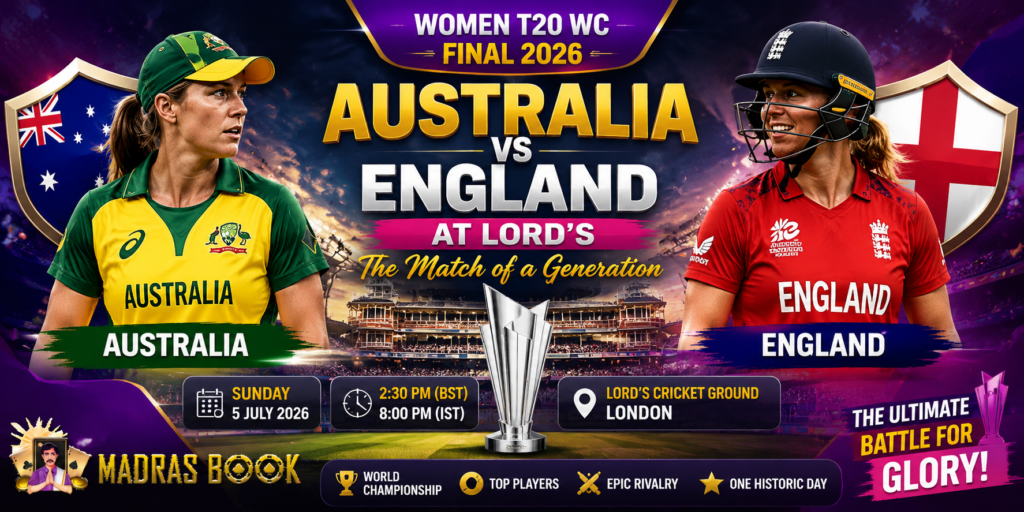
The Women T20 WC Final 2026 between Australia and England begins at 2:30 PM local time today at Lord’s Cricket Ground in London. And it arrives carrying a weight that no previous Women’s T20 World Cup Final has quite matched.
This is the first time Lord’s has hosted the Women T20 WC Final 2026. It is the first time both finalists have arrived at the ultimate match completely unbeaten — Australia with six wins from six, England with seven wins from seven. It is the clash of the two teams who have scored at the highest run rates in this entire tournament — Australia at 9.4 runs per over, England at 9.2. It is the meeting of the two most successful nations in the competition’s history at the most iconic ground in the sport.
And it is, seventeen years after England lifted the inaugural Women’s T20 World Cup trophy at this same ground in 2009, an opportunity for England to complete one of sport’s most beautiful symmetries — beginning and ending the first decade of the Women’s T20 World Cup with a title at Lord’s.
The Women T20 WC Final 2026 is where all the analysis ends and the cricket begins. Let’s go through everything you need to know before the first ball.
Match Details — Final at a Glance
| Detail | Info |
|---|---|
| Match | ICC Women’s T20 World Cup 2026 Final |
| Date | Sunday, July 5, 2026 |
| Venue | Lord’s Cricket Ground, London |
| Start Time | 2:30 PM Local / 8:00 PM IST |
| Australia Captain | Sophie Molineux |
| England Captain | Nat Sciver-Brunt |
| Reserve Day | Monday, July 6 |
| Live TV (India) | Star Sports Network |
| Live Streaming | JioHotstar |
| Prize Money — Winner | $2.34 million |
| Prize Money — Runner-up | $1.17 million |
| Average 1st Innings Score (Lord’s) | 158 |
How Both Teams Got Here — The Unbeaten Record
Australia — Six Wins, Zero Losses, Maximum Domination
Australia have been extraordinary in this tournament. Not good. Not impressive. Extraordinary — in the specific sense of a team that has operated at a level so far above their opponents that the results have looked almost unfair.
Australia’s complete tournament record:
- vs South Africa — Won by 65 runs — The opening statement. South Africa, finalists in the last two editions, were dismantled.
- vs Bangladesh — Won by 9 wickets (63 balls remaining) — Ruthless efficiency. Bangladesh barely competed.
- vs Netherlands — Won by 98 runs — The debutants had no answer.
- vs Pakistan — Won by 113 runs — Ellyse Perry’s all-round masterclass. 113 runs. In a T20I.
- vs India at Lord’s — Won by 6 wickets — The highest successful run chase in Women’s T20 World Cup history. Perry 56, Gardner 53 not out, 100-run stand from 68 for 3.
- Semi-Final vs West Indies — Won by 8 wickets (42 balls remaining) — Beth Mooney 61 not out. Chase completed in 13 overs.
Net run rate of +4.724. The highest recorded by any team in Women’s T20 World Cup group stage history. Six matches. Six opponents. Six different margins of victory, all of them large.
The one uncertainty heading into the Women T20 WC Final 2026 from Australia’s side is Ellyse Perry. She retired hurt during the West Indies semi-final with what the team described as “minor quad awareness” — a deliberately vague medical description that has kept everyone guessing. She is listed in Australia’s probable XI, but whether she takes the field at Lord’s, and at what physical capacity, remains the most important team news question of the day.
England — Seven Wins, Zero Losses, At Home
England’s tournament has been equally impressive, though achieved against slightly more varied opposition in Group 2 before the knockout stages.
England’s complete tournament record:
- vs Sri Lanka — Won by 87 runs — Clinical opening performance.
- vs Ireland — Won by 4 wickets — Slightly tighter but the job was done.
- vs Scotland — Won by 38 runs — Dominant enough.
- vs West Indies — Won by 38 runs — Key group stage win against quality opposition.
- vs Bangladesh — Won by comprehensive margin — Group stage concluded.
- vs New Zealand (if applicable in their group) — Progression secured.
- Semi-Final vs South Africa — Won by 40 runs — England 169 for 5 (Sciver-Brunt 75, Knight 58), South Africa 129 for 8.
The semi-final was England’s defining tournament performance. Coming in at 23 for 3 — three wickets gone inside the powerplay, including opener Amy Jones bowled first ball by Shabnim Ismail — Nat Sciver-Brunt walked out and produced the innings that confirmed England were genuinely capable of winning this tournament. Her 75 off 47, combined with Heather Knight’s 58 off 47, built a 133-run partnership for the fourth wicket that is the highest partnership in Women’s T20 World Cup semifinal history.
England Women have never lost a home World Cup — in any format. That record has held across multiple editions spanning decades of women’s cricket. It will either extend to the Women T20 WC Final 2026 or end in the most high-profile manner possible on Sunday afternoon.
Women’s T20 WC Final 2026: Australia vs England at Lord’s & Trusted Online Cricket ID Guide
The Women’s Twenty20 WC Final 2026 between Australia and England at Lord’s brought international-level cricket, exciting fans all over the world. While tens of millions loved the movement in the round, many cricket fans also enjoy their shape day better using reliable online cricket ID A secure cricket ID gives users brief access to cricket markets, real-time odds, easy account management at some point of primary ICC occasion Be it the World Cup very last, bilateral series, or franchise league, choosing a trusted cricket ID provider ensures fast registration techniques, stable transactions, 24/7 customer support Enjoy every big cricket second responsibly with a reliable cricket identity and enjoy global cricket happily anyway Previously.
The Head-to-Head — Australia’s Dominance in Knockout Cricket
The history between these two teams in Women’s T20 World Cup knockout matches is one-sided — and England fans know it.
Australia hold a 4-1 advantage in knockout encounters across all Women’s T20 World Cup editions. Their three final victories over England — in 2012, 2014 and 2018 — are the specific results that England’s players will be determined to ensure do not add a fourth entry.
England’s only knockout victory over Australia at this tournament came in the semi-final of the 2009 inaugural edition — also at The Oval in London, also in England, also on home soil. Claire Taylor’s unbeaten 76 and Beth Morgan’s unbeaten 46 built an unbroken 122-run third-wicket partnership to guide England into the final, where they beat New Zealand to lift the trophy.
The 2009 connection matters today for reasons beyond sentiment. England have never lost a home Women’s World Cup. The only time they beat Australia in a knockout was in England. And the final is at Lord’s — the same ground where, seventeen years ago, England won the inaugural title.
Cricket is built on patterns. The pattern here is unmistakable.
The Players — Who Wins This Match
England’s Key Weapons
Danni Wyatt-Hodge — The Tournament’s Best Batter
She has been the single most important batting performer across the entire Women T20 WC Final 2026 campaign. 328 runs in 8 matches at an average of 54.67 and a strike rate of 147.08. Those numbers sit above every other batter in the tournament. She has set England’s tone from ball one in match after match — an opener who attacks from the first delivery and builds platforms that England’s middle order converts into match-winning totals.
If Wyatt-Hodge fires at Lord’s on Sunday, England post 165 or more. If she goes cheaply, England need someone else to step up in a way that no one in their lineup has been asked to do throughout this tournament.
Nat Sciver-Brunt — The Captain Who Came Back
Her return from a calf muscle injury for the semi-final against South Africa was the moment this England campaign truly caught fire. Her 75 off 47 was not just important — it was match-winning at a moment when England were 23 for 3 and in genuine danger of not reaching a defendable total.
As captain and all-rounder, Sciver-Brunt gives England a dimension that no other team in the tournament possesses in the same individual package. She can bat at three and accelerate the innings. She can bowl right-arm medium pace and take wickets in the middle overs. And she can set the tactical tone for a bowling performance — distributing her bowlers, managing the powerplay, making the changes that keep Australia’s batters guessing.
Heather Knight — The Experience England Needs
279 runs in recent matches at a strike rate of 128.57. Knight has been England’s most reliable batter in pressure situations—the player who builds when others are falling, who rotates strike when the boundaries are not coming, and who has been in enough big matches to not be overwhelmed by the occasion at Lord’s.
Her 58 in the semi-final, building that 133-run partnership with Sciver-Brunt from 23 for 3, was the kind of innings that experienced cricketers produce when the team most needs them. England will hope she is available to do the same thing again today if Wyatt-Hodge falls early.
Sophie Ecclestone — England’s Match-Winner With the Ball
37 wickets in 23 matches at an economy rate of 4.7 runs per over. Ecclestone is the best left-arm spinner in women’s cricket right now, and on a Lord’s surface that grips in the afternoon, she is potentially the most dangerous bowler in either XI.
Her ability to bowl both Beth Mooney and Phoebe Litchfield — Australia’s two most consistent run-scorers in this tournament — in the middle overs could be the single most decisive factor in whether England defend or concede a competitive total. Australia will have specific plans for her. She will have specific plans for them. The duel between Ecclestone and Mooney is the bowling battle that could decide the final.
Lauren Bell — The New-Ball Threat
Two wickets in the semi-final. The right-arm pace bowler who has been England’s most potent opening bowling option throughout the tournament. On a Lord’s pitch that tends to offer early movement — particularly under the overcast skies forecast for Sunday afternoon — Bell’s ability to generate awkward bounce and extract swing from the Pavilion End gives England a new-ball weapon that Australia’s opening batters will need to negotiate carefully before the surface settles.
Australia’s Key Weapons
Beth Mooney — The Knockout Specialist
She averages 72.00 in Women’s T20 World Cup knockout matches. Read that number again slowly. Seventy-two — in knockout cricket, when the pressure is at its absolute maximum, when a mistake cannot be recovered from, when the composure required is of a completely different order from group stage matches.
After two lower scores against South Africa and Bangladesh in the group stage, Mooney produced 74 not out against Netherlands, and then 61 not out in the semi-final against West Indies. She finds her best form when it matters most. The specific quality that separates knockout performers from regular performers is not talent — it is the mental reset that allows a player to be fully present when the stakes are highest. Mooney has demonstrated that quality more consistently than almost any player in Women’s T20 World Cup history.
Ellyse Perry — If She Plays
The question that has dominated Australian cricket discussion since the semi-final. “Minor quad awareness” covers a spectrum from “completely fine, played it safe in the semi” to “genuinely uncertain whether it will hold up for 20 overs of fielding plus batting.”
If Perry plays and is fully fit, she is Australia’s most experienced match-winner. Her all-round record at Lord’s in this tournament — 56 off 38 against India, plus bowling contributions — and her seventeen years of Women’s T20 World Cup experience make her the player England most specifically do not want to see in the opposition XI.
Ashleigh Gardner — The X-Factor
She needs 42 runs to reach 500 career Women’s T20 World Cup runs. Her 53 not out against India at Lord’s — the innings that sealed Australia’s semi-final place — showed what she is capable of when given the opportunity to bat deep into the innings. Gardner’s hitting power from the middle order gives Australia the ability to accelerate dramatically from overs 15 to 20 regardless of where they are in the innings.
Sophie Molineux — The Captain and Best Bowler
Ten wickets in this tournament at an economy rate of 6.83. Her left-arm spin from the Pavilion End at Lord’s — where the slope creates specific angles that right-handed batters find difficult to read — gives Australia a bowling weapon that matches England’s Ecclestone in quality if not quite in economy rate. Molineux has also been outstanding as a captain — unflappable under pressure, proactive in her bowling changes, and trusted completely by her players.
Georgia Wareham — The Secret Weapon
Ten wickets in this tournament at an economy rate of 5.03 — the best among all front-line bowlers in this edition. Wareham’s leg-spin at pace is difficult to read and difficult to score off. Crucially, she has dismissed England captain Nat Sciver-Brunt three times in five T20I innings — Sciver-Brunt averaging just 3.6 against her. If Wareham gets the ball against Sciver-Brunt at a critical moment in the England innings, Australia will be in a position to change the match.
The Probable Playing XIs
England (Probable XI): Amy Jones (wk), Danni Wyatt-Hodge, Nat Sciver-Brunt (c), Alice Capsey, Heather Knight, Freya Kemp, Dani Gibson, Charlie Dean, Sophie Ecclestone, Linsey Smith, Lauren Bell
England are unlikely to make changes — the XI that beat South Africa by 40 runs in the semi-final will take the field at Lord’s.
Australia (Probable XI): Georgia Voll, Beth Mooney (wk), Phoebe Litchfield, Ellyse Perry (fitness-dependent), Ashleigh Gardner, Georgia Wareham, Annabel Sutherland, Nicola Carey, Sophie Molineux (c), Kim Garth, Lucy Hamilton
The only genuine uncertainty is Perry. If she does not play, Australia’s batting loses its most experienced match-winner and they will need one of their middle-order options — Sutherland or Wareham — to step into that role.
Pitch and Conditions — Lord’s on July 5
Two of the three Women’s T20I matches played at Lord’s this tournament have been won by the chasing side. The average first innings score at Lord’s in this edition has been 158. England are the only team to have successfully defended a total after electing to bat first at this venue during the tournament.
Cloud cover is expected throughout the afternoon — temperatures hovering around 26 degrees Celsius with the dry conditions that the reserve day planners were hoping for. Under cloud, the ball swings in the powerplay — Lauren Bell from the Pavilion End with the new ball under overcast skies is potentially the most dangerous opening bowling scenario England can produce.
The Lord’s slope — falling from the Pavilion End to the Nursery End — creates the tactical asymmetry that makes this ground unique. Ecclestone bowling from the Pavilion End with the slope assisting her angle across right-handers. Bell bowling from the same end with outswing moving the ball away from Australia’s top-order right-handers. Both scenarios are deeply uncomfortable for opposing batters who have not played here frequently.
The toss will matter. The team batting second has won two of the three matches at Lord’s this tournament. Both captains will want to chase if they win the toss.
The 2009 Symmetry — Can England Complete the Circle?
Seventeen years ago, at this same ground, England lifted the inaugural Women’s T20 World Cup trophy. The final was against Australia in 2009. England won by 6 wickets. Katherine Sciver-Brunt — Nat Sciver-Brunt’s predecessor as England’s most important all-rounder — took 3 for 6 in the bowling innings.
Today, Nat Sciver-Brunt captains England at the same ground, in the same tournament’s final, against the same opponents. The woman who played in 2009 has her name connected to the woman who leads England today through more than just a shared surname — through a shared identity as England’s most important cricketer, across two different generations, at the same iconic venue.
England Women have never lost a home World Cup. In any format. Across all the editions they have hosted. That record holds today, or it ends today.
Our Prediction — The Final Will Go Down to the Wire
This is the Women’s T20 World Cup Final that women’s cricket has been building toward for three weeks and arguably much longer than that.
Both teams are unbeaten. Both teams have scored at above 9 runs per over in this tournament. Both teams have seven individual fifty-plus scores. Their bowling economies are separated by less than a run per over. On paper — on every statistical measure — these two teams are as closely matched as any two finalists in Women’s T20 World Cup history.
At Lord’s. In July. With 30,000 English fans creating an atmosphere that Australia captain Sophie Molineux has already acknowledged will be “an incredible challenge.”
Our prediction: England win by 7 runs in a final that is not decided until the final over. Wyatt-Hodge scores 62. Ecclestone takes 3 for 24. England post 163. Australia’s chase falls short with Wareham run out off the penultimate ball attempting a second run.
England lift the Women T20 WC Final 2026 trophy at Lord’s. Seventeen years after the first one. Same ground. Same trophy. Different generation. Equally deserved.
Semi-Final Results — How Both Teams Got Here
| Semi-Final | Result |
|---|---|
| SF1 (June 30, The Oval) | Australia beat West Indies by 8 wickets — Mooney 61* |
| SF2 (July 2, The Oval) | England beat South Africa by 40 runs — Sciver-Brunt 75, Knight 58 |
FAQ — Women T20 WC Final 2026
Q1: Who is playing in the Women T20 WC Final 2026?
Australia and England are playing in the Women T20 WC Final 2026 at Lord’s Cricket Ground in London on July 5. Both teams are unbeaten — Australia won all six of their matches, England won all seven including the semi-final.
Q2: What time does the Women T20 WC Final 2026 start?
The final starts at 2:30 PM local time (BST) which is 8:00 PM IST on Sunday July 5, 2026 at Lord’s Cricket Ground, London.
Q3: Is Ellyse Perry playing in the Women T20 WC Final 2026?
Perry retired hurt in the semi-final with “minor quad awareness” but is listed in Australia’s probable XI. Her participation and fitness level will be confirmed at the toss on match day.
Q4: Who is England’s best player in the Women T20 WC Final 2026?
Danni Wyatt-Hodge is England’s tournament standout — 328 runs in 8 matches at 54.67 average and 147.08 strike rate — the highest run tally of any batter in the tournament. Sophie Ecclestone with 37 wickets at 4.7 economy is England’s best bowler.
Q5: What is Australia’s head-to-head record against England in Women’s T20 WC knockouts?
Australia lead 4-1 in Women’s T20 World Cup knockout encounters. Their four wins include three finals victories over England in 2012, 2014 and 2018. England’s only knockout win came in the 2009 semi-final — also in England, also at The Oval in London.
Q6: Where can I watch the Women T20 WC Final 2026 live in India?
Star Sports Network on TV and JioHotstar for live streaming in India. Match starts at 8:00 PM IST on July 5, 2026.