
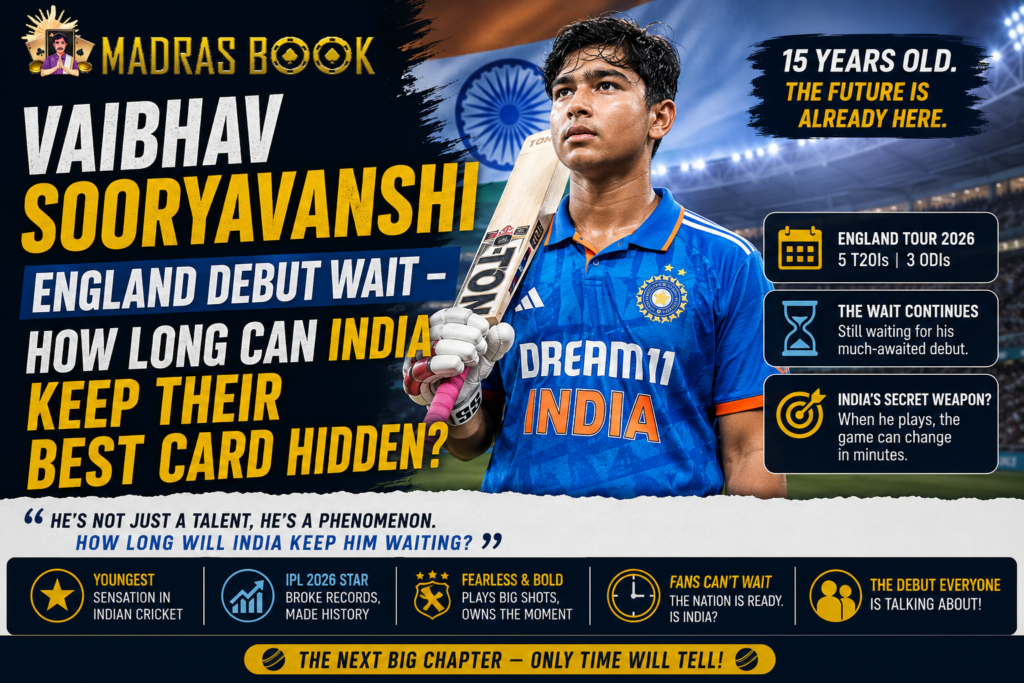
At some point, patience stops being a strategy and starts being a problem.
We are not there yet with Vaibhav Sooryavanshi England debut. Not quite. But we are closer than the Indian team management probably wants to admit — and after watching a fifteen-year-old with 776 IPL runs and an Under-19 World Cup final century sit in the dugout through two T20Is in Belfast and then the first T20I against England in Durham, the question has moved from “when will he debut?” to something sharper and less comfortable: what exactly are they waiting for?
Vaibhav Sooryavanshi England debut has been the story of this entire white-ball tour. Not the matches themselves, not the results, not the tactics — all of which have been complicated enough — but the teenager who has been present for all of it without actually being allowed to do anything. He travelled to Ireland. He sat on the bench. He watched India lose both T20Is — including a historic 2-0 series defeat that ended India’s 16-match bilateral series winning streak. He then travelled to Durham for the England series, and when the first T20I team was announced, his name was again absent.
Vaibhav Sooryavanshi England debut is the most anticipated individual moment in Indian cricket this summer. And India’s management — for reasons that are becoming increasingly difficult to explain — keeps postponing it.
Shreyas Iyer, asked about it before the Durham match, gave an answer that was almost perfectly designed to say nothing: “You never know what’s going to happen.” Which is technically true. You never know what’s going to happen. It is also technically true that the sun will rise tomorrow, that cricket balls are red in Test cricket, and that Jasprit Bumrah is a very good bowler. True statements that tell you nothing about the actual question you asked.
Assistant coach Ryan ten Doeschate was slightly more specific, which at least gave people something to respond to. “As ready as Vaibhav is, and as excited as we all are to see him play,” Ten Doeschate said after the Ireland whitewash, “he’ll have to go through the same process as everyone else, bide his time, and wait for his opportunity.” The problem with that statement — well-intentioned and defensible in theory — is the specific context around it. The same process as everyone else. Vaibhav Sooryavanshi is not everyone else. He is a fifteen-year-old who broke Chris Gayle’s IPL sixes record, scored 175 in an Under-19 World Cup final, and made a fifty in eleven deliveries in an India A series decider. The “same process as everyone else” argument makes sense for a talented but unproven domestic performer. It makes considerably less sense for someone who has already broken records set by the greatest T20 hitter who ever lived.
This is the Vaibhav Sooryavanshi England debut story as it stands on July 2, 2026. And it is a story with no satisfying resolution yet.
Vaibhav Sooryavanshi — Complete Career Story From Bihar to India Squad
What The Management Is Actually Saying
Before the criticism lands — and it is landing, heavily, from every corner of Indian cricket — it is worth understanding exactly what India’s coaching staff has said publicly about the Vaibhav Sooryavanshi England debut delay. Because the reasoning exists, even if a growing number of people find it unconvincing.
The core argument is this: Sanju Samson and Abhishek Sharma are India’s established opening partnership. Both were involved in India’s T20 World Cup title defence. Samson in particular was Player of the Tournament at the World Cup — 321 runs, three fifties, 89 off 46 balls in the final. You do not simply remove a player of that quality from the XI because a fifteen-year-old has arrived in the squad, however talented that teenager might be.
Ten Doeschate made this point explicitly when he said that India want to “give players confidence and send the right message to the squad.” The implied message is that selection should be based on consistent performance over time, not on public excitement about a teenager who has not yet played a senior international match. That is a philosophically sound position. Most cricket coaches would agree with it in the abstract.
The problem is the specific timing. Ireland was not a series where India’s current approach was vindicated. They lost both games. Samson scored 5 in the first match and was dismissed off the first ball in the second — LBW to Jai Moondra for a duck. Ishan Kishan scored 1 in the first match and 12 in the second. The batting combination that was being protected by not selecting Sooryavanshi produced, across two matches in Belfast, a combined top-order total that would embarrass most club cricket XIs.
At what point does “protecting the established combination” give way to acknowledging that the established combination is not working? That is the question India’s management has not yet answered satisfactorily.
Chief selector Ajit Agarkar had said, when Sooryavanshi was first named in the squad, that the youngster had “effectively earned his place through performance alone.” Those words — earned his place through performance alone — sit awkwardly alongside the fact that Sooryavanshi has now been in the squad for multiple matches without playing a single ball.
India’s Batting Collapse in Ireland — What Went Wrong in Belfast
The ECB Safeguarding Rules — The Complication Nobody Mentions
There is one aspect of the Vaibhav Sooryavanshi England debut story that Indian cricket media has not always acknowledged clearly, and it deserves specific mention.
Sooryavanshi is fifteen years old. In England, the ECB has specific safeguarding policies for players under sixteen that require them to change separately from their teammates. This is not a slight on Sooryavanshi or an obstacle placed specifically in his path — it is a standard child protection policy that exists for entirely sensible reasons. The ECB confirmed this arrangement before the tour began.
What this means in practical terms is that Sooryavanshi’s presence in the squad creates logistical and welfare considerations that a standard adult international cricketer’s presence does not. The Indian management is navigating not just the cricket question — which eleven players give India the best chance of winning — but also the pastoral care question of how a fifteen-year-old is best supported in his first experience of international cricket in England.
That context does not fully explain the Ireland situation, where the same welfare considerations applied and yet India still chose not to play him in either match. But it adds a layer of complexity to the England debut decision that is worth acknowledging rather than dismissing.
What Sooryavanshi Has Done to Earn This Moment
The case for Vaibhav Sooryavanshi England debut does not need to be made at length at this stage of the tour, because it has been made so many times and so thoroughly that only the most determined skeptic would require further convincing. But for completeness, here it is again.
IPL 2026: 776 runs in 16 matches at a strike rate of 237.30. Orange Cap. MVP award. Super Striker of the Season. Super Sixes award. Emerging Player of the Season. Five major awards — a clean sweep that no batter in IPL history had achieved before. Seventy-two sixes in a single season, breaking a record that Chris Gayle had held since 2012.
Under-19 World Cup 2026: 175 off 80 balls in the final against England. Player of the Tournament. The highest individual score in a Women’s T20 World Cup final — sorry, in any Under-19 World Cup final. India won by 100 runs.
India A: 94 off 29 balls in a series decider in Dambulla. Fifty in eleven deliveries — the fastest List A fifty in history. Player of the Match. Series won.
Ranji Trophy debut: at twelve years and 284 days — one of the youngest in the competition’s history.
He is fifteen years and ninety-seven days old today. When he eventually makes his debut — whether it is in the second T20I against England at Trent Bridge or the third at Old Trafford or the fourth at Edgbaston or some other match entirely — he will become the youngest Indian cricketer in history to play senior international cricket, breaking Sachin Tendulkar’s record that has stood since 1989.
The question is not whether Sooryavanshi is ready. India’s own coaching staff have said he is ready. Ten Doeschate used the word “ready” explicitly — “as ready as Vaibhav is.” The question is why ready is not being translated into selected.
The Durham Match — What Happened When He Didn’t Play
The first T20I against England at Chester-le-Street in Durham on July 1 happened without Vaibhav Sooryavanshi in India’s playing XI.
India lost by 11 runs. England posted 194 — a total that was always going to be difficult to chase on a pitch that was doing a bit under overcast Durham skies, but a target that was not beyond India’s batting lineup on paper. In practice, India’s top order — the same top order that had been protected by Sooryavanshi’s non-selection — managed 183 for 7, falling just short.
Abhishek Sharma top-scored with 54. Ishan Kishan contributed 38. Shreyas Iyer made 21. The middle order did not accelerate when India needed acceleration. And somewhere in the India dressing room or the team hotel or wherever Sooryavanshi was watching the match from, a fifteen-year-old who scored 776 IPL runs against the same quality of bowling sat and waited for a phone call that did not come.
The specific cruelty of the situation is this: India went into the England series 0-2 in the tour, having lost both T20Is in Belfast. They needed something different. They had something different available to them. They chose not to use it, and they lost the first England T20I as well. Three matches into the tour, India are 0-3. The logic of not disrupting the established combination is becoming harder to defend with each passing match.
England’s players, for their part, are aware of Sooryavanshi. Harry Brook — England’s captain for the series — said before the first T20I that India’s squad depth, including Sooryavanshi, made them a formidable opponent across five matches. Brook knows, as any captain in this situation would, that a batter Ireland and England’s bowlers have never faced in match conditions is a wildcard they cannot fully prepare for. Preparing for Abhishek Sharma is relatively straightforward — you have footage, you have data, you have a plan. Preparing for Vaibhav Sooryavanshi in his debut international match is a significantly more complicated exercise.
The Series India Really Cannot Afford to Lose
There is a broader context to the Vaibhav Sooryavanshi England debut story that matters more than just one player’s debut timing.
India came into this England tour on the back of their worst T20I bilateral series performance in years — a 0-2 defeat to Ireland that nobody predicted and that has generated genuine concerns about the team’s adaptability to conditions outside the subcontinent. The England series — five T20Is against a home side that is currently ranked among the world’s best in the format — was always going to be a stern test. It has now become, after the Dublin disaster, something more loaded than a routine bilateral series.
India’s T20I captaincy transition is also very much in focus. Shreyas Iyer took over from Suryakumar Yadav with enormous expectation and has now lost three consecutive T20Is as captain — two in Ireland and one in England. That is not a record that generates confidence in either the captain or the team’s current approach.
The England series is not just about five T20I results. It is about whether India’s new-look T20I setup — without Rohit Sharma, without Virat Kohli in T20Is, with a new captain and a rebuilt squad — can establish itself as a credible force in the format. Losing this series would raise uncomfortable questions about the direction of India’s T20 cricket in the two years before the next World Cup.
In that context, Sooryavanshi is not just about one player’s debut. He is potentially the X-factor that changes the entire momentum of India’s tour. A player England have not faced. A strike rate that makes their bowling attack look entirely different. An energy that a team that has been struggling for three consecutive matches desperately needs.
What Comes Next — Trent Bridge and Beyond
Four T20Is remain in the England series. Trent Bridge on July 4. Old Trafford on July 6. Edgbaston on July 8. Southampton on July 11.
Sooryavanshi’s debut, which has been described as inevitable by everyone from chief selector Ajit Agarkar to assistant coach Ten Doeschate to captain Shreyas Iyer himself, cannot be delayed indefinitely. At some point, one of those four matches becomes the match. Whether India’s management chooses to make that Trent Bridge — where the pitch tends to be flatter and the batting conditions more forgiving — or wait further will be watched extremely closely.
The Trent Bridge pitch in July is generally good for batting. India have played there before and their batters tend to like the pace and true bounce that the surface offers. If there is a venue on this tour where Sooryavanshi’s natural game — attacking from ball one, clearing the boundary with timing rather than brute force, hitting straight and hard — would suit the conditions perfectly, Trent Bridge is probably it.
There is also, quietly, a symmetry in the possibility of his debut coming against England. The Under-19 World Cup final he dominated — 175 off 80 balls, Player of the Tournament — was against England Under-19. The English bowling lineup at that level faced him and had no answer. Whether the senior England attack poses a similar challenge or a dramatically different one is the question that makes the eventual debut so compelling to anticipate.
Whatever happens, Vaibhav Sooryavanshi England debut is coming. India cannot take a fifteen-year-old to England, have their coaching staff describe him as ready, have their captain make cryptic “you never know” comments, and then send him home without a cap. The wait will end. The only question is which ground, which opponent, which over.
And when it does end — when Sooryavanshi finally walks out in a blue jersey somewhere in England — it will be one of the most watched moments in Indian cricket this year. The entire country has been building toward it for weeks. Every match he hasn’t played has added another layer of anticipation. By the time the moment actually arrives, the noise will be extraordinary.
Quick Facts — Vaibhav Sooryavanshi on Tour
| Detail | Info |
|---|---|
| Age | 15 years, 97 days (as of July 2, 2026) |
| T20Is played on tour | 0 |
| Matches sat out | 3 (2 vs Ireland, 1 vs England) |
| Record if debuts | Youngest Indian international cricketer ever |
| Tendulkar’s record | 16 years, 205 days (debut 1989 vs Pakistan) |
| ECB safeguarding | Changes separately from teammates (under-16 policy) |
| Ten Doeschate quote | “As ready as Vaibhav is… he’ll have to bide his time” |
| Iyer quote | “You never know what’s going to happen” |
| Agarkar quote | “Earned his place through performance alone” |
| Remaining T20Is | 4 (Trent Bridge, Old Trafford, Edgbaston, Southampton) |
Watch the England Series with a Trusted Online Betting ID Provider
As the anticipation mounts around the long-awaited debut of Vaibhav Suryavanshi, cricket enthusiasts across India are gearing up to watch every ball of the England series. Such high-profile fits attract millions of viewers who enjoy the pace of live cricket and real-time fits. To make it even better than cool, many fanatics choose a dependable Online Betting ID from a reliable company that gives stable registration, fast withdrawal, and 24/7 customer service. Popular platforms including TigerExch and 11xPlay have access rights to stay in cricket markets, offensive odds, and throughout international tours, IPL and ICC occasions. Finally, whether Suryavanshi makes his debut or India establishes a presence, every match offers exciting possibilities for cricket fans. Before signing up, consistently choose a certified bet ID company that values account security, clear transactions, and responsible gaming. A true cricket identity guarantees continuous enjoyment so that you can enjoy every interesting second of India’s journey in England with self-assurance.
FAQ — Vaibhav Sooryavanshi England Debut
Q1: Has Vaibhav Sooryavanshi made his England debut yet?
No — as of July 2, 2026, Vaibhav Sooryavanshi has not played a single international match despite being in India’s squad for the Ireland series (2 matches) and the first England T20I in Durham. His debut is expected in one of the remaining four England T20Is.
Q2: Why hasn’t Vaibhav Sooryavanshi debuted yet?
India’s assistant coach Ryan ten Doeschate explained that the team wants to give players a “long run” and that Sooryavanshi must “bide his time and wait for his opportunity” like everyone else. Sanju Samson and Abhishek Sharma have retained their opening spots despite poor form in Ireland.
Q3: What record will Sooryavanshi break on debut?
He will become the youngest Indian cricketer in history to play senior international cricket, breaking Sachin Tendulkar’s record that has stood since 1989. Tendulkar was 16 years and 205 days old at his debut — Sooryavanshi is currently 15 years and 97 days.
Q4: What did Shreyas Iyer say about Sooryavanshi’s debut?
When asked before the first England T20I at Durham, Iyer said: “You never know what’s going to happen” — a deliberately non-committal answer that gave no specific indication of when or whether Sooryavanshi would play in the England series.
Q5: Which England venue is most likely for Sooryavanshi’s debut?
Trent Bridge (July 4) is considered the most likely venue — a flat, batting-friendly surface where Sooryavanshi’s aggressive style would suit the conditions best. India have lost three consecutive T20Is and the pressure to make a bold selection call is increasing.
Q6: What are ECB’s safeguarding rules affecting Sooryavanshi?
The ECB has specific safeguarding policies for players under sixteen requiring them to change separately from teammates. This applies to Sooryavanshi (15 years old) during England matches and was confirmed before the tour began. It does not prevent him from playing — it is a welfare policy about dressing room arrangements.