
Three boundaries in one over. Then a wicket. Then a send-off. Then a confrontation.
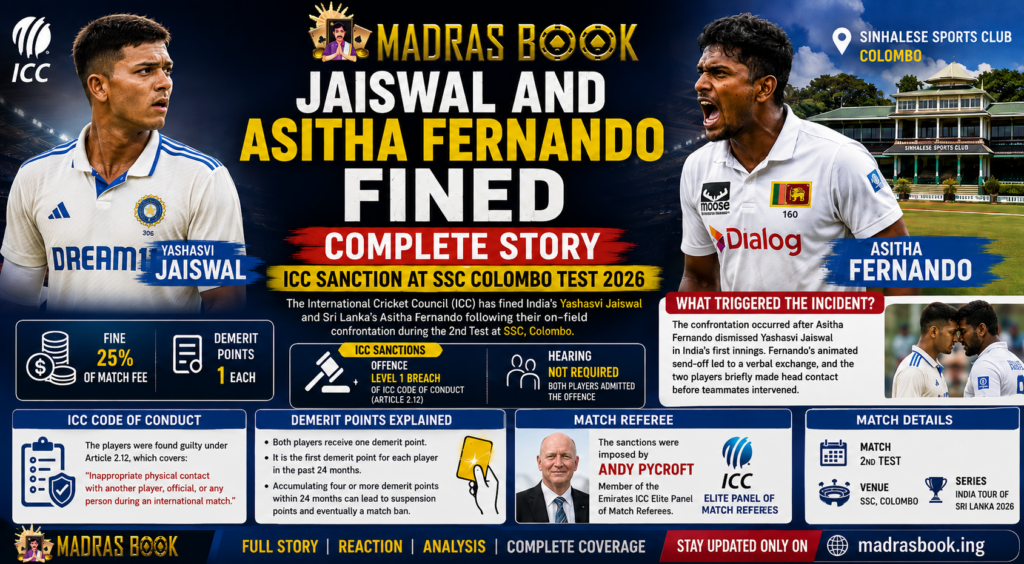
The Jaiswal Asitha fined 2026 story began in the 17th over of India’s first innings at the Sinhalese Sports Club in Colombo — and ended with the International Cricket Council sanctioning both players with a 25 per cent match fee fine and one demerit point each for breaching Article 2.12 of the ICC Code of Conduct. The specific sequence: Yashasvi Jaiswal had hit Asitha Fernando for three consecutive boundaries in that over before the Sri Lanka pacer produced the delivery that beat his defence and crashed into the stumps. Jaiswal was dismissed. Instead of walking directly back to the dressing room, he turned around and approached Fernando. The two exchanged words. Fernando moved his head toward Jaiswal. Jaiswal leaned back into him. Head-to-head contact was made. Players from both teams stepped in to separate the pair before anything further escalated. The the Colombo incident case was referred to match referee Andy Pycroft of the Emirates ICC Elite Panel immediately after play. Both players admitted the offence. Both accepted the sanctions. No formal hearing was required. The this ICC sanction story sanction is a Level 1 breach — the lowest category of ICC Code of Conduct violation — but it carries the specific significance of being the first offence for both Jaiswal and Fernando in the preceding 24-month period, meaning neither carries accumulated demerit points that would trigger further escalation.
What Happened — Ball by Ball
The incident occurred in the 17th over of India’s first innings on Day 1 of the second Test at the SSC Colombo.
Asitha Fernando was bowling. Yashasvi Jaiswal was batting. The over had not gone Fernando’s way. Jaiswal hit the first three deliveries for boundaries — nine runs from three balls, the specific scoring rate that makes a pace bowler’s over disappear very quickly and that generates the specific frustration that leads to exactly what happened next.
The fourth delivery — or another delivery in that over — beat Jaiswal’s defence completely. The ball pitched on off stump and either swung late or found an edge or simply found the gap between bat and pad and hit the stumps. The exact mechanism of the dismissal produced the result that changed the atmosphere immediately.
Fernando celebrated. He gave Jaiswal a send-off — the specific gesture of celebration directed at the dismissed batter that crosses the line between acknowledging a wicket and directing it personally at the batter.
Jaiswal, walking back toward the pavilion, turned around. He approached Fernando rather than continuing toward the dressing room. The two exchanged words — a verbal confrontation that escalated from send-off words into the specific physical proximity that triggered the ICC’s Article 2.12 concern.
Fernando moved his head toward Jaiswal. Jaiswal leaned back into him. Head-to-head contact occurred. Players from both teams immediately stepped in — recognising that the confrontation had reached a point where intervention was necessary before it escalated further.
India’s team management responded quickly. Team manager Kotak addressed the media after the day’s play with the specific assessment that captures the incident’s nature accurately: “I think maybe one of the bowlers may have commented something, and it was a heat-of-the-moment thing. Obviously, Jaiswal, I don’t think he should have gone so close, but that happens in the heat of the moment.”
Jaiswal took to social media to defend his actions — claiming that the bowler had made comments that provoked his response.
Jaiswal Asitha fined 2026 — ICC Ruling
What the Law Says
Article 2.12 of the ICC Code of Conduct for Players and Player Support Personnel covers “inappropriate physical contact with a Player, Player Support Personnel, Umpire, Match Referee or any other person (including a spectator during an International Match).”
The specific offence: head-to-head contact between two players during an international match. Fernando moving his head toward Jaiswal and Jaiswal leaning back into him — both acts constituted the inappropriate physical contact that Article 2.12 is designed to govern.
The Punishment
Both Yashasvi Jaiswal and Asitha Fernando received:
- 25% of their match fee as a fine
- 1 demerit point added to their disciplinary records
The ICC confirmed that neither player had committed a similar offence in the preceding 24 months — making this the first demerit point on both players’ records. This matters because ICC demerit points accumulate: four points in a 24-month period triggers a one-match suspension. At one demerit point each, neither player is at risk of suspension from any upcoming matches.
The Match Officials
| Official | Role |
|---|---|
| Ahsan Raza | On-field umpire |
| Sharfuddoula Ibne Shahid | On-field umpire |
| Rod Tucker | Third umpire (TV) |
| Prageeth Rambukwella | Fourth umpire |
| Andy Pycroft | Match referee — proposed sanctions |
Both Jaiswal and Fernando accepted the Level 1 charges proposed by Pycroft. No formal hearing was held. The ICC released the official statement confirming the sanctions the following day.
Jaiswal Asitha fined 2026 — The Context
The three boundaries Jaiswal hit off Fernando before his dismissal are the specific context that makes the incident intelligible — not defensible, but intelligible.
Fernando had been hit for three consecutive fours. His celebration of the wicket — a send-off directed at the batter he had just dismissed after being hit around the park — is the kind of response that occurs in the heat of Test cricket with the specific frustration of having conceded boundaries adding fuel to the celebratory moment.
From Jaiswal’s perspective: he had been batting well, he scored boundaries off Fernando’s bowling and then was dismissed. The send-off — directed personally at him rather than a general celebration — triggered the turn-around and the approach. His social media response claiming the bowler’s comments provoked him is the explanation he chose to offer publicly, though it does not change the finding that both players admitted to the Article 2.12 breach.
The match report from Cricinfo’s Day 1 live blog noted the heated exchange between Jaiswal and Asitha as one of the day’s significant moments — alongside Padikkal’s 117, Pant’s retirement hurt and Jadeja being bowled in the final over.
The incident also explains the specific “heat-of-the-moment” language from India’s team manager. International Test cricket between India and Sri Lanka in Colombo — with series points and WTC consequences at stake — is not a clinical environment. Players are operating at their emotional ceiling. The Jaiswal-Fernando incident is the specific consequence of that intensity expressing itself in a way that the ICC Code of Conduct exists to govern.
Jaiswal Asitha fined 2026 — What Happened After
The Jaiswal Asitha fined 2026 incident happened on Day 1. The Test continued.
By the end of Day 2 at the SSC Colombo, India had declared at 503 for 9. Dhruv Jurel — who had come to the crease after Pant’s retirement hurt and batted through the middle order’s contributions — was unbeaten on a century at the declaration. Rain ended play in the third session on Day 2 before the full day’s cricket was completed.
India’s first innings total of 503 for 9 declared on a flat SSC pitch puts them in a commanding position in the second Test. Their 1-0 series lead from the Galle win by 165 runs means India need either a draw or a win in Colombo to take the series.
Saransh Jain’s debut bowling figures — his first competitive overs in Test cricket — are the specific bowling watch point as India move into Sri Lanka’s first innings with a large total on the board.
Jaiswal Asitha fined 2026 — Demerit System
The ICC demerit point system is designed to accumulate across a 24-month rolling period. Points trigger suspensions at specific thresholds:
| Demerit Points | Consequence |
|---|---|
| 1-3 | Warning / fine |
| 4 | 1-match suspension |
| 8 | 2-match suspension |
| 12 | Longer ban |
Both Jaiswal and Fernando now hold one demerit point each — their first in 24 months. To reach a suspension, each would need three more demerit points within the same rolling 24-month window. Given both players’ clean disciplinary records before this incident, a single Level 1 breach does not threaten either’s availability for any upcoming matches.
Jaiswal plays the rest of the SSC Colombo Test. Fernando bowls for Sri Lanka in the same match. The ICC’s quick processing of the case — both admitted the offence, accepted the sanctions, no formal hearing needed — means neither player’s preparation for the remainder of the Test was disrupted.
Jaiswal Asitha fined 2026 — Broader Picture
The Jaiswal-Fernando incident is not the first time this series has produced flash points. Lahiru Kumara — a different Sri Lanka pace bowler from Fernando — hit both Rishabh Pant and Ravindra Jadeja with short balls on Day 1 of the SSC Test, forcing Pant to retire hurt and striking Jadeja’s forearm before bowling him in the final over.
India are leading the series 1-0. The specific WTC stakes — each Test worth 12 WTC points, India needing both wins to significantly improve their 2027 Final qualification path — make every session of the Colombo Test high-stakes cricket. That intensity, combined with Sri Lanka’s specific motivation to level the series at home, produces the conditions where a three-boundary over followed by a wicket and a send-off generates exactly the confrontation that the ICC Code of Conduct exists to manage.
The sanction is appropriate. The incident is understood. Both players have moved on. The Test continues.
Jaiswal Asitha fined 2026 — Quick Summary
| Detail | Info |
|---|---|
| Match | India vs Sri Lanka — 2nd Test, SSC Colombo |
| When | Day 1 — 17th over of India’s innings |
| What | Send-off by Fernando → Jaiswal approached → Head-to-head contact |
| Charge | Article 2.12 — Inappropriate physical contact — Level 1 |
| Fine | 25% match fee each |
| Demerit | 1 point each (first offence in 24 months) |
| Decision | Both admitted — no formal hearing |
| Referee | Andy Pycroft — Emirates Elite Panel |
| Suspension? | No — needs 4 demerit points |
FAQ — Jaiswal Asitha Fined 2026
Q1: Why did the Jaiswal Asitha fined 2026 incident happen?
Yashasvi Jaiswal and Asitha Fernando were fined 25 per cent of their match fees and given one demerit point each by the ICC following a heated on-field altercation on Day 1 of the second Test at SSC Colombo. The incident occurred in the 17th over when Fernando dismissed Jaiswal and gave him a send-off. Jaiswal turned back and approached Fernando. The two exchanged words before Fernando moved his head toward Jaiswal and Jaiswal leaned into him — making head-to-head contact. Both were found guilty of breaching Article 2.12 of the ICC Code of Conduct for inappropriate physical contact.
Q2: What is Article 2.12 of the ICC Code of Conduct?
Article 2.12 of the ICC Code of Conduct for Players and Player Support Personnel covers “inappropriate physical contact with a Player, Player Support Personnel, Umpire, Match Referee or any other person (including a spectator during an International Match).” It is classified as a Level 1 breach — the lowest category of offence — which carries a fine of 25 to 50 per cent of match fee and one demerit point. Both Jaiswal and Fernando were found guilty under this article.
Q3: Will either player be suspended after Jaiswal Asitha fined 2026?
No. Both Jaiswal and Fernando received one demerit point each — their first offence in the preceding 24 months. Under the ICC demerit point system, a player needs to accumulate four demerit points within a 24-month rolling period before a one-match suspension is triggered. At one point each, neither player faces any suspension risk from upcoming matches.
Q4: What happened before the Jaiswal Fernando altercation in the Colombo Test?
In the 17th over of India’s first innings, Yashasvi Jaiswal hit Asitha Fernando for three consecutive boundaries. When Fernando then dismissed Jaiswal, he gave the Indian batter a send-off — celebrating the wicket in a manner directed personally at Jaiswal. India’s team manager described it as “a heat-of-the-moment thing” and acknowledged Jaiswal “should not have gone so close.” Jaiswal claimed on social media that bowler comments provoked his response.
Q5: What is India’s score in the SSC Colombo 2nd Test after the incident?
India declared their first innings at 503 for 9 in the second Test at SSC Colombo. Dhruv Jurel was unbeaten on a century at the declaration. Rain ended the third session on Day 2. India lead the two-match series 1-0 after winning the first Test at Galle by 165 runs on August 15-19.
Q6: Who decided the Jaiswal Fernando fine in the Colombo Test?
Andy Pycroft of the Emirates ICC Elite Panel of Match Referees proposed the sanctions and confirmed both players’ guilt. The on-field umpires who officiated the match and reported the incident were Ahsan Raza and Sharfuddoula Ibne Shahid. The third umpire was Rod Tucker and fourth umpire was Prageeth Rambukwella. Both Jaiswal and Fernando accepted the Level 1 charges without requesting a formal hearing.